1992issue C081-6
Constructing multi-span smoothed rate-of-change filters
Rate of change is written as a signed lookback ratio around a zero equilibrium, then smoothed and stacked across companion spans so a longer curve can confirm or veto a shorter turn.
- Rate of change compares the current level with the level from a stated lookback span and plots the signed result around a zero equilibrium.
- A moving average reduces jagged false reversals in the raw series but does not remove them, and readings farther from zero are treated as more reliable.
- Companion spans are stacked so the longest smoothed curve can confirm or veto a shorter turn; simultaneous alignment is the coherent trend-filter reading.
- Mixed directions across spans are treated as cycle conflict and a milder implied reaction than full alignment.
What the construction does
Rate of change is a signed oscillator that compares the current observation with the observation from a stated number of periods earlier and plots the result around a zero equilibrium.
Write the signed lookback ratio
The oscillator is constructed by dividing the current level by the level from n periods earlier, multiplying by 100, and plotting the signed departure from 100 around a zero equilibrium.
Identical values in the two comparison periods plot the oscillator at zero. Longer lookback spans are treated as more significant than short ones, and a 10-day series is described as less meaningful than 12-month or 24-month spans.
Smooth the raw series
A raw rate-of-change plot is jagged and produces frequent false reversals. Smoothing it with a moving average reduces, but does not remove, those whipsaws. Readings farther from zero are treated as more reliable.
A spreadsheet construction computes a 10-day rate of change as the current price divided by the price 10 sessions earlier, times 100, minus 100, then takes a 5-day moving average of that series.
Why one lookback span is not enough
A single lookback span encodes only one cycle, so that particular oscillator is treated as uninformative if that cycle is inactive or dominated by others.
Editorial note: companion spans are added so the construction can be read as a trend filter rather than as one isolated cycle.
Stack companion spans as a trend filter
One illustrated monthly stack uses 6-month, 12-month, and 24-month oscillators, with the first two smoothed by a 6-month moving average and the 24-month series smoothed by a 9-month moving average.
In that stack the shortest smoothed series typically turns first and is more sensitive. The longest series is used as the background for major moves.
Simultaneous alignment of all three curves is the construction's condition for a coherent trend-filter reading. Mixed directions are treated as cycle conflict and a milder implied reaction.
Daily spans and composite weighting
The same stacked construction is applied to daily data with 10-day, 15-day, and 30-day oscillators.
A later compromise is a single composite that combines four rate-of-change series by composite weighting, with each span weighted according to its length.
S&P 500 10-, 15- and 30-day rate of change, January–July 1990
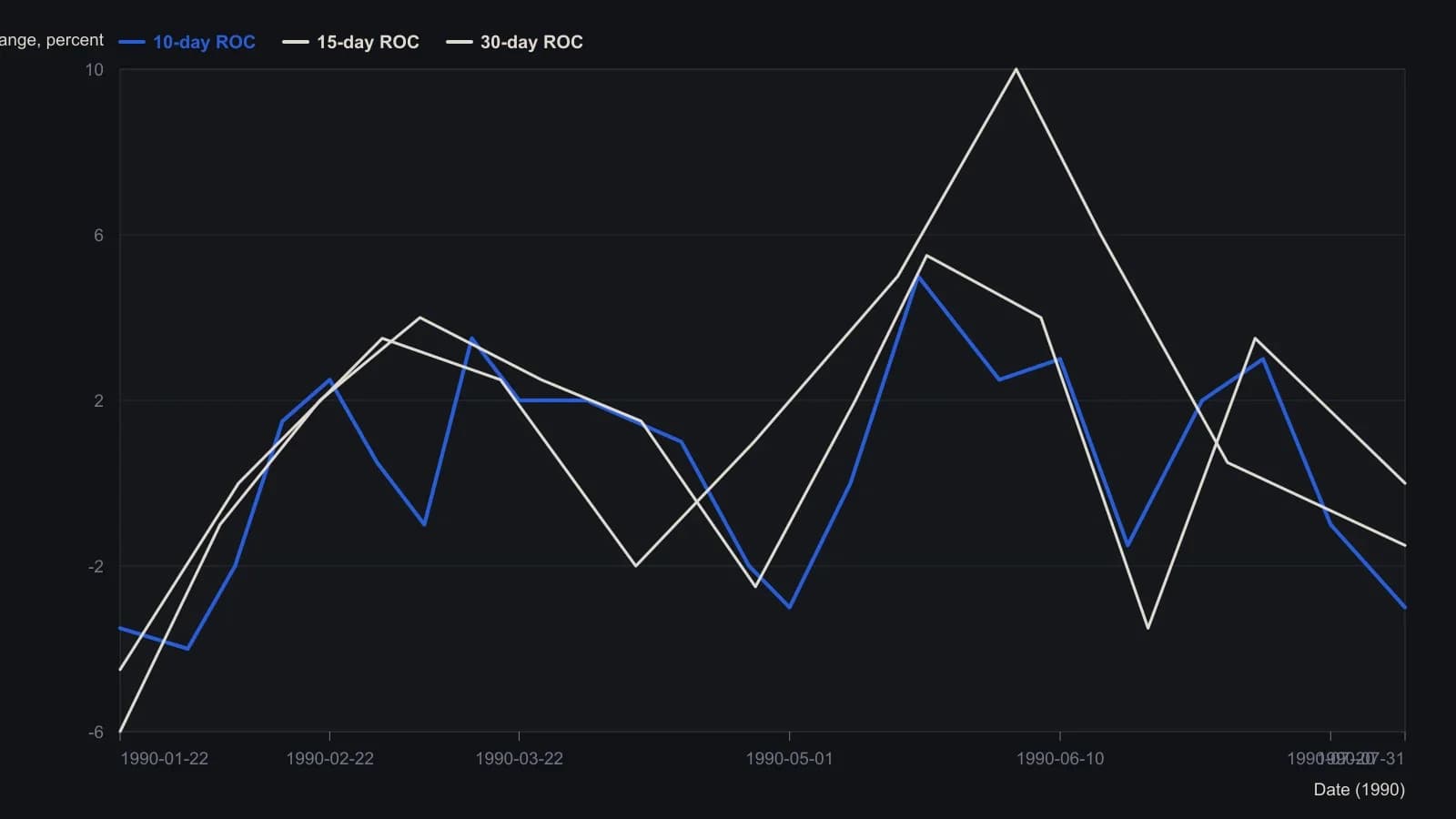
Printed raster, so levels are approximate to about half a percentage point. The 15-day series begins after its lookback fills, and the 30-day series begins still later. Zero is the equilibrium the source plots against.
All readings on this track · 46 readings
- 1985Constructing excess and momentum difference-curve oscillators
- 1988Five reading rules for smoothed indicator charts
- 1989Momentum overlays that speed moving-average oscillators
- 1990A laboratory template that constructs Rate of Change as a pane module
- 1991Volume-scaled rate of change as a momentum construction
- 1991Three-indicator market overview from tape, sentiment and rates
- 1991Three-component trend model with rate-of-change filters
- 1992A KST oscillator from a weighted rate-of-change stack
- 1992Four-window weighted rate-of-change composite
- 1992Constructing multi-span smoothed rate-of-change filters
- 1992Constructing a four-horizon summed rate of change
- 1992Constructing KST from four weighted smoothed rates of change
- 1992Constructing a composite from weighted smoothed rates of change
- 1992Three-horizon KST maturity alignment
- 1992Construct a bond-led dividend-to-bond-yield regime first
- 1992Constructing relative-strength KST from weighted rate-of-change
- 1993Constructing a volume oscillator from average ratios and smoothed rate of change
- 1994Gold as a cycle clock for commodities and yields
- 1994Constructing a composite from weighted, smoothed rate-of-change windows
- 1994Constructing gold-mining rate-of-change tripwires for Treasury bonds
- 1994A capacity-stress checklist across commodities, bonds, and breadth
- 1994Rate of change parameters for testable entries
- 1994Constructing rate-of-change midpoints, lookbacks and divergence
- 1994Lead oscillator breaks need price trendline confirmation
- 1994Nested averages for an annual momentum curve
- 1994Evaluating a Coppock-style rate of change as a bottom-regime filter
- 1995A weighted eleven-month Dow rate of change as one testable timing procedure
- 1996Named lookbacks, thresholds, and streaks for entry rules
- 1997A midpoint rate-of-change test for bond trend follow-through
- 1997Constructing a short-rate-adjusted equity momentum filter
- 1998Daily momentum rank-churn as a portfolio-construction problem
- 1999Constructing a lagged rate of change cycle system
- 2000A triple delay line then a one-bar elliptic oscillator
- 2001Confirming rate of change divergences with price
- 2001Momentum trendline breaks need price confirmation
- 2001Market breadth, On-balance volume, and Rate of Change as a combined timing framework
- 2001Know Sure Thing with stacked horizons and trendline confirmation
- 2003Constructing a mechanical system from a rate of change condition
- 2003Constructing momentum from two closes and spotting divergence
- 2003Formula choice tilts which momentum mismatches count as divergences
- 2004RSI and momentum agreement as an asymmetric filter
- 2005Constructing price-normalized moving-slope hybrids
- 2005Unsigned speed gates on a fixed average-cross pair
- 2007Rebuilding rate of change as a path-weighted oscillator
- 2008Construct Special K so short-horizon signals stay inside the primary trend
- 2013Restore volume balance before adding another price-time indicator