1992issue C051
Constructing true strength from double-smoothed momentum
An editorial worksheet locks the exponential weights first, then keeps signed momentum and unsigned magnitude on parallel smoothers so a relative-strength reading and a momentum signal can be audited before either is treated as a forecast.
- Lock the smoothing constant first. Exponential smoothing blends the newest observation with the previous average using a weight strictly between 0 and 1, often set as 2 divided by one plus the chosen lookback length.
- Momentum and absolute momentum run on parallel tracks. The one-session net change in the close and the unsigned size of that change each receive the same 14-then-3 double smoothing.
- The true strength index is the twice-smoothed signed series divided by the twice-smoothed absolute series, a relative strength index formed from the same momentum input.
- The twice-smoothed signed series is also kept as a directional indicator so a momentum strategy can treat either track as a testable rule input before either reading is treated as a forecast.
A two-track worksheet
The archive describes a historical workflow that starts from the one-session net change in the close. A companion series stores the unsigned size of that change. Both series are then passed through the same nested exponential averages.
An editorial reading treats that workflow as a two-track worksheet. Lock the exponential weights first, then keep signed momentum and unsigned magnitude on parallel smoothers so a relative-strength reading and a momentum signal can be audited before either is treated as a forecast.
Lock the exponential weights first
Exponential smoothing is an update that blends the newest observation with the previous average using a weight strictly between 0 and 1. The complementary weight is applied to yesterday's average.
That newest-observation weight is the smoothing constant. It may be set from a lookback length n as 2 divided by n plus one.
A 14-period first pass uses the weight 0.1333. A 3-period second pass uses the weight 0.50. Double smoothing is a second exponential average applied to the output of the first.
Keep signed and unsigned series in parallel
Momentum is the net one-session change in the close. Absolute momentum is the unsigned size of that one-session change.
Signed momentum is averaged first with the 14-period exponential smoother. Those averages are then averaged again with the 3-period smoother.
Absolute one-session changes receive the same 14-then-3 nested averaging. That second track forms the scale of the reading.
Two readings from the same input
The true strength index is the twice-smoothed signed series divided by the twice-smoothed absolute series. It is a relative strength index: a strength reading formed by scaling directional change against the magnitude of change over the same nested lookbacks.
The twice-smoothed signed series is also retained as a standalone directional indicator, a direction measure read on its own for a momentum signal.
A momentum strategy is a testable procedure that uses the signed-momentum track, or the finished strength ratio, as the directional input to an entry, exit, or abstention rule. An editorial stance is to keep those rules auditable as one procedure before either output is treated as a forecast.
Sample TrSI from the double-smoothed worksheet
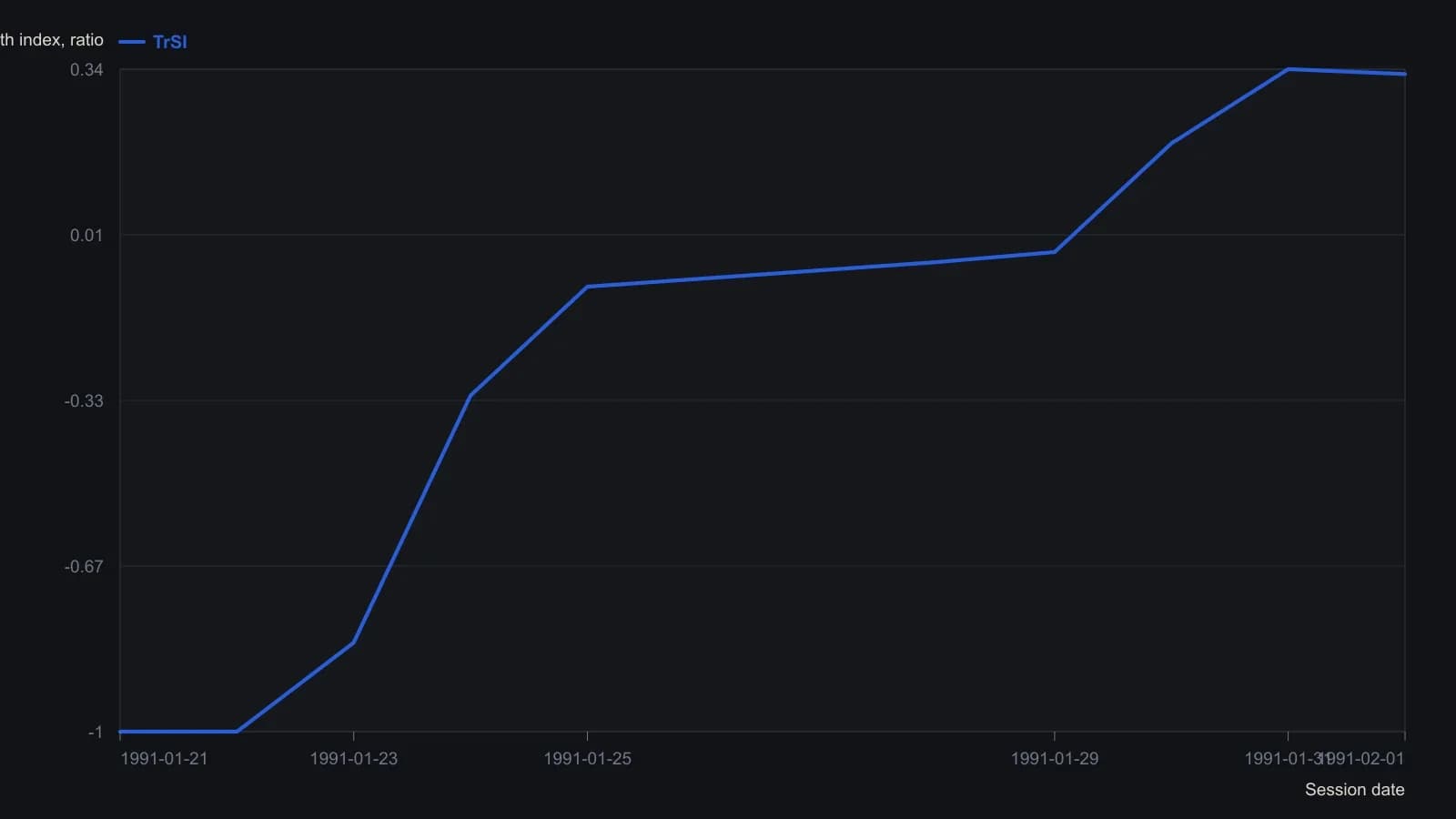
The sidebar locks the first EMA weight at 2/(14+1)=0.1333 and the second at 2/(3+1)=0.50. The 4 February row prints only cell formulas, so it is omitted.
All readings on this track · 51 readings
- 1984Half-cycle differencing for momentum signals
- 1987Relative strength evaluation under competing optimization criteria
- 1988Weekly MACD as a two-clock momentum confirmation stack
- 1989Equal-weight zero-cross from smoothed spreads
- 1989Testing relative-strength-index reversal rules against trend continuation
- 1989Smoothed three-day futures filter for index option bounces
- 1989Cycle-length windows for momentum, Relative Strength Index, and stochastic construction
- 1991Filtered rally magnitude as a bull-regime breakout
- 1992Constructing true strength from double-smoothed momentum
- 1992Constructing a double-smoothed true strength index
- 1993When momentum structure and breadth break together
- 1993Constructing double-smoothed range and momentum oscillators
- 1993Constructing a two-parameter relative momentum index
- 1993Building a bounded momentum oscillator with RSI smoothing
- 1993Two-speed oscillators with divergence and trendline gates
- 1993Constructing a relative momentum index from the relative strength index
- 1994Constructing daily advance-decline breadth tools
- 1994Building a composite regime score from monetary climate and weekly trend
- 1994Averaging Relative Strength Index and the stochastic oscillator into one reversal oscillator
- 1995Dividend-yield regression as a hold versus momentum gate
- 1996Jump and hold filters for long-term Treasury yield direction
- 1997Constructing extendedness from a 10 percent swing filter
- 1997A range-expansion oscillator that can refuse its own stretch
- 1997RSI trend permission and Fibonacci pullback rules
- 1998Nested midpoint construction for a range-normalized oscillator
- 1999Evaluating Relative Strength Index momentum with zero-line and threshold rules
- 1999Treat RSI and momentum as three mechanical procedures
- 2000Thrust strength figure from moving-average swings
- 2001Constructing a non-range-bound balance of market power score
- 2004Cleaned breadth oscillator and new-high divergence: a swing-market case file
- 2004Evaluating advance-issues-momentum on a fixed-symbol-basket
- 2004Constructing a trend filter from two adjacent high-low windows
- 2006A dollar-versus-commodity extreme as a regime case
- 2008Zero-centered stochastic bands and bracket stops
- 2012Evaluating engulfing momentum across hold windows
- 2012Staged stops as one mechanical entry and exit procedure
- 2012Stacking a relative-strength-index forecast, a trend filter, and long-only momentum
- 2013Constructing fair-value filters from averages and momentum
- 2014Constructing a multi-window slope divergence entry
- 2015Bandedge trend filter construction with inverse crossover rules
- 2017Opposite rules for index price and volatility momentum
- 2018A three-state overlay that colors a trend only after the line clears the bar
- 2018Half-cycle relative-strength index with a Fisher map for cyclic reversals
- 2018Emotion as a rule input when momentum breaks
- 2018Two-bar body expansion as a momentum breakout construction
- 2019Pair a two-day high breakout with a volume-weighted exit on the same chart
- 2020Building reflex and trendflex cross and extreme entry rules
- 2020Construct a dual-series price momentum oscillator overlay
- 2020A multi-timeframe stochastic as a panel of weekly voters
- 2020Centerline crossovers that compare index momentums
- 2020Multi-timeframe stochastic voting as one mechanical rule