1991issue C061-9
Variable-length moving average from change dispersion
A variable-length moving average shortens its lookback after unusually large recent changes and lengthens it when recent changes stay inside a narrow range. Length is set by placing the latest price change into one of three bands around the mean of recent changes.
- A variable-length moving average is an adaptive moving average whose current lookback is set by how large the latest price change is relative to the recent price-change-distribution.
- The latest price change is placed in one of three partition-bands around the mean of recent changes: the inner band lengthens the average, the middle band leaves length unchanged, and the outer band shortens it, unless a declared minimum or maximum has already been reached.
- The user must set the allowed lookback range, the band thresholds, and the length-adjustment-rate. After each new observation the mean and standard deviation of changes are recomputed and the band boundaries are redrawn.
- The length-adjustment procedure is described as workable for simple and linear moving averages and adaptable to triangular averages, but not as workable for exponential averages.
What a moving average is built to do
A moving average is built to suppress small fluctuations in an ordered series so an underlying direction can be read, while still reacting when that direction changes. The moving average replaces each point in an ordered price, volume, or breadth series with the average of a stated number of neighboring observations.
How lookback length changes
An adaptive moving average is a moving average whose lookback is allowed to change from one sampling interval to the next instead of staying fixed. A variable-length moving average is an adaptive moving average whose current lookback is set by how large the latest price change is relative to the recent distribution of changes.
It shortens its lookback after unusually large recent changes and lengthens it when recent changes stay inside a narrow range. Lookback-length is the number of ordered observations included in the average at a given time, kept inside user-set minimum and maximum values.
How partition bands set the next length
Length is governed by placing the latest price change into one of three partition-bands drawn around the mean of recent changes at user-chosen standard-deviation distances. The price-change-distribution is the recent sample of successive changes used to estimate a mean and a standard deviation against which the next change is compared.
A change in the inner band lengthens the average, a change in the middle band leaves length unchanged, and a change in the outer band shortens the average, unless a declared minimum or maximum length has already been reached.
Settings that must be declared
Construction requires the user to set the allowed lookback range, the band thresholds, and the number of sampling intervals added or removed when a band is hit. That last setting is the length-adjustment-rate.
After each new observation the mean and standard deviation of changes are recomputed and the band boundaries are redrawn before the next interval.
Which averages the procedure fits
The length-adjustment procedure is described as workable for simple and linear moving averages and adaptable to triangular averages, but not as workable for exponential averages.
When the bands or the rule fail
Estimating the mean and standard deviation from a short sample can make the band boundaries move sharply from one interval to the next.
If the rule does not lengthen during a quiet stretch the average remains a short, sensitive smoother. If it does not shorten when a new direction appears the average behaves as a fixed-length smoother.
One fully specified construction
One fully specified construction kept lookback between five and ten intervals, treated changes inside 0.25 standard deviations as the inner band and changes beyond 1.75 standard deviations as the outer band, and moved length by one interval at a time.
November 1990 crude: close versus the variable-length average
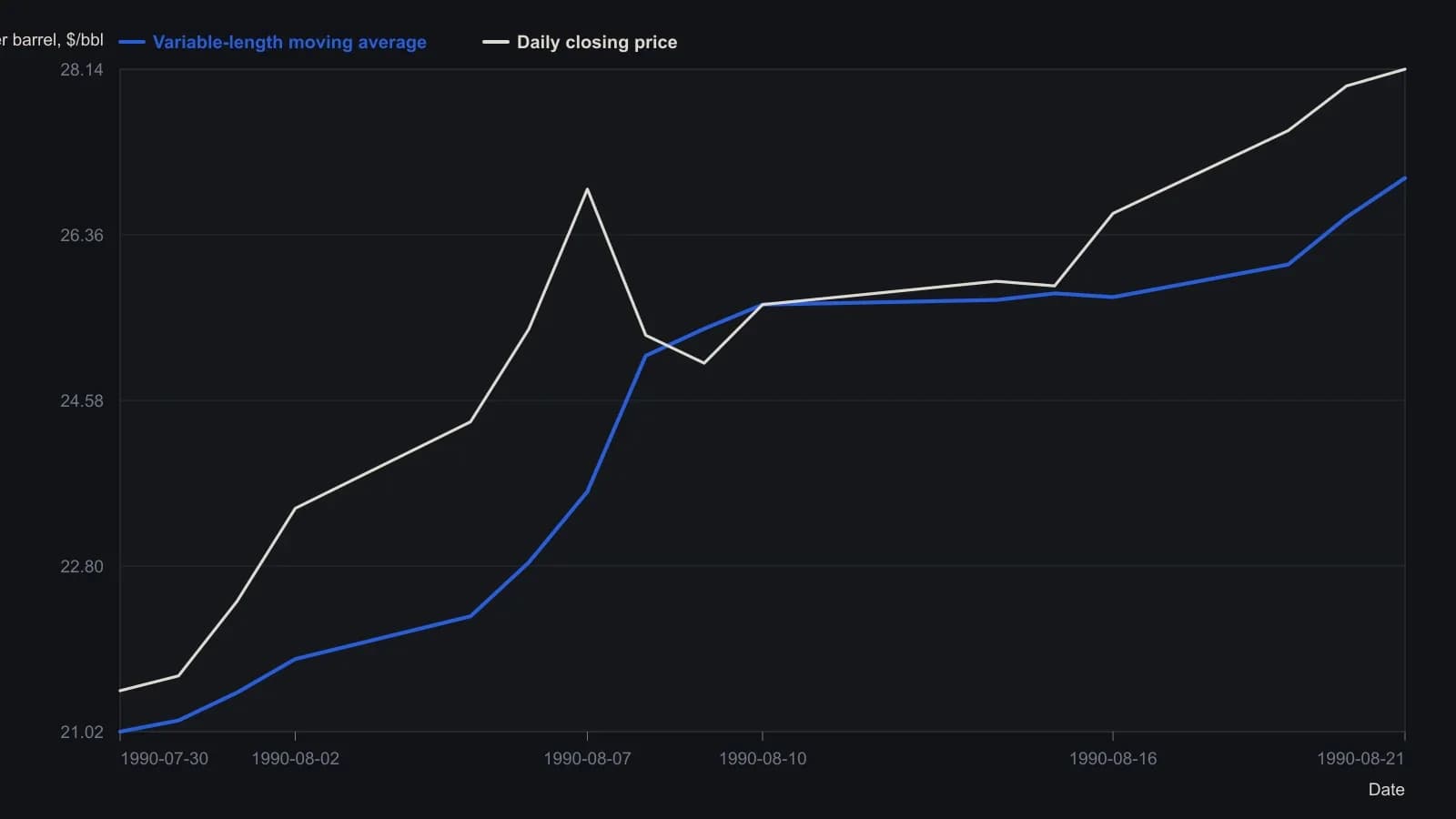
The source fixes the partition edges at 0.25 and 1.75 standard deviations from the rolling mean of recent price changes; those two multipliers decide whether the next lookback shortens, holds, or lengthens.
All readings on this track · 24 readings
- 1991Building variable-length moving averages from partitioned price changes
- 1991Variable-length moving average from change dispersion
- 1992Constructing volatility-adaptive exponential smoothing
- 1995Constructing an adaptive moving average with an efficiency ratio and filter
- 1995Two-gate breakout confirmation with adaptive averages
- 1995Building momentum-scaled adaptive moving averages
- 1995Adaptive length as a construction choice inside exponential smoothing
- 1998Testing price-channel breakouts with a lag-aware adaptive average
- 1998Constructing filters by nesting offsets and variable weights
- 1998Constructing an efficiency ratio adaptive average and entry filter
- 2001Encoding candle structure as a numeric filter
- 2001Adaptive averages driven by cycle-phase speed
- 2005Constructing an adaptive moving average from a fractal-dimension weight
- 2005Range-dimension adaptive exponential filter
- 2010Constructing simple, exponential, and adaptive averages
- 2010How a price-hugging smoother is assembled from ordinary averages
- 2013Evaluating an adaptive moving average against a same-window moving average
- 2016Three-layer confirmation: adaptive average, stochastic relative strength index, and stop-and-reverse
- 2017One-alpha reverse-path exponential smoothing
- 2018Pair two adaptive averages to filter swing turns
- 2018Two Adaptive moving averages as a confirmation pair
- 2018Constructing an adaptive filter for adoption-cycle reversals
- 2018Constructing a deviation-scaled adaptive moving average
- 2020Walk-forward and adaptive averages as two tests of the same trend