2020issue C0248-55
Building reflex and trendflex cross and extreme entry rules
Editorial framing: treat a low-lag oscillator as a two-stage recipe. First choose whether the residual subtracts a sloped cycle line or a flat lookback. Then attach either a two-length cross or an extreme-of-oscillator rule so entry, exit, and abstention stay one testable procedure.
- Both constructions start from the same two-pole smoother of the midpoint of the current and previous close, and Length is treated as the assumed cycle period.
- The reflex residual averages gaps to a sloped projection of the smoother, while the trendflex residual averages raw differences from the current smoother value over the same length window.
- A mean-square scale converts each residual into standard-deviation units and skips the division when that scale term is zero.
- A faster trendflex cross of a slower trendflex, or a reflex extreme checked against whether a long is already open, turns the scaled series into a discrete next order.
A shared smoother feeds both residuals
The construction converts a price series into a scaled oscillator and then into a discrete trade instruction. Both constructions first smooth the midpoint of the current and previous close with a two-pole recursive filter whose coefficients depend on Length, which is treated as the assumed cycle period.
From that shared smoother history the procedure then forms a residual sum. The choice at this stage is whether the residual subtracts a sloped cycle line or a flat lookback.
Sloped residual or flat lookback
The reflex residual estimates a slope from the current smoother value to the value Length bars earlier, then averages the gap between that projected line and each intervening smoother value. The trendflex residual averages the raw difference between the current smoother value and each past smoother value over the same Length, omitting the slope projection.
A companion note states that reflex is meant to follow the cycle component of price while trendflex is meant to keep the trend component. A single-length implementation can compute both series from one smoother history by setting the slope to zero for the trend residual and to the lookback slope for the reflex residual, with Length defaulting to 20.
A mean-square scale puts both residuals in the same units
After averaging, both series divide the residual by the square root of a recursive mean-square that mixes 0.04 of the current squared residual with 0.96 of the prior mean-square. That mean-square scale converts the residual into standard-deviation units. The constructions skip that division when the mean-square term is zero.
A two-length trendflex cross as a momentum procedure
A momentum procedure is a testable procedure that acts when a faster trendflex reading crosses a slower one. An example computes a 20-length and a 50-length trendflex series and issues a next-bar market buy when the faster series crosses above the slower series, or a next-bar market short when it crosses below.
The same fast and slow lengths can be shown as the difference between the two trendflex values against a zero reference line instead of as discrete orders. In either presentation the faster and slower readings, the cross, and the next-bar market instruction stay inside one procedure.
Daily AAPL Trendflex 20 versus Trendflex 50
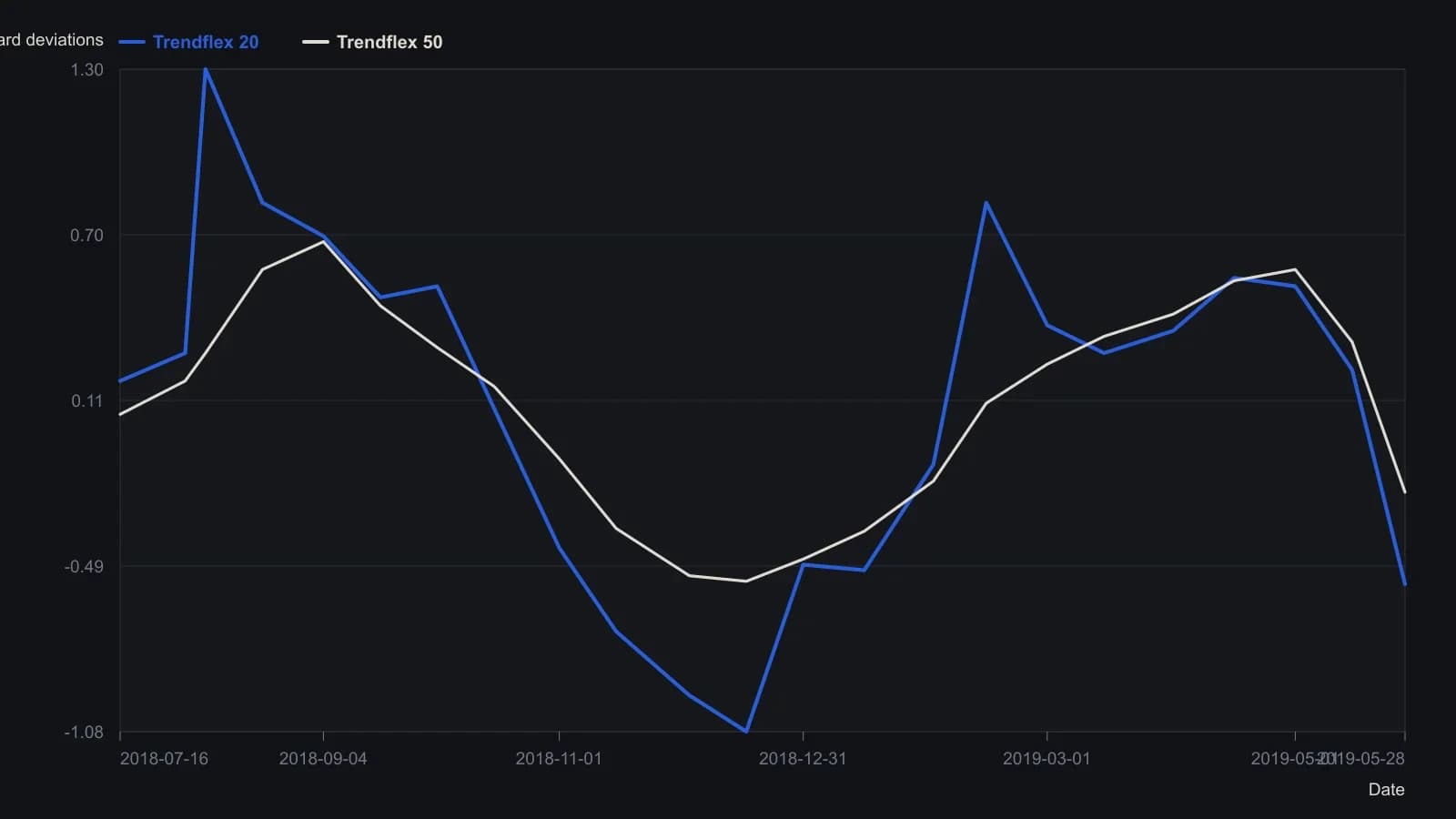
TradeStation example uses FastLength 20 and SlowLength 50. Normalization is Ehlers' running mean square (0.04 of current Sum squared plus 0.96 of the prior mean square). Visible window is mid-July 2018 through late May 2019; turning points are approximate because they were read from the screenshot.
A reflex extreme as a rule-based entry
A rule-based entry is a named condition that places or withholds the next order from oscillator state and whether a position is already open. A long entry fires when the reflex series equals its lowest value over 200 bars and no long position is already open. A paired exit is defined when the series turns down from a 20-bar high.
The open-position check withholds a second long while one is already open, so abstention is part of the same named condition as the entry and the paired exit.
All readings on this track · 51 readings
- 1984Half-cycle differencing for momentum signals
- 1987Relative strength evaluation under competing optimization criteria
- 1988Weekly MACD as a two-clock momentum confirmation stack
- 1989Equal-weight zero-cross from smoothed spreads
- 1989Testing relative-strength-index reversal rules against trend continuation
- 1989Smoothed three-day futures filter for index option bounces
- 1989Cycle-length windows for momentum, Relative Strength Index, and stochastic construction
- 1991Filtered rally magnitude as a bull-regime breakout
- 1992Constructing true strength from double-smoothed momentum
- 1992Constructing a double-smoothed true strength index
- 1993When momentum structure and breadth break together
- 1993Constructing double-smoothed range and momentum oscillators
- 1993Constructing a two-parameter relative momentum index
- 1993Building a bounded momentum oscillator with RSI smoothing
- 1993Two-speed oscillators with divergence and trendline gates
- 1993Constructing a relative momentum index from the relative strength index
- 1994Constructing daily advance-decline breadth tools
- 1994Building a composite regime score from monetary climate and weekly trend
- 1994Averaging Relative Strength Index and the stochastic oscillator into one reversal oscillator
- 1995Dividend-yield regression as a hold versus momentum gate
- 1996Jump and hold filters for long-term Treasury yield direction
- 1997Constructing extendedness from a 10 percent swing filter
- 1997A range-expansion oscillator that can refuse its own stretch
- 1997RSI trend permission and Fibonacci pullback rules
- 1998Nested midpoint construction for a range-normalized oscillator
- 1999Evaluating Relative Strength Index momentum with zero-line and threshold rules
- 1999Treat RSI and momentum as three mechanical procedures
- 2000Thrust strength figure from moving-average swings
- 2001Constructing a non-range-bound balance of market power score
- 2004Cleaned breadth oscillator and new-high divergence: a swing-market case file
- 2004Evaluating advance-issues-momentum on a fixed-symbol-basket
- 2004Constructing a trend filter from two adjacent high-low windows
- 2006A dollar-versus-commodity extreme as a regime case
- 2008Zero-centered stochastic bands and bracket stops
- 2012Evaluating engulfing momentum across hold windows
- 2012Staged stops as one mechanical entry and exit procedure
- 2012Stacking a relative-strength-index forecast, a trend filter, and long-only momentum
- 2013Constructing fair-value filters from averages and momentum
- 2014Constructing a multi-window slope divergence entry
- 2015Bandedge trend filter construction with inverse crossover rules
- 2017Opposite rules for index price and volatility momentum
- 2018A three-state overlay that colors a trend only after the line clears the bar
- 2018Half-cycle relative-strength index with a Fisher map for cyclic reversals
- 2018Emotion as a rule input when momentum breaks
- 2018Two-bar body expansion as a momentum breakout construction
- 2019Pair a two-day high breakout with a volume-weighted exit on the same chart
- 2020Building reflex and trendflex cross and extreme entry rules
- 2020Construct a dual-series price momentum oscillator overlay
- 2020A multi-timeframe stochastic as a panel of weekly voters
- 2020Centerline crossovers that compare index momentums
- 2020Multi-timeframe stochastic voting as one mechanical rule