1984issue C031-4
Matching average age across price filters
Specify a trend filter by the average age you will allow in the average, then build that same delay as an equal-weight moving average or as exponential smoothing. The two constructions stay comparable instead of competing as branded indicators.
- A single daily price sample, such as a close, discards information and can distort the underlying signal through recording mistakes, spillover from other instruments, rumors, political events, and amplification of small intraday moves by exchange intermediaries.
- Filtering modifies a daily price stream to strip noise and recover directional content. The hard design choice is how much noise can be removed without destroying tradable movement.
- The average age of a simple linear weighted moving average is (N-1)/2. Equating that vintage with single exponential smoothing gives a smoothing factor of 2/(N+1).
- Equal-weight linear averages sit halfway back through the window and trail current price. Exponential weights reduce the influence of older prints, update recursively, and are said to plot with less lag.
Daily prices need a filter
A single daily price sample, such as a close, discards information and can distort the underlying signal. The distortions named in the archive workflow are recording mistakes, spillover from other instruments, rumors, political events, and amplification of small intraday moves by exchange intermediaries.
Filtering is the modification of a daily price stream to strip noise and recover directional content. The hard design choice is how much noise can be removed without destroying tradable movement. A trend filter, in this workflow, is any averaging construction used to strip sampling noise while leaving directional movement intact enough to study.
Average age puts both constructions on one delay scale
The average age of data in a simple linear weighted moving average equals (N-1)/2, where N is the number of past days averaged. The average age of single exponential smoothing equals (1-a1)/a1. Setting those two vintages equal defines an equivalence between the weighting schemes.
Under that equivalence the single smoothing factor can be written as 2/(N+1) in terms of the familiar linear lookback N. The smoothing factor is the control on how many past observations, such as closing prices, still affect the forecast or average.
Equal-weight windows trail current price
Equal-weight linear averages are logically centered halfway back through the window and therefore trail current price. Exponential weights reduce the influence of older prints, update recursively, and are said to plot with less lag.
A well-tuned simple linear moving average is presented as often matching a much more elaborate filter. The complicated construction is sometimes only slightly better at separating noise.
Higher-order smoothing and a weekly visual filter
Higher-order recursive exponential smoothing is introduced in the same workflow. Triple, or order 3, weighting uses the prior three prices. The average-age relation is extended so a p-th order factor can be expressed from the same N used for a linear moving average.
Inspecting weekly ranges instead of daily ranges, sometimes marking only the Friday close, is treated as a simple visual weekly filter on otherwise hectic daily trading.
Smoothing factors that match an N-day average's age
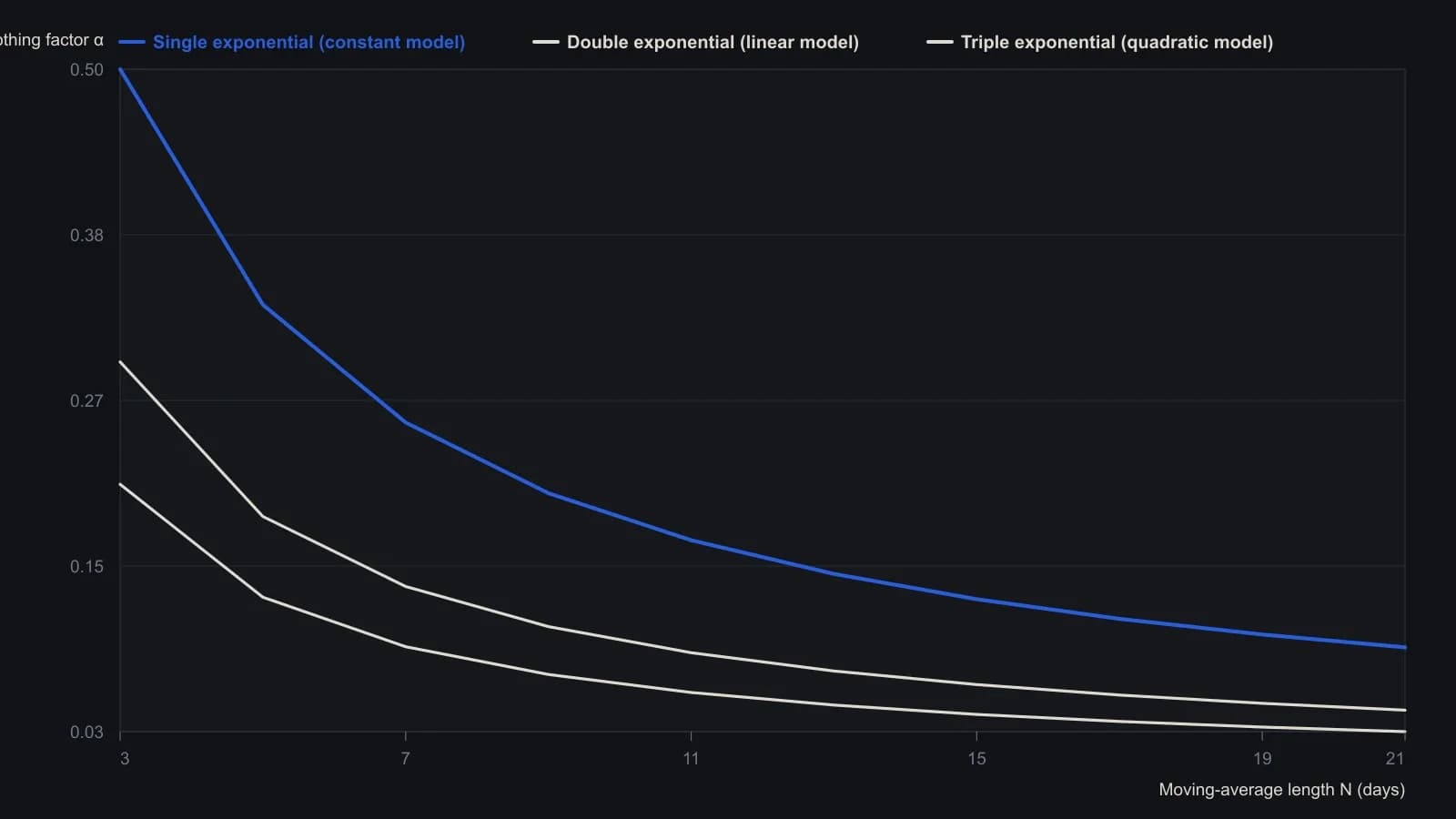
Hutson equates average age K=(N−1)/2 of the equal-weight window with the lag of each exponential order and solves αp=1−(1−2/(N+1))^(1/p). Column heads use N+1; the formula printed above the table uses N−1.
All readings on this track · 41 readings
- 1984Matching average age across price filters
- 1984Residual-impact construction of exponential smoothers
- 1988Constructing simple and exponential moving averages as specified filters
- 1989Evaluating smoothed free reserves and funds-discount spreads
- 1990Integer construction of moving averages and exponential smoothing
- 1990Constructing incremental moving average filters
- 1991Constructing a double-smoothed stochastic oscillator
- 1991Constructing an exponential average from a smoothing weight
- 1991Constructing a double-smoothed momentum oscillator family
- 1991Competing certainty rules from exponential-average conditions
- 1991Hybrid construction of a mechanical timing system from smoothed signals
- 1991Constructing an exponential smoother from a moving-average length
- 1991Equivalent relative-strength-index constructions from a ratio and from smoothed momentum
- 1991Constructing the true strength index from double-smoothed momentum
- 1991True strength index from signed, double-smoothed momentum
- 1992Constructing exponential averages from simple lookbacks
- 1992Constructing exponential averages by the smoothing constant, startup length and lag
- 1992Nested range smoothing and windowed high-low damping
- 1992A weekly equity stance from the discount-bill spread
- 1993Double-smoothed stochastics momentum index construction
- 1993Constructing the true strength index with double exponential smoothing
- 1994Polarized fractal efficiency with a shared exponential smoother
- 1994Five-interval exponential smoothing of ten-interval signed path-efficiency
- 1994Hand-ranked price-volume series with stacked smoothing and stochastic
- 1995Range expansion filter on multi-horizon averages
- 1995The exponential smoothing constant from averaging lag
- 1997Construct a nested-average rainbow band and oscillator
- 1998Filter stacks that combine a moving average with exponential smoothing
- 2002Smoothed relative-strength construction from wilder-averaging and a price prefilter
- 2003Reverse-engineered RSI price targets
- 2004Piecewise trend quality from moving-average reversals
- 2004Nested smoothing recipes versus unaudited oscillator experiments
- 2008Weight construction beyond the N-day label
- 2010A consensus filter for objective RSI and smoothing construction
- 2012Sentiment-zone oscillator from signed closes
- 2012Classic RSI one-over-N smoothing versus the standard exponential average
- 2013Why exponential smoothing uses two over n plus one
- 2015Constructing ratio indicators with moving-average and exponential-smoothing weights
- 2015Slow relative-strength index from an exponentially smoothed price
- 2017Rebuilding the relative strength index as open-scale buy-sell pressure
- 2017Comparing Wilder and exponential smoothing inside a relative-strength index