2012issue C0678-79
Constructing a simple moving average filter with fixed crossing rules
A simple moving average applied to a monthly high-yield series can be paired with crossing rules that mark discrete buy and sell events. Average length is treated as a construction parameter, and the same entry-exit procedure is rerun on two historical windows.
- A simple moving average on a monthly high-yield series can be paired with crossing rules that mark discrete buy and sell events.
- Lookback length is a construction parameter that can be stepped from two months through 24 months while the rest of the entry-exit procedure stays fixed.
- The same procedure is rerun on a later window from 2003 through 2011 and an earlier window from 1990 through 2002 so the rule set is not judged on one sample only.
- An eight-bar simple moving average is one explicit construction; buy and sell marks follow that average rather than discretionary placement.
The simple moving average as a baseline
A simple moving average is a constructed average of consecutive sampled prices. It becomes the quantitative baseline for later comparison.
When that average is applied to a monthly high-yield series, it can be paired with crossing rules that mark discrete buy and sell events. A crossing rule is a binary entry or exit event triggered when the observed series moves through the average.
Lookback length as a construction parameter
Lookback length is the number of sampling intervals included in the average. It is a design choice, not a hidden property of the series.
Average length is treated as a construction parameter that can be stepped from two months through 24 months rather than locked to a single lookback. That sweep is a stepped parameter scan: one construction parameter moves across a stated range while every other rule stays fixed.
An eight-bar simple moving average is one explicit construction used to show how changing the period shifts the timing of those signals. Buy and sell marks on the illustrated monthly chart are generated from that eight-period average rather than from discretionary placement.
The same procedure on two windows
The entry-exit procedure is the combined rule set that decides when to enter, when to exit, and when to do neither. That procedure stays the same while the sample changes.
The same procedure is rerun on a later window from 2003 through 2011 and an earlier window from 1990 through 2002 so the rule set is not judged on one sample only. Each of those intervals is a split-sample window: a second historical interval used to rerun the identical procedure instead of judging it on a single stretch of data.
A summary diagnostic tracks how a ratio of compounded growth to peak decline changes as moving-average length changes.
A reusable worksheet
A reusable worksheet construction can reload a downloaded history or switch the symbol while keeping the same average and crossing rules. The simple moving average and the crossing rules stay in place; only the loaded series changes.
Eight-period simple moving average of monthly FAGIX
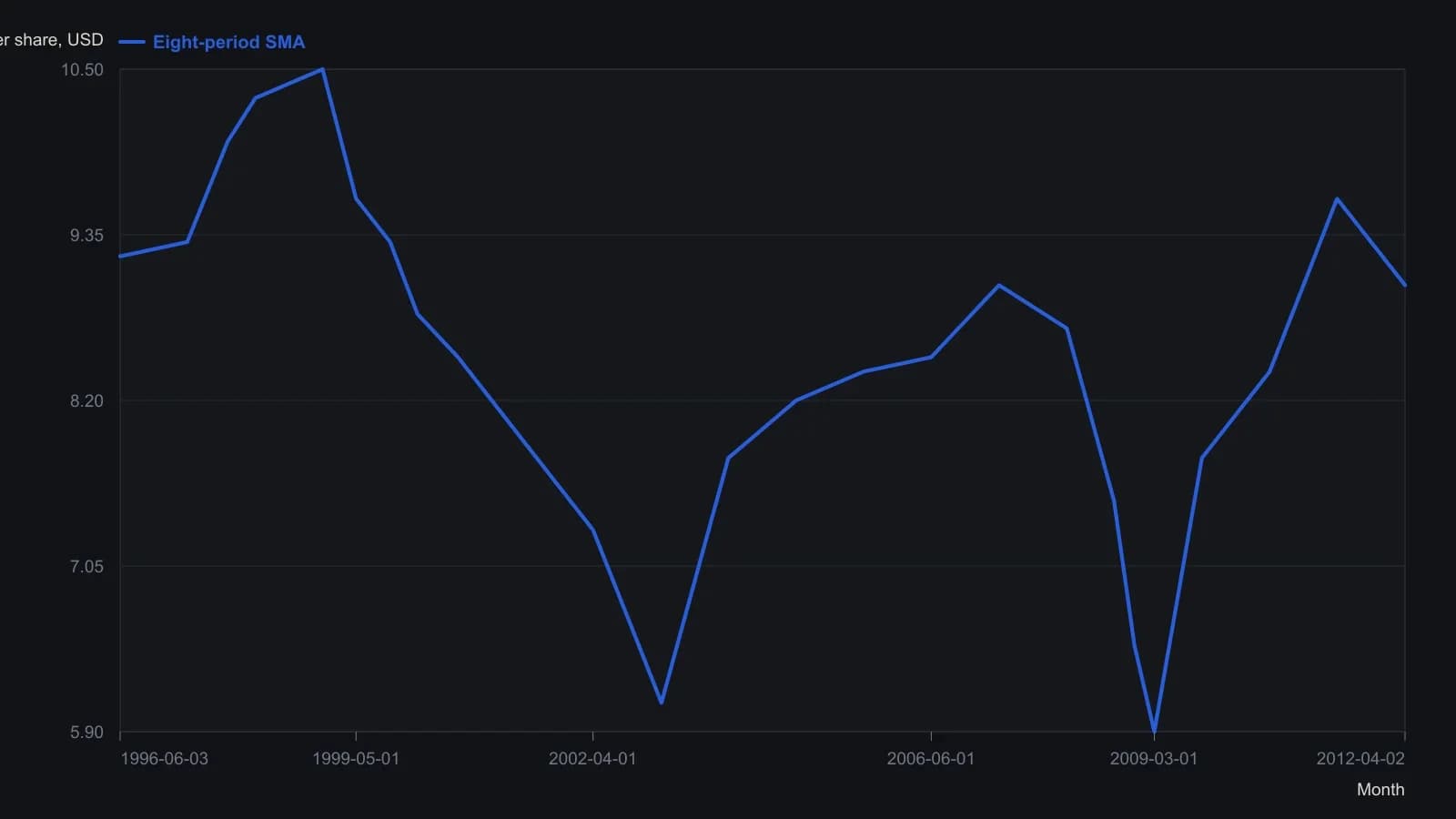
Lookback is fixed at eight monthly closes, the setting used in the Excel worksheet figure. Green buy and red sell dots on the source page mark discrete crosses and were not turned into a second numeric series.
All readings on this track · 14 readings
- 1990Moving-average direction, range penetration, and a dollar stop
- 1990Rally and reaction day signals as a mechanical stock system
- 1991Constructing steppable currency games with stop alerts
- 1995Trading as a business: a case study of preparation and rule-based entry
- 1997Bond timing rules as one testable procedure
- 2000Rule-based moving average commentary as a testable filter
- 2004Constructing a fifteen-bar trend trigger as a next-open system
- 2005State-locked rules for mechanical trading
- 2007Same-session long entry from a moving-average filter
- 2012Liquidity, share count, and stop-trigger costs
- 2012Monthly eight-bar average entry and exit rules
- 2012Constructing a simple moving average filter with fixed crossing rules
- 2014A two-average brick crossover is not yet a trading system
- 2020Reject long-bar entries driven by volatility fear of missing out