2007issue C071-10
Constructing a three-factor volume-price confirmation filter
A volume-price confirmation series can be built as the product of a long-window average gap, a short-window price-average ratio, and a participation ratio, then used only as a gate on a separate trend signal.
- Volume-price analysis can assemble a confirmation series that classifies whether volume agrees with or opposes the prevailing price trend.
- A simple price average records level changes but omits participation, so the core term is the gap between a long-window volume-weighted price average and a simple price average of the same length.
- The finished series multiplies that long-window gap by a short-window volume-weighted-to-simple price ratio and a short-to-long volume-average ratio, then a moving average of the product lets the pair be read as a line-and-signal oscillator.
- Volume confirmation can gate a separate MACD crossover with that product, or with on-balance volume in the same role, and tick count can replace share volume when share volume is unavailable.
What the series is built to classify
The volume-price confirmation series is built to classify whether volume agrees with or opposes the prevailing price trend. Volume-price analysis starts from that classification rather than from a standalone entry rule.
A simple moving average of price records level changes but omits participation, while a volume-weighted average rescales each close by that bar's share of lookback volume.
Assemble the product from three terms
The core confirmation term is the difference between a long-window volume-weighted price average and the same-length simple price average.
The finished series is the product of that long-window average gap, a short-window volume-weighted-to-simple price ratio, and a short-to-long volume-average ratio.
Use the product as a gate
Reconstructions typically plot both the raw product and a moving average of the product so the pair can be read as a line-and-signal oscillator.
One construction uses the series as a confirmation gate on a separate MACD crossover, allowing a long only when the product is above its own average and a short only when it is below.
Weekly VPCI on Toyota Motor, 2004–2007
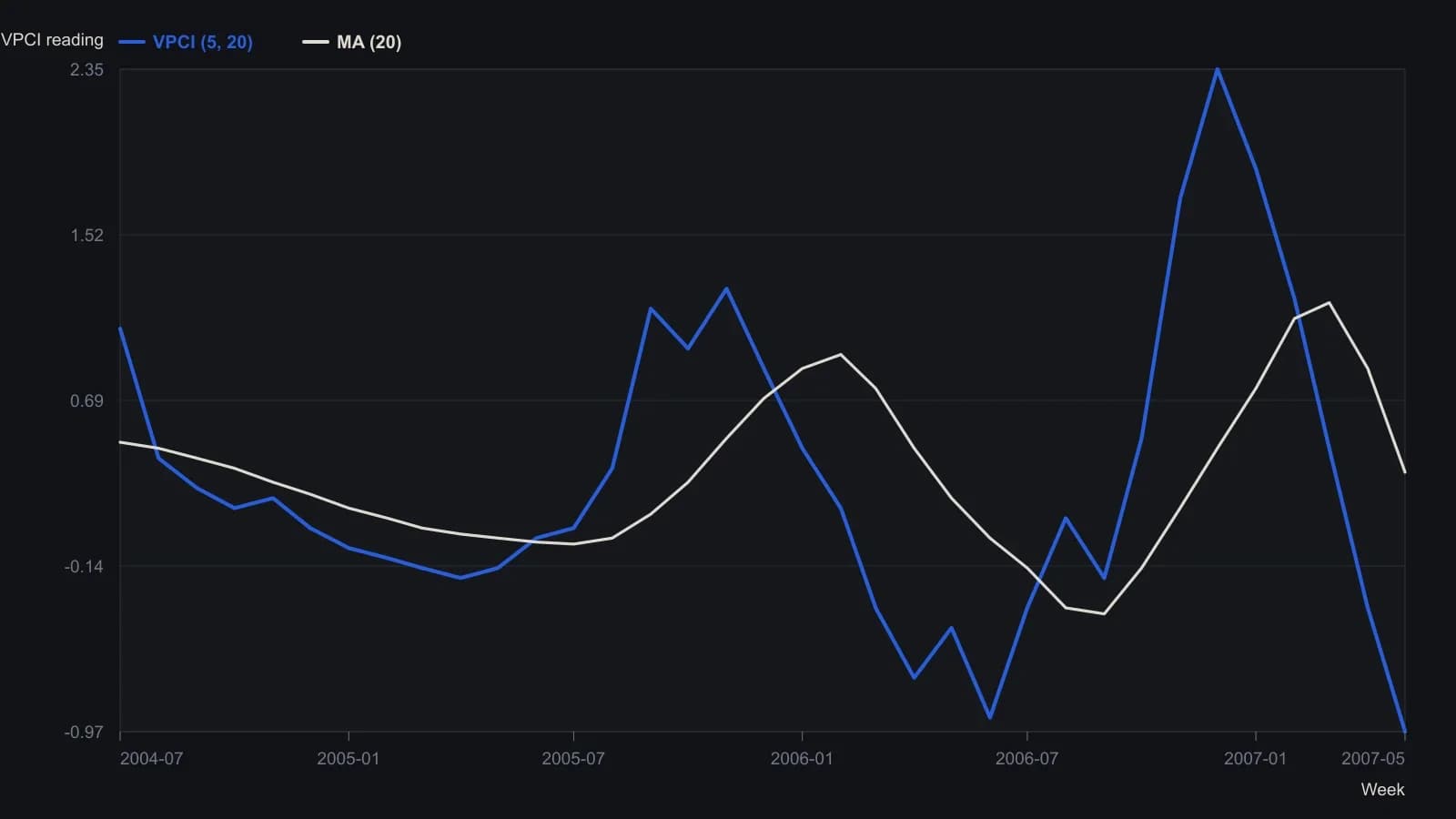
VPCI windows are 5 and 20 weeks; the average uses 20 weeks. Last on-screen readings are −0.97 and 0.33 on the 10 May 2007 bar. Monthly samples from a weekly raster, so peaks and troughs are approximate.
On-balance volume as a substitute gate
The same gate design can substitute on-balance volume, allowing a long only when on-balance volume is above its own average and a short only when it is below.
Independent reconstructions chart the product beside on-balance volume so the two volume-based confirmation series can be compared on the same bars.
Tick count when share volume is missing
When share volume is unavailable, the same formulas accept tick count, the number of price changes in the bar, as the volume input.
All readings on this track · 40 readings
- 1988Constructing volume-confirmation overlays on OHLC spreadsheet charts
- 1989Commodity advance-decline from delivery months
- 1989The most-active list as a three-layer breadth lab
- 1989Constructing a yield-curve volume-breadth composite
- 1989A bond-futures case study in support, volume, and confirmation
- 1989Volume-scaled price boxes and volume cycles
- 1990Futures-signed on-balance volume construction
- 1990Self-relative volume boxes for news-free breakouts
- 1990Broadening swings, demand tests, and volume filters
- 1991A same-session pressure test of breadth and volume share
- 1991Tick extremes that confirm double tops and bottoms
- 1991Constructing auction fuel from volume and open interest
- 1994Constructing On-balance volume with smoothing and timeframe confirmation
- 1996A volume-gated moving-average trend combination
- 1996Constructing four-state range-volume bars
- 1997Failed trade review of a descending-triangle breakdown
- 1997Construct a head-and-shoulders before the neckline break
- 2004Volume confirmation is not optional for a head-and-shoulders reversal
- 2007Constructing a three-factor volume-price confirmation filter
- 2007Constructing a three-condition moving-average entry with a volume filter
- 2008Breakout rules that wait for volume and liquidity
- 2011Screen futures liquidity with open interest and volume
- 2011Filter executable futures with liquidity and open interest
- 2012Rank listed futures by liquidity before a forecast chooses the name
- 2012Filter futures liquidity using open interest and volume
- 2013Pre-trade futures liquidity as an execution filter
- 2014A futures liquidity screen from range, open interest and volume
- 2014Evaluating futures contract liquidity before execution
- 2014Constructing defended price lines from volume clusters
- 2014Filter futures by equal-dollar size, open interest, and volume
- 2015Filter futures ideas by ranked contract liquidity
- 2017Screen listed futures for execution liquidity first
- 2017Filter futures orders by liquidity, open interest, and volume
- 2018Using open interest and volume to rank futures liquidity
- 2018Score listed futures as an execution menu before the setup
- 2019Filtering futures orders with liquidity, open interest and volume
- 2019Futures liquidity as an execution filter
- 2020A futures liquidity board as a pre-trade execution filter
- 2020Sequenced volume and golden-cross breakout rules
- 2020Use a listed-futures liquidity filter before execution