2017issue C0922-25
A three-flag swing window with a bandpass midpoint
Two flanking marks bound a swing-trading window from first alert to a later trend-filter cross. An intermediate bandpass-smoothed midpoint is added between them so the three-mark sequence can be read as one confirmation-ladder.
- An early-warning-window runs from a first alert that a turning region may be near to a later trend-filter cross treated as the last usable chance.
- The alert is built to appear well before a usable swing decision, and the confirmation often arrives after the preferred entry or exit, so an intermediate mark is placed between them.
- That intermediate mark is a bandpass-filter residual of two center-of-gravity series, then passed through a gaussian-shifted-smoother applied in both time directions.
- Window, offset, and shape of the smoother are adjustable, and a later volume projection is reserved as an extra confirmation layer on the same sequence.
Two marks bound the window
A swing-trading rule treats entry, exit, and waiting as one sequence over a holding period of days to weeks. Two early-warning marks bound the early-warning-window in which a swing decision is considered. The first is an alert that a turning region may be near. The later mark is a trend-filter cross: price has crossed a short-horizon moving filter used as a horizontal center line. That cross is treated as confirmation that a turn has occurred and as the last usable chance in the window.
The interval between those marks can last one session or several weeks. When both early-warning marks fire inside the indicator-column array, the procedure marks them with distinct dots because the triggering pattern changes can be too small to read reliably by eye.
The three-mark order
The alert mark is built to appear well before a usable swing decision, and the confirmation mark often appears after the preferred entry or exit has passed. An intermediate mark is added to occupy the space between them.
The marks form a confirmation-ladder. First, a trading opportunity is approaching. Next, a preferred entry or exit has occurred. Last, a later trend-continuation cross is treated as the last usable chance. Each later mark is intended to raise confidence and validate the prior mark, not to replace the window test.
The intermediate mark from a bandpass and a smoother
The intermediate mark is produced by combining filters. A center-of-gravity calculation that overweights the most extreme and most recent values is run at two lengths, differenced as a passband, then sent into a smoothing stage.
The documented bandpass-filter subtracts a 6-period center-of-gravity series that uses only the close from a 10-period series that uses the candle midpoint of open plus close divided by two. The residual emphasizes swing highs and lows while slower drift is reduced.
The passband output is smoothed with a gaussian-shifted-smoother reconstructed at a 4-bar window, an offset of 0.67, and a sigma of 1.1. Window, offset, and sigma are presented as adjustable controls for smoothness versus responsiveness.
That smoother is applied in both time directions to suppress small fluctuations and reduce one-way moving-average lag. Its peak weight is kept off the newest bar because the center-of-gravity stage already concentrates uncertainty there.
Eight-day center of gravity on American Express, October–November 2016
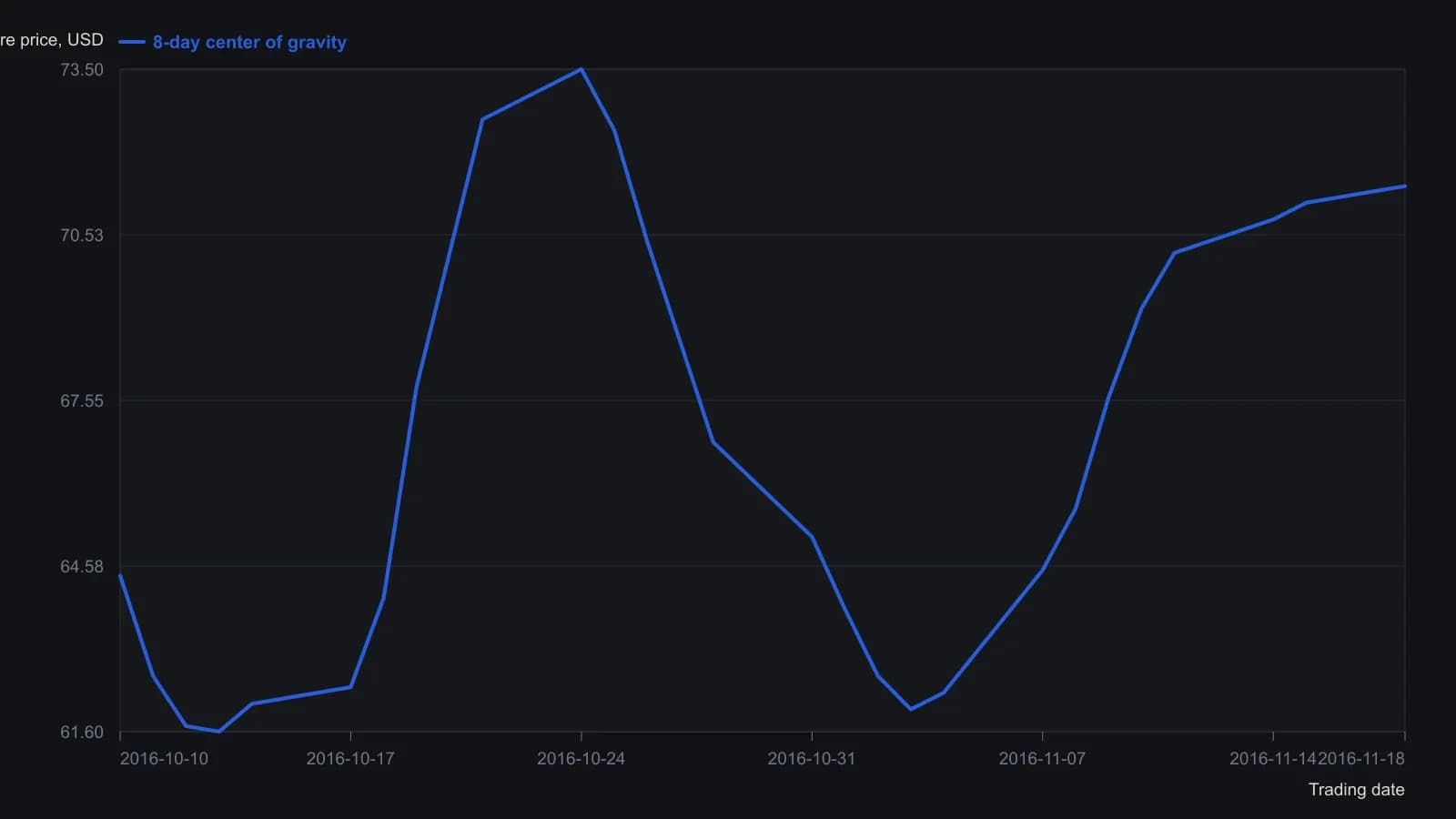
The source fixed the COG lookback at eight days and heavily weighted the most extreme and most current bars inside that window. ALMA smoothing used later in the article (window 4, offset 0.67, sigma 1.1) is a separate stage and is not this series.
Short lookbacks and a reserved volume layer
Lookback lengths are kept short because the swing-trading horizon contemplated is a few days to a few weeks. The same adjustable smoother is described as allowing the procedure to be retuned to shorter intraday sampling.
A later companion projection that uses volume is reserved as an extra confirmation layer on the same early-warning plus intermediate-filter sequence.
All readings on this track · 9 readings
- 1994Constructing a cycle-aligned bandpass from paired lowpass filters
- 2008A bandpass filter bank for dominant cycle construction
- 2010Construct a bandpass, cycle, and trend mode detector
- 2015Constructing a one-parameter bandpass oscillator from two-bar momentum
- 2015Bandpass cycle models cannot promise certainty
- 2016Dual exponential Super Passband filter construction
- 2017A three-flag swing window with a bandpass midpoint
- 2019Building a three-harmonic Fourier series cycle wave
- 2019Lock a band, take a short lead, then gate empty readings