2020issue C088-14
Keep neutrality as a first-class input in three-state market data
Traditional bull-bear spreads can assign the same score to very different three-state mixes, and bull-to-bear ratios become undefined or extreme when one opposing side is near zero. This archive article treats unchanged shares as a first-class construction input for market breadth, on-balance volume, and divergence.
- Traditional bull-bear spreads can assign the same score to very different three-state mixes.
- Bull-to-bear ratios become undefined or extreme when one opposing side is near zero.
- A three-state observation is fully determined by any two of advancing, declining, and unchanged shares.
- Editorial reading: rebuild market breadth, on-balance volume, and divergence from the three-state mix so neutrality is an input, not leftover noise.
The same score can hide different mixes
Traditional bull-bear spreads can assign the same score to very different three-state mixes. A spread that only compares a bull side with a bear side can land on one number while advancing, declining, and unchanged shares sit in different combinations.
Editorial reading: the third state is the usual casualty. Unchanged shares drop out of the score, so neutrality is treated as leftover noise instead of as part of the observation.
Ratios break when one side is near zero
Bull-to-bear ratios become undefined or extreme when one opposing side is near zero. A construction that divides one side by the other cannot stay stable if the opposing side almost disappears.
Editorial reading: that instability is a property of the ratio. It is not a reason to discard advancing, declining, or unchanged shares, and it is not a substitute for the three-state mix.
RDoS on the article's hypothetical sentiment scenarios
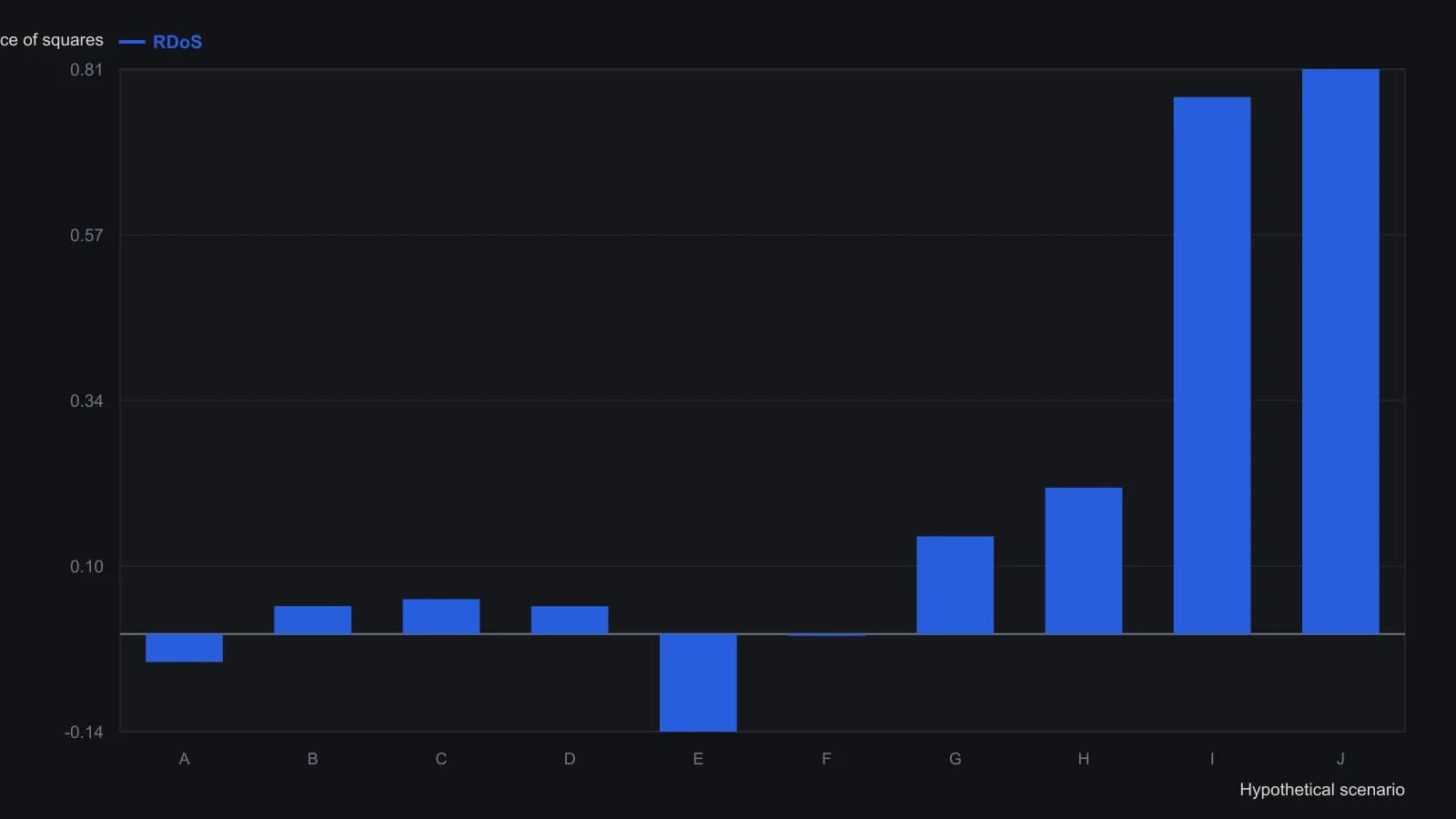
Scenario F is any mix with equal bullish and bearish shares (neutral = 100% − 2α); the table fixes RDoS at 0. Values are the published two-decimal readings, not recomputed from the percentages.
Any two states determine the third
A three-state observation is fully determined by any two of advancing, declining, and unchanged shares. Record any pair and the missing share is already fixed. Neutrality does not have to be recovered later as a residual. It can enter the construction as a first-class input from the start.
Editorial reading for breadth, volume, and divergence
Editorial reading: rebuild the three-state record before deriving a market-breadth condition, an on-balance-volume update, or a price-indicator divergence check. Keep the full mix in view so two-state spreads and ratios are not asked to stand in for the observation they collapse.
The teaching point is construction, not a trading rule. Neutrality stays visible when unchanged shares are kept as an input. It disappears when the workflow starts from a bull-bear score and treats everything else as leftover noise.
All readings on this track · 61 readings
- 1988Cumulative volume trend and 200-session polarity
- 1988Three clocks when cumulative volume led price
- 1988Payoff index checkpoints for open interest and divergence
- 1988Relative strength, stochastics, and on-balance volume as a turning-point stack
- 1988Signing volume by open interest change
- 1988Case study: weekly on-balance volume with trendlines and a 21-period average
- 1988Combining weekly and daily MACD divergences with on-balance volume
- 1988Restoring the original tests for market breadth, on-balance volume, and trendlines
- 1989Evaluating volume-weighted breadth extremes
- 1989Demand oscillator construction with a momentum overlay
- 1989Constructing a volume percentage ratio from advance-decline flow
- 1990Constructing net positive volume as On-balance volume
- 1990Buying-share scale with on-balance volume
- 1990Friday-filtered on-balance confirmation lines
- 1991Constructing rate-market volume breadth from on-balance volume
- 1991Building a breadth composite from on-balance volume breakouts
- 1992Constructing a rate-complex volume-breadth index
- 1992Constructing a breadth index from on-balance volume
- 1992Constructing signed market thrust from issue volume
- 1992Constructing indicator phase across averages, volume and bands
- 1993Force on-balance volume to agree with itself at slower horizons
- 1993Three transforms of market thrust from breadth and volume
- 1994Constructing a tick-line momentum oscillator
- 1994Constructing a smoothed on-balance tick momentum oscillator
- 1994Histogram confirmation and a second-series veto for MACD-family alerts
- 1994Constructing a 40-period envelope on on-balance volume
- 1996Constructing a matched percent-B volume disparity
- 1997Constructing calendar regime overlays and volume-weighted rules
- 1997Constructing market thrust from breadth and volume
- 1997Constructing on-balance volume as a signed running total
- 1997A three-layer construction for a signed volume-force oscillator
- 1997Constructing a range-sum volume-force oscillator
- 1999On-balance volume confirmation, price-indicator divergence, and bounded exits
- 2000A daily long-only confirmation stack on the tether line
- 2000A three-filter tether and volume trend system
- 2003Constructing finite volume elements as a finite-period money-flow filter
- 2003Constructing on-balance volume from signed session volume
- 2003On-balance volume as a market-breadth participation ledger
- 2003Construct a volatility-adjusted on-balance volume filter before confirming a breakout
- 2004Opening and midday ranges as an on-balance-volume breakout case
- 2004Constructing a volatility-gated volume-flow measure
- 2004Constructing a volume-flow series from on-balance volume
- 2004Volume-flow indicator construction from on-balance volume
- 2004Volume-flow slope divergence, then separate on-balance-volume and crossover rules
- 2004Volume flow and band construction as one inspectable problem
- 2004Auditing advance-decline confirmation for scale, horizon, and composition
- 2005Bounded market breadth from the Arms index to BRIN
- 2006Overnight-hold entry and exit construction
- 2007Evaluating Volume-price confirmation versus On-balance volume and MACD
- 2009Volume confirmation versus a price advance
- 2010Typeahead retrieval of a moving average, on-balance volume, and a stochastic oscillator
- 2010Modified volume-price trend and log-price scale alignment
- 2010Constructing liquidity accelerometers from advance-decline averages
- 2012Failed short cycles as breadth and volume tests
- 2016Earnings straddles, implied volatility, and money-flow filters
- 2017A volume residual filter and a price projection matrix
- 2019Volume-volatility parabola and signed-volume momentum
- 2019Separating on-balance volume into breadth and volume
- 2020Constructing the obvm signal line
- 2020Constructing smoothed on-balance volume with a signal line
- 2020Keep neutrality as a first-class input in three-state market data