2018issue C0748-55
Deviation-Scaled Moving Average construction from a two-bar difference
A Deviation-Scaled Moving Average is assembled from a two-bar close difference, a Super Smoother, a Lookback Period Root Mean Square, and an Adaptive Alpha applied to Close. The same construction is restated as a reusable overlay and as a two-average crossover rule.
- The construction starts with a two-bar close difference that is intended to place zeros at DC and Nyquist and to produce a nominal zero-mean series before smoothing.
- A Super Smoother whose coefficients come from the Lookback Period is applied to that difference, then a Period-length Root Mean Square rescales the smoothed series into standard-deviation units when the Root Mean Square is not zero.
- Adaptive Alpha is the absolute Scaled Filter times 5 divided by Period and is used as the coefficient of a one-pole recursion on Close.
- Vendor implementations treat Period as a required positive lookback, often shown at 40 bars, and a demonstration pair uses FastPeriod 40 and SlowPeriod 100 with next-bar market entries when the faster average crosses the slower average.
How the pieces fit
The July 2018 construction begins with a two-bar close difference, applies a Super Smoother to that difference, rescales the smoothed series with a Lookback Period Root Mean Square, and then forms an Adaptive Alpha for a one-pole recursion on Close. The finished series is the Deviation-Scaled Moving Average.
The same construction is restated across platforms as a reusable function plus a chart overlay, with alerts or plots on price crossing the average, so the filter can be rebuilt rather than only visually inspected.
A two-bar difference before smoothing
The construction begins with a two-bar close difference. That difference is intended to place zeros at DC and Nyquist and to produce a nominal zero-mean series before smoothing.
Super Smoother coefficients
A Super Smoother is then applied to that two-bar difference using coefficients a1, b1, c1, c2, and c3 derived from the Lookback Period.
The Super Smoother coefficients use a1 = exp(-1.414 * pi / (0.5 * Period)), b1 = 2 * a1 * cos(1.414 * 180 / (0.5 * Period)), c2 = b1, c3 = -a1 * a1, and c1 = 1 - c2 - c3.
Root Mean Square scaling
A Period-length Root Mean Square of the smoothed series is computed and used to rescale that series into standard-deviation units, provided the Root Mean Square is not zero. That rescaled series is the Scaled Filter.
Adaptive Alpha on Close
The adaptive coefficient is formed as the absolute Scaled Filter times 5 divided by Period, then used as Adaptive Alpha in a one-pole recursion on Close.
Inputs, overlays, and a two-average cross
Vendor implementations treat Period as a required positive lookback, with common demonstration defaults of 40 bars and a MetaStock input range of 2 to 200.
A demonstration strategy constructs two deviation-scaled averages with FastPeriod 40 and SlowPeriod 100 and issues next-bar market entries when the faster average crosses the slower average.
Daily SPY with a 40-period Deviation-Scaled Moving Average
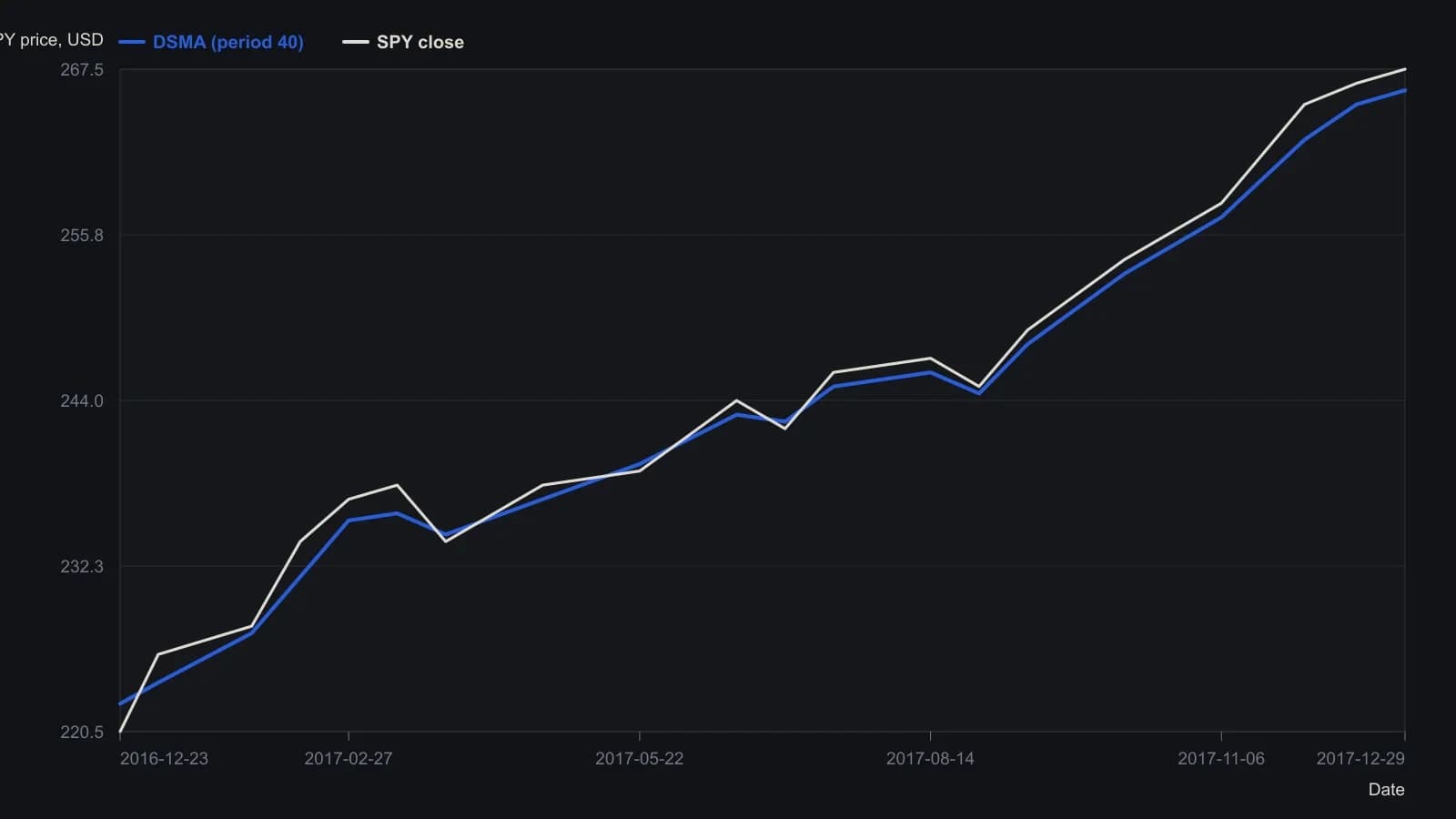
Period is 40 on 256 daily bars from 23 Dec 2016 to 29 Dec 2017. Super Smoother coefficients printed on the sheet are a1 0.8008, b1 1.5623, c2 1.5623, c3 -0.6413, c1 0.0790. Interior readings are approximate against a 10-point price grid.
All readings on this track · 39 readings
- 1982Three gates on a 1982 pork-belly short
- 1982Scale-free Commodity Channel Index construction
- 1986Constructing a commodity channel index and a regression price channel
- 1987Constructing scaled OHLC matrices for study overlays
- 1987Constructing the commodity channel, average directional, and relative strength indexes on a shared cycle scale
- 1992Eleven-bar commodity channel index from typical price and mean deviation
- 1992Evaluating Commodity Channel Index breakout versus range rules
- 1992Evaluating breakout and CCI rules as complete mechanical procedures
- 1993Constructing stochastic, RSI and CCI inputs for forecasts
- 1993Nested centered channels with a commodity channel index confirmation gate
- 1993Listed-option timing as three separable clocks
- 1994Constructing an eleven-period commodity channel index
- 1994Confirming Elliott wave turns with channels and the commodity channel index
- 1995Commodity Channel Index band rules lag zero-line timing
- 1995Building the commodity channel index from typical price
- 1995Staged reversal rules with commodity channel index and average channels
- 1995Commodity channel index construction from typical price to a smoothed zero line
- 2001Reader tests for unfinished lookback oscillators
- 2002Constructing the commodity channel index from typical price
- 2003Breadth-filtered commodity channel index entry and exit rules
- 2003Constructing the Commodity Channel Index from typical price and scaled deviation
- 2003A shallow, poorly participated advance is an unconfirmed trend
- 2003CCI and RSI parameter defaults as scaling conventions
- 2003A cost and capital audit of a Commodity Channel Index trade engine
- 2003Commodity channel index peak divergence as an exit after twin patterns
- 2004Constructing the Commodity Channel Index from typical price
- 2004Constructing the Commodity Channel Index from typical price and mean deviation
- 2006Building custom indicators from the Commodity Channel Index, a least squares moving average and a rule-based entry
- 2012Confirming breakouts and retracements with CCI, ADX, and averages
- 2012Stacking oscillator lookbacks into a heatmap mosaic
- 2013Constructing a consensus and volatility-normalized value oscillator
- 2013Walk-forward system evaluation with a commodity channel index and chandelier exits
- 2014Dual detrended oscillators and dual Bollinger Band channels
- 2014RSI, CCI, and moving-average trend-filter construction
- 2014Dual RSI, a moving average, and CCI as a confirmation stack
- 2017Constructing dual-average cross and channel-index filters
- 2018Treat CAM as a classification layer before confirmation becomes an entry
- 2018Four-state slope labels gated by a moving average and a commodity channel index
- 2018Deviation-Scaled Moving Average construction from a two-bar difference