2002issue C031-4
How a two-sided continuation factor becomes a testable trend rule
A trend detector becomes a testable procedure only after signed close-to-close changes are turned into mutually exclusive continuation states, wired to a next-open reversal, and then stressed with one shared lookback across a market basket and nearby window lengths.
- Daily construction splits the close-to-close difference into a positive change and a negative change so each side stores that day's move or zero.
- Each continuation factor is a same-direction run sum. The windowed trend factors then compare one side's changes with the opposite side's continuation.
- The two trend factors cannot be positive together. A joint-negative state is treated as consolidation, while the reversal-holding rule keeps the current side until the opposite factor turns positive.
- A shared-parameter basket applies one lookback and one rule set to every market, then reuses those rules at nearby window lengths. Trailing stops stay outside the core construction.
Split the close-to-close difference
Daily construction begins with the close-to-close difference. That difference is then split so an up day stores the rise as the positive change and records zero as the negative change. A down day does the reverse: it stores the decline as the negative change and records zero as the positive change.
Build each continuation factor as a run sum
Each continuation factor is a same-direction run sum. It equals zero when that side's daily change is zero. Otherwise it equals today's change plus yesterday's continuation factor on that side.
The positive continuation factor therefore resets when the latest close is not higher, and otherwise adds today's up-move to yesterday's accumulator. The negative continuation factor is the downside counterpart: it resets when the latest close is not lower, and otherwise adds today's down-move to yesterday's accumulator.
Compare both sides over one window
Over a 35-session window, the positive trend continuation factor equals the window sum of positive changes minus the window sum of negative continuation factors. The negative trend continuation factor is the mirror comparison, using the window sum of negative changes minus the window sum of positive continuation factors.
A positive reading on the positive trend continuation factor is treated as an uptrend state. A positive reading on the negative trend continuation factor is treated as a downtrend state. The two sides cannot be positive together. Joint negative readings are a joint-negative state and are treated as consolidation rather than as a trend.
Yen +CF and -CF run sums on the opening worksheet sessions
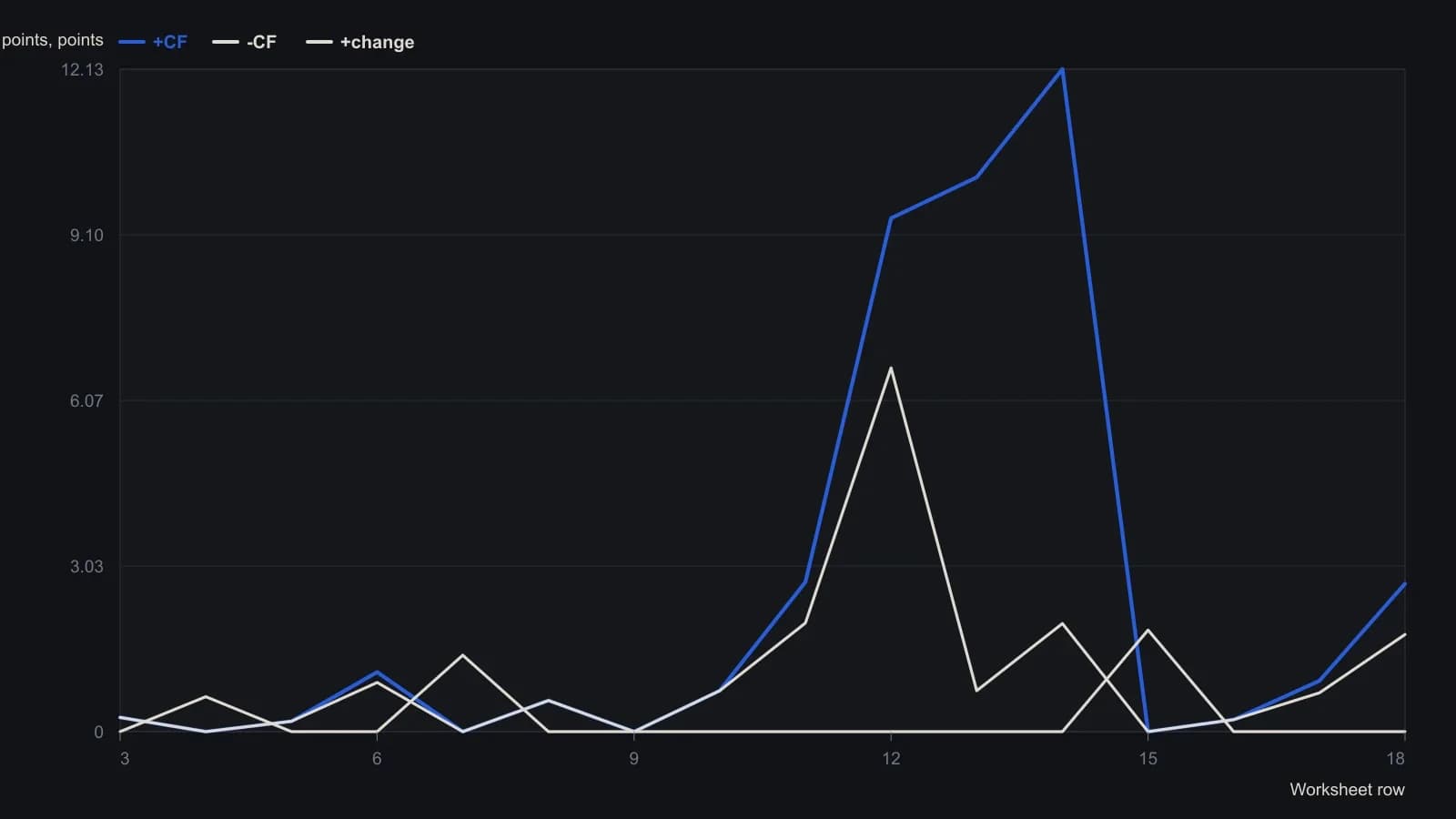
These opening rows predate the 35-day lookback, so the +TCF and -TCF columns are still empty. Isolated down days in this window make -CF equal that day's -change.
Attach a next-open reversal
The associated rule goes long at the next session's open after a positive reading on the positive factor. It goes short at the next open after a positive reading on the negative factor. Under the reversal-holding rule, the existing side is held until the opposite factor turns positive. The position is not flattened merely because both factors are negative.
Keep yesterday's position until the opposite side turns
Spreadsheet position logic maps a positive reading on the positive factor to long, a positive reading on the negative factor to short, and otherwise keeps yesterday's position. An entry price is written only when that state changes, and it uses the next session's open.
Apply one lookback to every market
The same lookback and reversal rules were applied as a one-contract-per-signal procedure across 15 markets from 4 January 1982 through 31 December 1998. A fixed cost of 75 was subtracted from each trade, and any remaining open trade was flattened at the final close. That shared-parameter basket uses one lookback and one rule set on every market so the construction is not refitted market by market.
Recheck nearby window lengths
Robustness checking reused the identical entry, exit, and cost rules while substituting lookbacks of 25, 30, 40, and 45 sessions in place of the 35-session default. The point was to inspect whether that default was unique to one fitted length.
The reported procedure did not include protective trailing stops. Those stops and separate money-management rules were described as optional later layers rather than part of the core construction.
All readings on this track · 51 readings
- 1986Degrees of freedom in trading system optimization
- 1988Walk-forward and neighborhood tests after optimization
- 1988Undisclosed rules block system robustness tests
- 1988Testing re-optimization calendars against random parameter controls
- 1989Binary search limits on multi-peak average grids
- 1989Parameter neighborhoods that survive a shift
- 1990Use profit mapping to keep a cycle and stop plateau
- 1990Why popular indicator optimization fails robustness
- 1991Retesting weighted indicator balances across horizons
- 1992Constructing forecast models with regression, walk-forward, and robustness
- 1992Diagnose regimes before you lock parameters
- 1992When stops change system timing
- 1993Walk-forward halt rules for forecast models
- 1994Walk-forward evaluation of genetic index rules
- 1995Input pruning as walk-forward system evaluation
- 1995Critiquing neural nets as incomplete trading systems
- 1996Rebuild the equity-path ratio before it ranks a designed system
- 1996Parameter grids can fit random walks
- 1996Walk-forward analysis belongs in the design of a mechanical trading system
- 1997When a holdout fails, discard the rule set
- 1997Test rewarded rule breaks before replacing the system
- 1997Walk-forward rules keep system research from rewriting live trades
- 1999Keep a channel-breakout to two lookbacks and test neighbor stability
- 1999Constant investment size in stock system evaluation
- 2000Forcing optimization maps mechanical system failure boundaries
- 2000Robust parameter selection with surface charts
- 2001A two-gate classroom test for a two-window momentum trend filter
- 2002How a two-sided continuation factor becomes a testable trend rule
- 2002Evaluating two-window trend intensity as a reversal rule
- 2003Discounting speculative bubbles in system robustness tests
- 2003Walk-forward evaluation of locked stochastic oscillator rules
- 2003Critiquing mechanical system design after extreme price regimes
- 2004Evaluating a two-window trend trigger
- 2005Grade backtested signals with holdouts and optimization plateaus
- 2006Reserved-sample evaluation of trading system design
- 2006Walk-forward critique of hindsight crossover systems
- 2008Condition-matched walk-forward evaluation for mechanical systems
- 2011Session-split evaluation of regular and overnight systems
- 2012Walk-forward evaluation as operator rehearsal
- 2013Two-window evaluation of mechanical trading systems
- 2013Walk-forward filter selection for repeated-median velocity
- 2014Walk-forward evaluation for fading-memory velocity systems
- 2015Test oscillator events before tuning rules
- 2016Walk-forward evaluation of a five-parameter parabolic stop-and-reversal
- 2016Walk-forward optimization without curve fitting
- 2017Optimization without overfitting in trend-system evaluation
- 2017Parameter stability is a better guide than a larger crossover grid
- 2018Point-in-time universes for system evaluation
- 2018Walk-forward robustness evaluation for optimized systems
- 2018Critiquing breakout systems through robustness tests
- 2018A critique of parameter fitting in system design