1990issue C041-4
Constructing a signed-range negative volume line
The construction writes a signed session-range increment, then books that value on a running on-balance line only when session volume is below the prior day's volume. Unchanged closes skip the increment, and the intermediate term is a four-to-six-week horizon.
- On an up close, the increment is the distance from the absolute low to that close, then multiplied by 100. On a down close, the increment is the distance from the close to the absolute high, then multiplied by -100.
- The absolute low is the smaller of the session low and the previous close. The absolute high is the larger of the session high and the previous close.
- Unchanged closes are omitted from the signed-range step, while volume is still recorded. The negative volume index updates the on-balance line only when session volume is below the prior day's volume, regardless of that day's price change.
- The construction defines its intermediate-term horizon as a period of four to six weeks.
What the line is
A negative volume index is a cumulative line that books a signed price-range value only on sessions when volume is lower than the prior session.
On-balance volume is a running total that adds or subtracts each booked increment to form one continuous line.
Volume-price analysis pairs a price-range measurement with a volume filter so the line reflects buying and selling pressure on quieter sessions.
The signed session-range increment
On an up close, the increment is the distance from the absolute low to that close, then multiplied by 100. The absolute low is the smaller of the session low and the previous close, and it is the origin of the up-close range.
On a down close, the increment is the distance from the close to the absolute high, then multiplied by -100. The absolute high is the larger of the session high and the previous close, and it is the origin of the down-close range.
Unchanged closes are omitted from the signed-range step, while volume is still recorded on those days.
The declining-volume gate
The negative volume index updates the on-balance line only when session volume is below the prior day's volume, regardless of that day's price change.
Each booked increment is the signed absolute-range value, added to or subtracted from a running on-balance total on those lighter-volume days.
Horizon and weekly plot
The construction defines its intermediate-term horizon as a period of four to six weeks. Intermediate-term, here, means that four-to-six-week horizon.
The weekly close of the constructed line was plotted against the cash index because two nearby futures contracts were active in the chart window.
Signed-range negative volume index on S&P futures
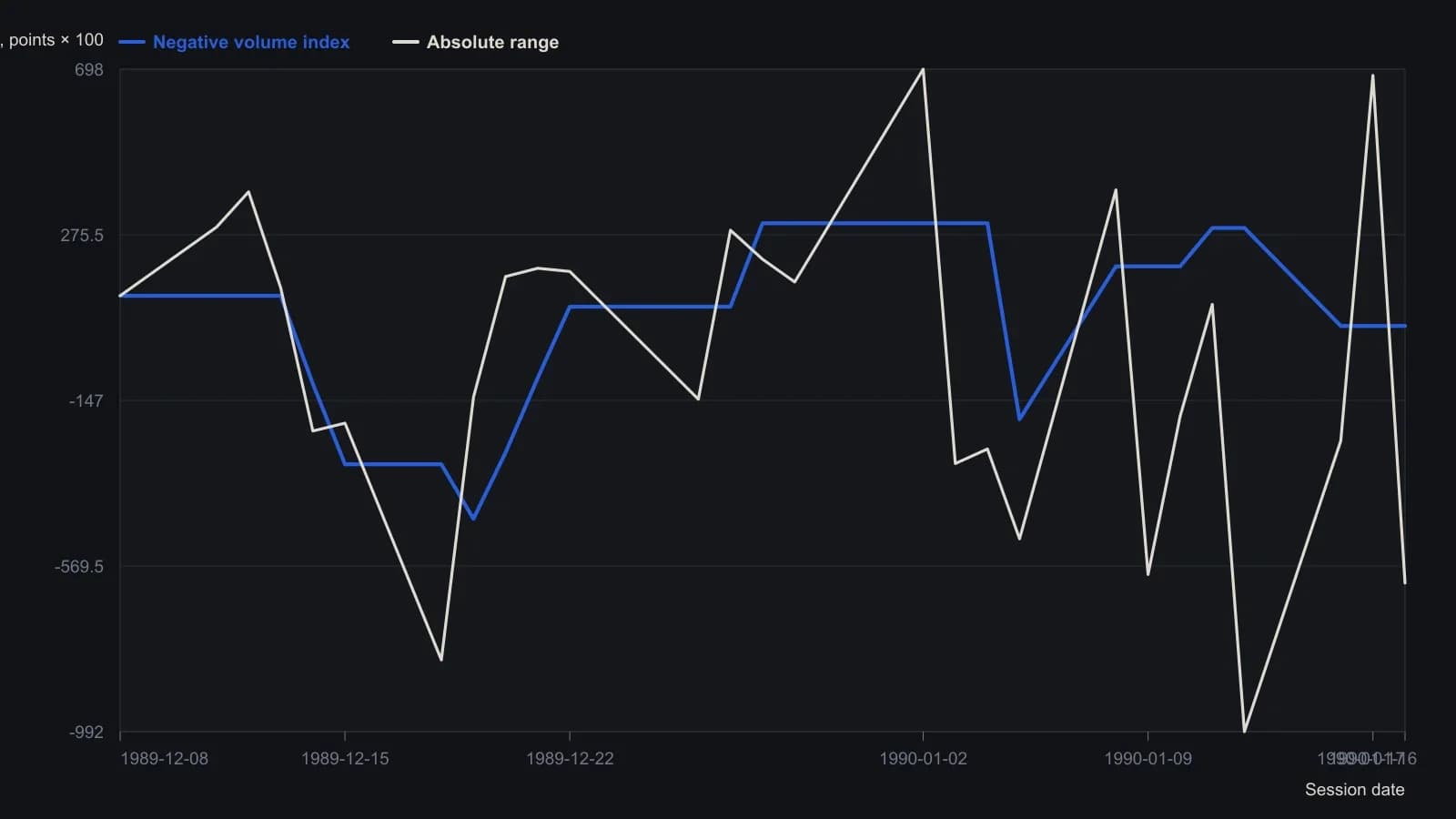
Unchanged closes skip the increment. The running total updates only when volume is strictly below the prior session. The printed worksheet scales an up-day as (close − min(low, prior close)) × 100 and a down-day as −100 × max(prior low − close, high − close).
All readings on this track · 9 readings
- 1986Volume confirmation, the negative volume index, and divergence
- 1990Constructing a signed-range negative volume line
- 1990When quiet-day breadth fails a horizon test
- 1994Stacking scored filters into a hierarchical stock outlook system
- 1996Constructing volume-split and advance-decline breadth signals
- 1996Constructing on-balance volume, volume-price analysis, and the negative volume index
- 1996Constructing volume disparity from percent-b
- 1996Constructing a price-volume percent-B disparity
- 2003Constructing a negative volume index as a moving-average regime test