1992issue C061
Constructing TRIX as triple-smoothed log-price momentum
TRIX is built as a short pipeline: convert the input to log-price, apply three exponential-smoothing stages that share one alpha, then take the one-period-difference of the third smooth so the finished series can be read as momentum.
- TRIX is constructed as an oscillator intended to display changes in momentum while damping erratic fluctuations in the input series.
- The build applies three successive exponential smoothers to log-price and then takes the one-period-difference of the third smooth.
- Each stage uses an alpha equal to two divided by one plus a chosen equivalent simple-average length, so changing that length changes sensitivity and is presented as a way to match a sampling horizon.
- A rising finished reading is treated as upward momentum and a falling reading as downward momentum, while the stacked smoothers are treated as a cycle-filter for fluctuations shorter than the selected length.
A momentum oscillator with a fixed build order
TRIX is constructed as an oscillator intended to display changes in momentum while damping erratic fluctuations in the input series.
In this construction, trix means a momentum oscillator built by applying three successive exponential smoothers to log price and then taking the one-period change of that final smooth.
Log-price, then three exponential stages
The first transform is log-price, the logarithm of the input price series, used before any smoothing stage.
The build then applies three successive exponential smoothers. Exponential-smoothing is a recursive blend of the latest observation with the prior smooth, controlled by a constant weight.
After the third smooth, the finished TRIX reading is the one-period-difference: the day-to-day change of that third smooth.
A spreadsheet scale for the finished series
In the worked spreadsheet layout, that one-period change is scaled by 10000 so the finished series is easier to read.
TRIX as the scaled one-day change of the third exponential smooth
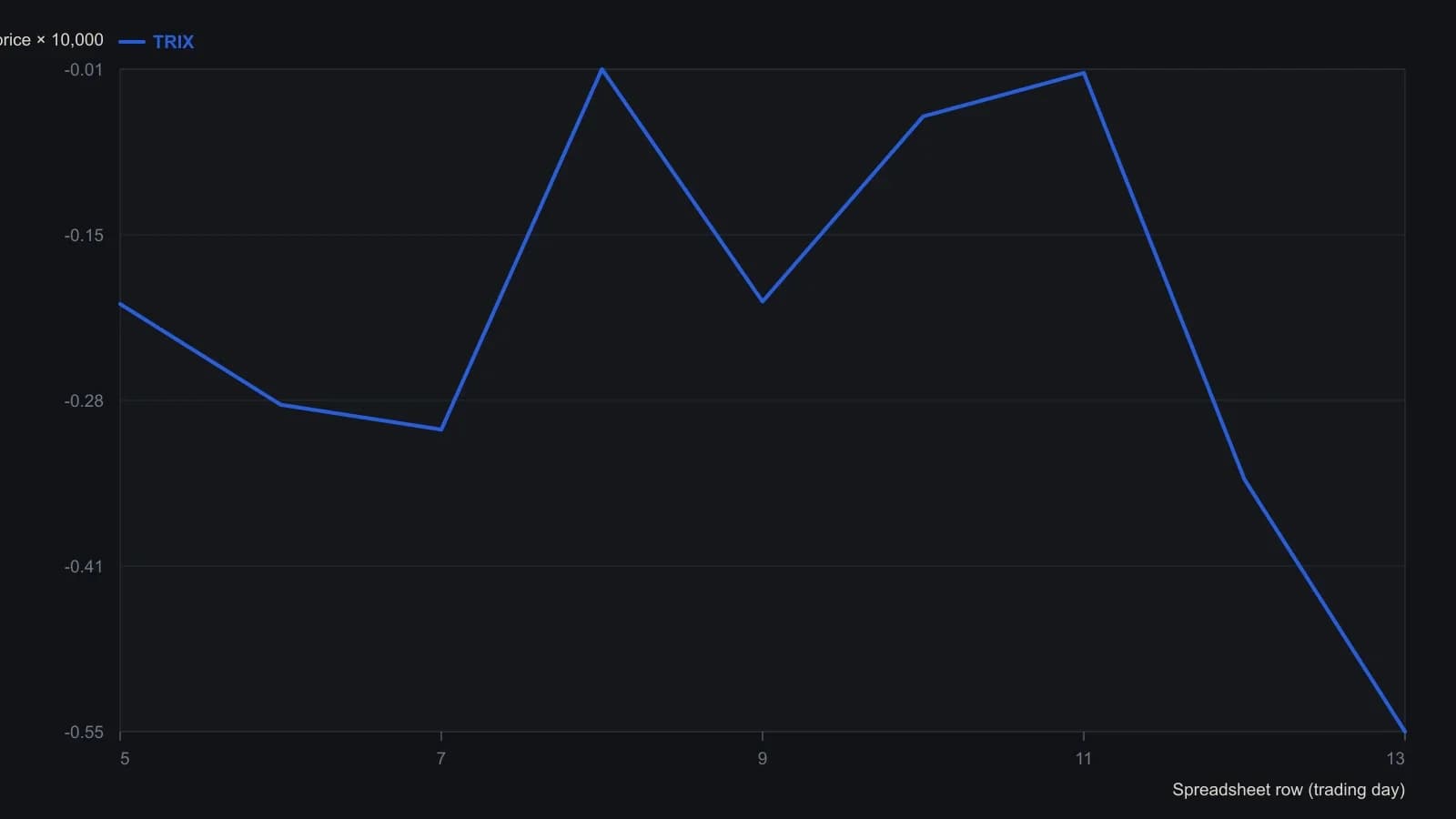
Alpha is locked to an equivalent 21-day average via 2/(K2+1), which the source states as 0.090909. The first three smooth columns are seeded from the log-price itself; TRIX is (F_t − F_{t−1}) × 10,000.
Alpha locked to an equivalent average length
Each exponential stage uses the same alpha. Alpha is the smoothing weight, set equal to two divided by one plus a chosen equivalent simple-average length.
When that equivalent length is set to 21, the resulting smoothing weight is 0.090909.
Changing the equivalent-length input changes indicator sensitivity and is presented as a way to match a chosen sampling horizon.
Reading slope and the cycle-filter role
Momentum direction is read from the slope of the finished series. A rising reading is treated as upward momentum and a falling reading as downward momentum.
Because the triple smooth is treated as a cycle-filter, fluctuations shorter than the selected length are intended to be removed. Cycle-filter here means the effect of stacked exponential smoothers that attenuates those shorter fluctuations.
All readings on this track · 15 readings
- 1984Constructing TRIX from a cutoff to one shared alpha
- 1988Isolate nested formulas before judging signals
- 1992Constructing TRIX from triple exponential smoothing
- 1992Constructing a TRIX oscillator from daily declines
- 1992A pre-trade checklist that stays flat until weekly support and TRIX agree
- 1992Constructing TRIX as triple-smoothed log-price momentum
- 1992Building TRIX crossover and momentum entries on a period grid
- 1992TRIX lookback and momentum derivative parameters
- 1994Seeding TEMA and DEMA with time-trend regression
- 1997Constructing the TRIX oscillator from triple smoothing
- 2002Constructing TRIX from triple-smoothing to signal rules
- 2002Lock the TRIX construction before reading a zero-line cross
- 2003Constructing TRIX from nested exponential averages
- 2004Construct TRIX entry, exit, and rest windows as one recipe
- 2004TRIX momentum and fundamental overlays for medium-term stock selection