2010issue C0330-33
How a price-hugging smoother is assembled from ordinary averages
A simple moving average cannot change its window when a series speeds up or slows down. This archive article shows how a McGinley dynamic is assembled from ordinary moving-average and exponential-smoothing parts so the line can hug prices and follow both fast and slow markets.
- A simple moving average is a fixed-length smoother of ordered prices and cannot change its window as the series speeds up or slows down.
- Exponential smoothing updates a prior trend with the latest observation using the constant 2/(n+1), so a 19-day average is a 10 percent trend.
- The McGinley update is prior dynamic plus the index-minus-dynamic gap divided by N times the fourth power of the index-to-dynamic ratio.
- The construction goal is a smoother that hugs prices, reduces whipsaws, and follows both fast and slow markets instead of acting as a signal generator.
Fixed windows and ordinary averages
A simple moving average is a fixed-length smoother of ordered prices. It needs a full window of past points and cannot change its length as the series speeds up or slows down.
A moving average is a rolling smoother of ordered prices or breadth that flattens a series over a chosen lookback. Two named problems of ordinary averages are inappropriate application and overuse, including being outrun by raw data when they are treated as trading systems.
EUR/USD daily rate and its 10-day simple moving average
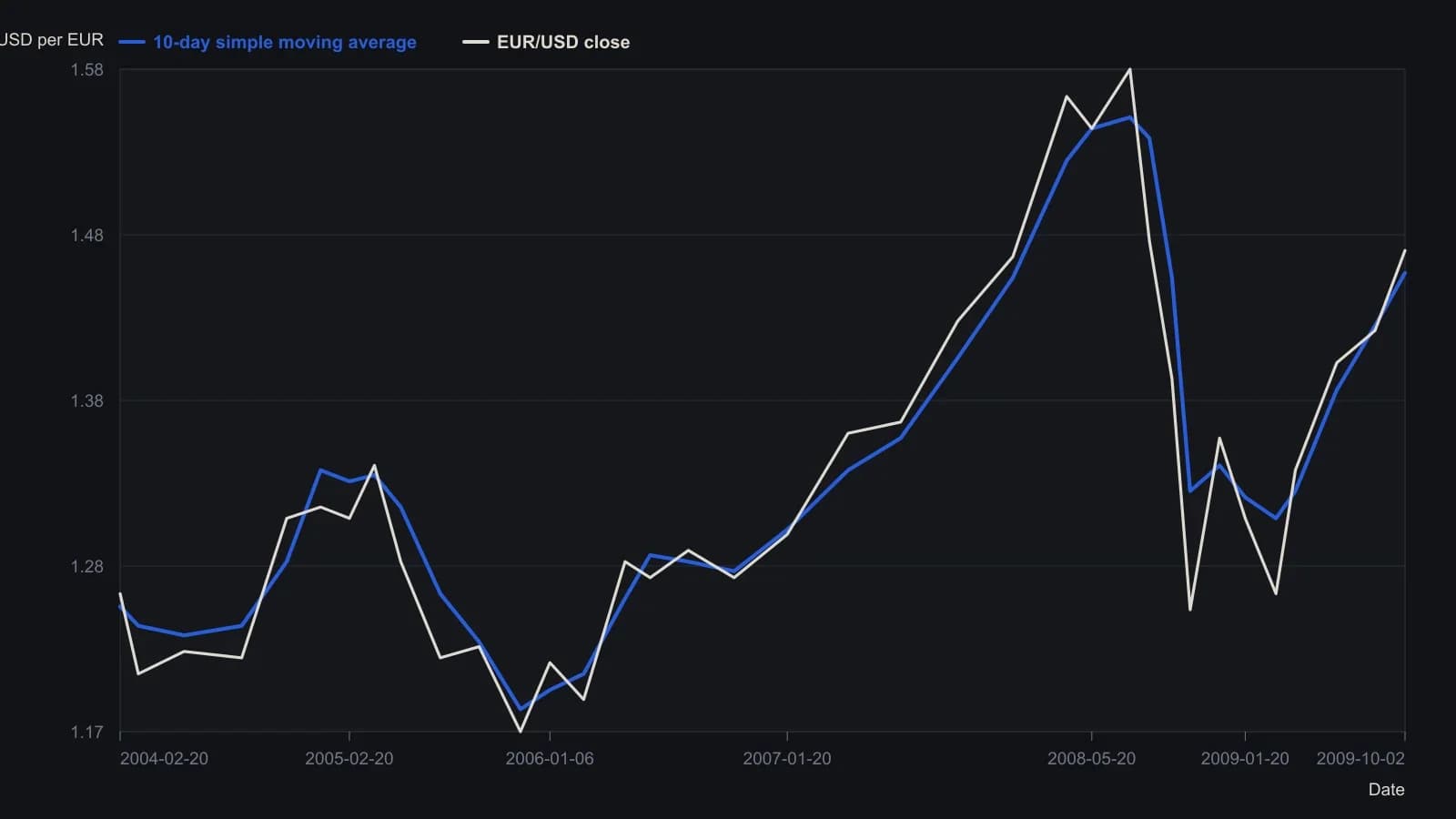
Window is the 10-day simple average drawn on the source chart. Levels are read from that raster against the printed 1.15–1.60 EUR/USD scale, so turning-point heights are approximate.
Exponential smoothing as a two-input update
Early moving-average practice treated fitting lines and graduation as ways to interpolate ordered series, later joined by exponential inventory-control smoothers.
Exponential smoothing updates a prior trend with the latest observation using the constant 2/(n+1). That smoothing constant is the weight that turns an n-day exponential average into a percent-of-trend update, so a 19-day average is a 10 percent trend.
Assembling the McGinley dynamic
An adaptive moving average is a smoother whose update speed changes with the current price-to-line ratio instead of staying a fixed length.
The McGinley update is prior dynamic plus the index-minus-dynamic gap divided by N times the fourth power of the index-to-dynamic ratio. The n-parameter is the user-chosen speed constant that keeps the McGinley update inside a percentage band.
The fourth-power ratio is the adjustment that lets the line accelerate, especially on downward moves, by enlarging the gap between the line and current data.
Built to hug prices, not to signal
The construction goal is a smoother that hugs prices, reduces whipsaws, and follows both fast and slow markets instead of acting as a signal generator. A whipsaw is a false turn created when a smoother lags or overshoots raw prices.
All readings on this track · 24 readings
- 1991Building variable-length moving averages from partitioned price changes
- 1991Variable-length moving average from change dispersion
- 1992Constructing volatility-adaptive exponential smoothing
- 1995Constructing an adaptive moving average with an efficiency ratio and filter
- 1995Two-gate breakout confirmation with adaptive averages
- 1995Building momentum-scaled adaptive moving averages
- 1995Adaptive length as a construction choice inside exponential smoothing
- 1998Testing price-channel breakouts with a lag-aware adaptive average
- 1998Constructing filters by nesting offsets and variable weights
- 1998Constructing an efficiency ratio adaptive average and entry filter
- 2001Encoding candle structure as a numeric filter
- 2001Adaptive averages driven by cycle-phase speed
- 2005Constructing an adaptive moving average from a fractal-dimension weight
- 2005Range-dimension adaptive exponential filter
- 2010Constructing simple, exponential, and adaptive averages
- 2010How a price-hugging smoother is assembled from ordinary averages
- 2013Evaluating an adaptive moving average against a same-window moving average
- 2016Three-layer confirmation: adaptive average, stochastic relative strength index, and stop-and-reverse
- 2017One-alpha reverse-path exponential smoothing
- 2018Pair two adaptive averages to filter swing turns
- 2018Two Adaptive moving averages as a confirmation pair
- 2018Constructing an adaptive filter for adoption-cycle reversals
- 2018Constructing a deviation-scaled adaptive moving average
- 2020Walk-forward and adaptive averages as two tests of the same trend