1994issue C041-11
Cycle-tuned momentum with spectral peaks
Momentum becomes a two-frequency design when a Fourier power spectrum isolates a dominant cycle and a faster trigger cycle, then a stacked first-difference filter and a local weighted-average check lock to those peaks. Entries, exits, and waits can then be written as one procedure.
- Momentum can be an absolute period-to-period difference or a relative ratio, and both forms are often combined with moving-average filters.
- A Fourier power spectrum isolates a dominant-cycle and a faster trigger-frequency so momentum-filter lengths can be tuned to those peaks, while weaker higher peaks are treated as noise.
- Weighted, simple, and exponential averages leave long-cycle power nearly intact, cut higher-frequency power, and add low-frequency lag that grows roughly linearly with frequency.
- The momentum-strategy delays a buy or sell from the stacked wami until a local weighted-moving-average, sized to match trigger lag, agrees with the turn.
A two-frequency design
Editorial reading: treat momentum as a two-frequency design problem. Read a price series as a dominant-cycle plus a faster trigger-frequency, then lock a stacked filter and a local trend check to those peaks so entries, exits, and waits become one testable procedure.
Momentum can be measured as an absolute period-to-period difference or as a relative ratio, and both forms are often combined with moving-average filters.
Sine waves versus phase angle
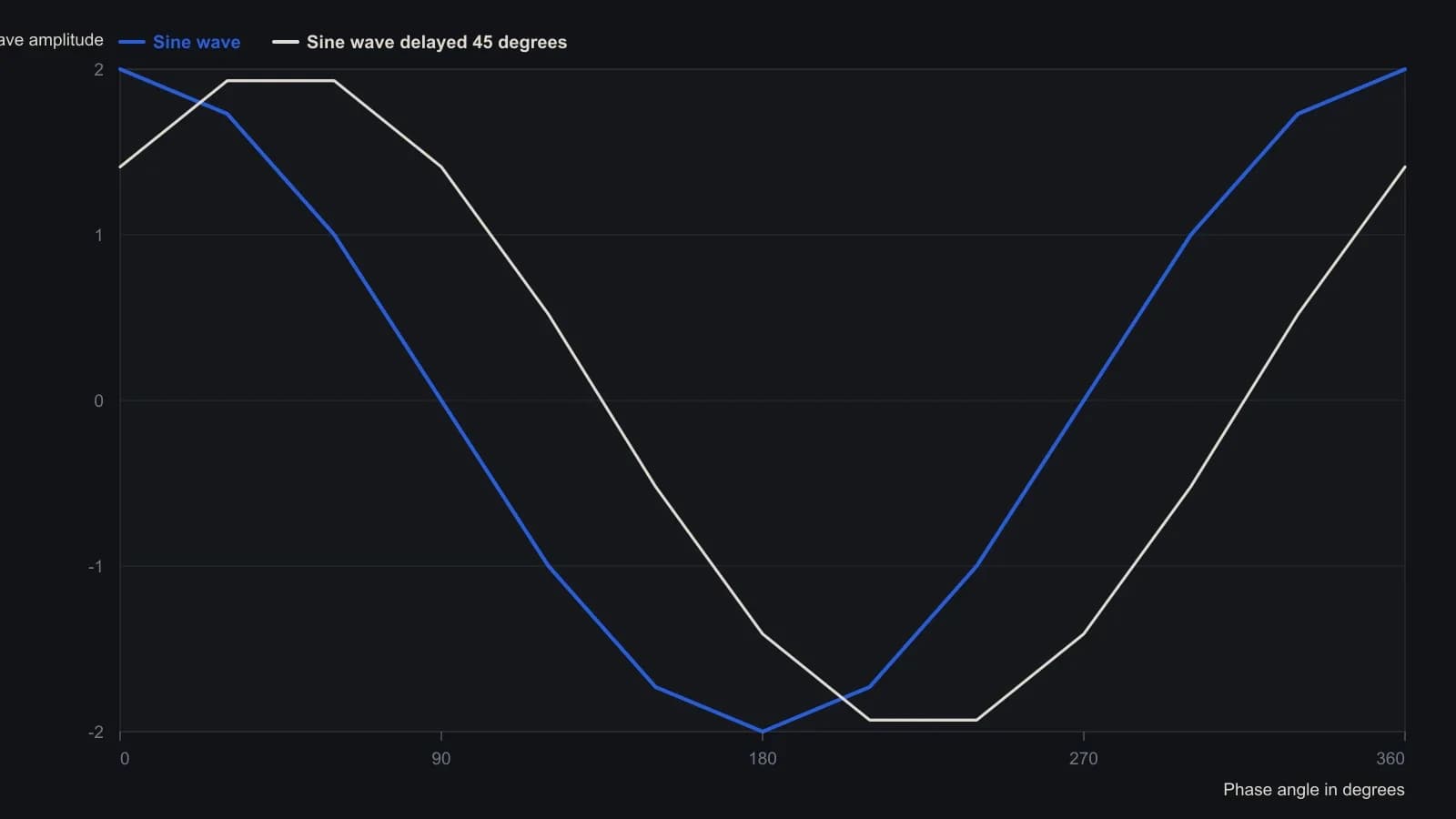
The source states maximum amplitude A = 2.0 and a 45-degree phase delay; points are sampled from the plotted curves at the 30-degree vertical bars.
Read the two peaks first
Spectral analysis is a Fourier power-spectrum read of ordered prices that isolates a dominant-cycle and a faster trigger-frequency for parameter choice. The dominant-cycle is the highest-power usable frequency band after the zero-frequency leftover is set aside. The trigger-frequency is the next meaningful higher-frequency peak used to time turns near cyclic tops and bottoms.
Cycle length and frequency are inverse: L equals 360 divided by F. A 30-degree-per-week wave completes in 12 weeks, and a 10-degree-per-week wave completes in 36 weeks.
The same two-peak reading
On 71 weekly Montana Power bars, the dominant usable peak is about 13 degrees per week, or 28 weeks, and the trigger peak is about 29 degrees per week, or 12.5 weeks. Higher, weaker peaks are treated as noise for tuning.
The same two-peak reading appears on other series: a 120-week bond-fund spectrum at about 7 and 15 degrees per week, and a 50-week metals-fund spectrum at about 8 and 34 degrees per week.
What a linear filter does to a cycle
A linear filter applied to a sine wave of frequency f multiplies amplitude by a frequency-dependent gain and adds a frequency-dependent phase shift.
Weighted, simple, and exponential moving averages leave long-cycle power nearly intact while cutting higher-frequency power. At low frequency they add lag that grows roughly linearly with frequency.
Stack the oscillator, then wait for the short trend
Once the two cycle peaks are known, the stacked momentum formula can be written as successive weighted and exponential moving averages of the first price difference, using the optimized lengths L, M, and N. That stack is the wami: a first-difference plus weighted and exponential smoothers whose lengths are chosen from the two identified cycles.
A weighted-moving-average is a local weighted smoother used as a trend-consistency check so a momentum signal is delayed until the short filter agrees. A local weighted-average length is chosen to match trigger lag: NWMA equals 3p over F2 plus 1. With p of 50 and F2 of 29 that length is 6. A sell is delayed until that local trend is down, and a buy is delayed until that local trend is up.
One procedure for entry, exit, and wait
A momentum-strategy is a complete procedure that turns a cycle-tuned oscillator and a local trend check into entry, exit, and wait rules.
Editorial note: after the two peaks are read, the wami lengths and the local weighted-moving-average length are fixed by those frequencies. The archive workflow can then be handled as a single procedure rather than as a pile of unrelated knobs.
All readings on this track · 20 readings
- 1988Indicator smoothing: lookback, weight, and scale
- 1990Recency weighting in simple, linear, and exponential moving averages
- 1990Seed and recurrence construction for moving averages
- 1990Constructing a five-day step-weighted moving average
- 1992Constructing simple, weighted, and exponential moving averages
- 1992Constructing moving averages with weighting schemes and extra filters
- 1992Constructing a weighted-average TRIN10 with Bollinger envelopes
- 1992Constructing a banded weighted open-TRIN oscillator
- 1993Evaluating a weighted dual rate-of-change momentum filter
- 1993Constructing equal, linear and exponential moving averages
- 1993Constructing a general weighted moving average from one exponent
- 1993Calibrating the weighted-moving-average exponent
- 1993Constructing an exponent-weighted average of put-call ratios
- 1994Cycle-tuned momentum with spectral peaks
- 1999How a five-bar sine-weighted average is assembled
- 2003Same-scale trend filter from a rolling least-squares endpoint
- 2003How a rolling linear-regression endpoint is assembled as a moving-trend
- 2004Constructing a volume-weighted moving average as a forecast baseline
- 2005Constructing a move, volume and recency weighted average
- 2016MACD as a zero-line filter with dual moving averages