2001issue C041-5
Momentum trendline breaks need price confirmation
Treat a momentum oscillator as a second chart with its own momentum-trend. Grade each trendline by length, touches, and slope, keep divergence as a separate reading, and leave a rate-of-change break unfinished until price-confirmation appears.
- Apply the same trendline tools used on price to the oscillator series and read that path as a momentum-trend.
- Grade a trendline by length, how often it is touched or approached, and slope, treating steeper lines as less sustainable.
- Keep divergence, a split between price direction and oscillator direction, separate from judging the oscillator's own trend.
- Treat a rate-of-change or other momentum break as an unfinished hypothesis until independent price-confirmation appears.
The oscillator as a second chart
Momentum oscillators trend in the same way price does, so the same trend-identification tools used on price can be applied to the oscillator series.
Editorial interpretation: treat that series as a second chart. Its momentum-trend is the directional path of the oscillator itself, not only an overbought or oversold reading.
Standard readings and the extra technique
Standard oscillator readings include overbought and oversold conditions and divergence. Analyzing the trend of the oscillator is an additional interpretive technique.
How to grade a momentum trendline
A trendline is a straight line across successive peaks or troughs on price or on a momentum series. A penetration marks a candidate trend change in that series.
A trendline's importance is judged by its length, how often it is touched or approached, and how steep it is, with steeper slopes treated as less sustainable.
A more significant momentum trendline raises the chance of an important price reversal, especially when the matching price trendline is equally well defined. The momentum break typically appears first.
Keep divergence as a separate reading
Divergence is a split between price direction and oscillator direction. It is a standard momentum reading and is distinct from judging the oscillator's own trend.
Editorial interpretation: score divergence on its own. A trendline drawn on the oscillator is a claim about the momentum-trend, not a substitute divergence reading.
Wait for price-confirmation
A reversal in the trend of momentum is usually, but not always, associated with a similar reversal in price.
A trendline across successive oscillator peaks or troughs, matched with a price trendline break, is used to confirm a likely trend change or at least a consolidation.
Editorial interpretation: a rate-of-change or other momentum break remains an unfinished hypothesis until price-confirmation appears. That confirmation is an independent price-trend break, average cross, or completed price pattern, and only then is the event treated as a market-trend change.
Patterns on the oscillator still wait for price
Classic chart patterns can form on oscillators, but they remain momentum reversals until a price break confirms them. They usually give earlier warning than price.
A momentum-pattern breakout near an extreme is less trustworthy. Upside completions well above the equilibrium line and downside completions well below it are treated as weaker signals.
Rate-of-change and other jagged oscillators
Rate-of-change is a jagged momentum oscillator that measures how far price has traveled over a lookback and can itself carry trendlines and chart patterns.
Rate-of-change and similarly jagged oscillators display constructible trendlines more often than smoother series. Even then, usable lines are uncommon.
German DAX and 52-week ROC, 1992–1997
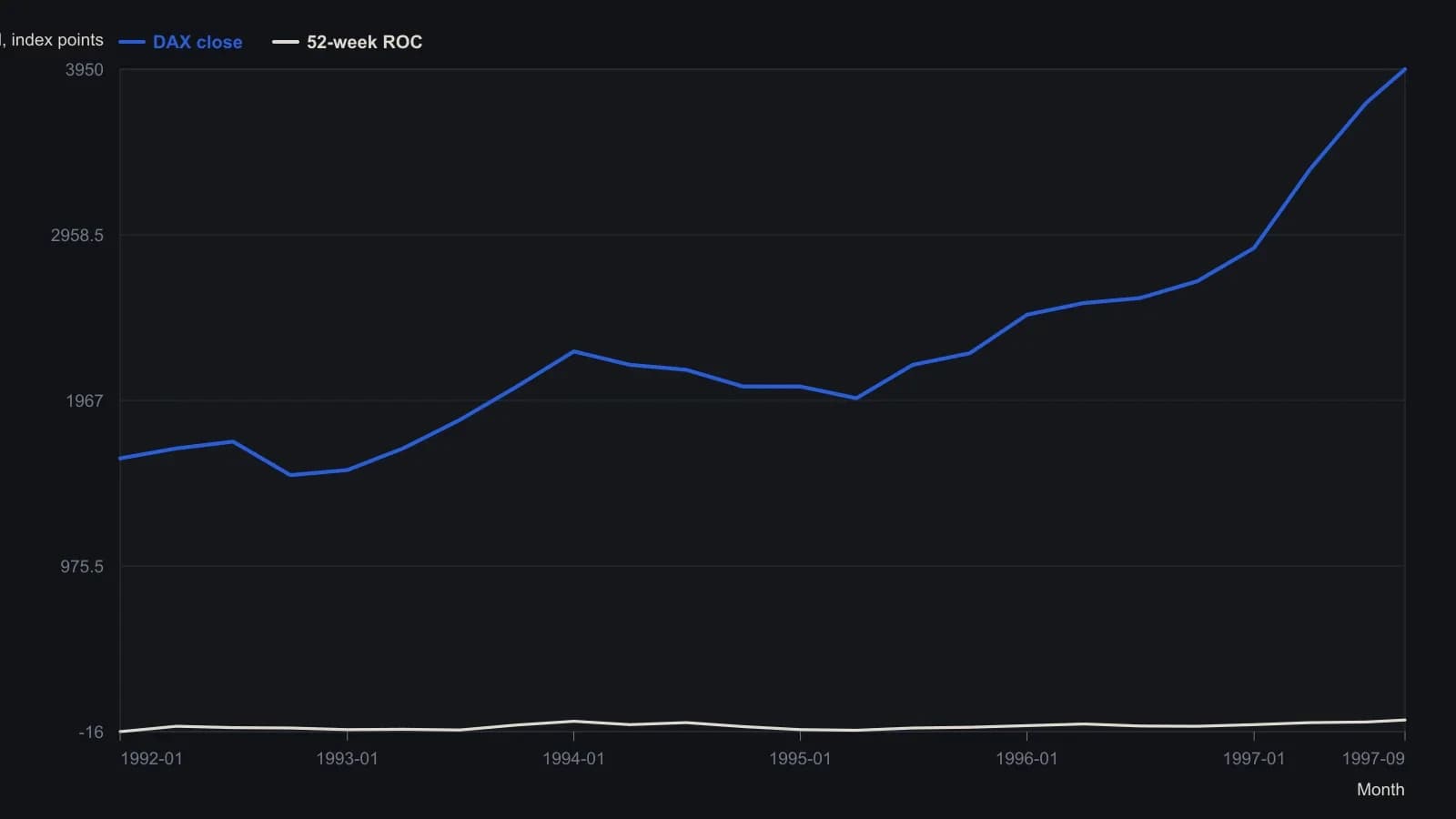
Coordinates are approximate readings from the printed raster; the 52-week ROC is the smoother lower pane. Colored construction lines on the source figure are not plotted.
All readings on this track · 46 readings
- 1985Constructing excess and momentum difference-curve oscillators
- 1988Five reading rules for smoothed indicator charts
- 1989Momentum overlays that speed moving-average oscillators
- 1990A laboratory template that constructs Rate of Change as a pane module
- 1991Volume-scaled rate of change as a momentum construction
- 1991Three-indicator market overview from tape, sentiment and rates
- 1991Three-component trend model with rate-of-change filters
- 1992A KST oscillator from a weighted rate-of-change stack
- 1992Four-window weighted rate-of-change composite
- 1992Constructing multi-span smoothed rate-of-change filters
- 1992Constructing a four-horizon summed rate of change
- 1992Constructing KST from four weighted smoothed rates of change
- 1992Constructing a composite from weighted smoothed rates of change
- 1992Three-horizon KST maturity alignment
- 1992Construct a bond-led dividend-to-bond-yield regime first
- 1992Constructing relative-strength KST from weighted rate-of-change
- 1993Constructing a volume oscillator from average ratios and smoothed rate of change
- 1994Gold as a cycle clock for commodities and yields
- 1994Constructing a composite from weighted, smoothed rate-of-change windows
- 1994Constructing gold-mining rate-of-change tripwires for Treasury bonds
- 1994A capacity-stress checklist across commodities, bonds, and breadth
- 1994Rate of change parameters for testable entries
- 1994Constructing rate-of-change midpoints, lookbacks and divergence
- 1994Lead oscillator breaks need price trendline confirmation
- 1994Nested averages for an annual momentum curve
- 1994Evaluating a Coppock-style rate of change as a bottom-regime filter
- 1995A weighted eleven-month Dow rate of change as one testable timing procedure
- 1996Named lookbacks, thresholds, and streaks for entry rules
- 1997A midpoint rate-of-change test for bond trend follow-through
- 1997Constructing a short-rate-adjusted equity momentum filter
- 1998Daily momentum rank-churn as a portfolio-construction problem
- 1999Constructing a lagged rate of change cycle system
- 2000A triple delay line then a one-bar elliptic oscillator
- 2001Confirming rate of change divergences with price
- 2001Momentum trendline breaks need price confirmation
- 2001Market breadth, On-balance volume, and Rate of Change as a combined timing framework
- 2001Know Sure Thing with stacked horizons and trendline confirmation
- 2003Constructing a mechanical system from a rate of change condition
- 2003Constructing momentum from two closes and spotting divergence
- 2003Formula choice tilts which momentum mismatches count as divergences
- 2004RSI and momentum agreement as an asymmetric filter
- 2005Constructing price-normalized moving-slope hybrids
- 2005Unsigned speed gates on a fixed average-cross pair
- 2007Rebuilding rate of change as a path-weighted oscillator
- 2008Construct Special K so short-horizon signals stay inside the primary trend
- 2013Restore volume balance before adding another price-time indicator