2013issue C0959-61
Constructing paired percent-b and stochastic swing oscillators
The archive specifies a modified percent-b together with a smoothed-stochastic, including a slow %K form, as the fifth installment of a seven-part sequence of indicator rules for a swing-trading strategy. Fast and slow variants are decision-support outputs inside a trading-system procedure, with coded series, a spreadsheet of parameter-controls, and several chart overlays used to inspect the pair.
- A modified percent-b is specified together with a smoothed-stochastic, including a slow %K form.
- The pair is the fifth installment of a seven-part sequence of indicator rules for a swing-trading strategy, with fast and slow variants as decision-support outputs.
- One coded construction takes four input parameters, stores intermediate results in 24 series-type instrument variables, and fills those series through a bar-by-bar-update.
- A spreadsheet places the two oscillator calculations across 32 columns and isolates parameter-controls from derived results so the same columns can be re-run under alternative parameters.
The specified oscillator pair
A modified percent-b oscillator is specified together with a smoothed-stochastic, including a slow %K form. Percent-b is a Bollinger-based oscillator that places the latest price inside an envelope built from a moving average and a multiple of dispersion. A smoothed-stochastic is a stochastic calculation whose %K is lengthened or averaged so the output moves more slowly than a raw fast stochastic.
The oscillator pair is presented as the fifth installment of a seven-part sequence of indicator rules for a swing-trading strategy. Fast and slow oscillator variants are specified as decision-support outputs inside a trading-system procedure. Those variants form a fast-and-slow-pair: two related oscillator calculations that share a construction family but use different smoothing or lookback settings.
Coded series and a bar-by-bar update
One coded construction takes four input parameters and stores intermediate results in 24 series-type instrument variables. Those four inputs act as parameter-controls: user-editable lookback and averaging inputs that rebuild the same oscillator series without changing the formula layout.
Series used as plotted indicators must have plotting enabled, with a chosen color, line style, and a separate pane label when they are not overlaid on price. Indicator values are computed in an update pass that runs once on each bar of a test and accumulates each series bar by bar. That pass is a bar-by-bar-update: each indicator series is recalculated once per completed bar so historical values accumulate in sampling order.
Spreadsheet columns and chart inspections
A spreadsheet construction places the two oscillator calculations across 32 columns and isolates editable control values from the derived results so the same columns can be re-run under alternative parameters.
The same pair is shown on a Ford daily overlay of percent-b and slow %K, an intraday German DAX rainbow-series with a Percent-Bollinger preview, a EUR/USD daily oscillator pane, and a US Steel chart of both oscillators. A rainbow-series is a stacked set of successive smooths shown together so an oscillator path can be compared across layers.
A later workbook in the same cumulative series adds a direct historical-data pull that requires a symbol, a from date, a to date, and a data type, while still allowing import from a previously saved file.
Ford daily ZLRB percent-b and slow %K, summer 2010
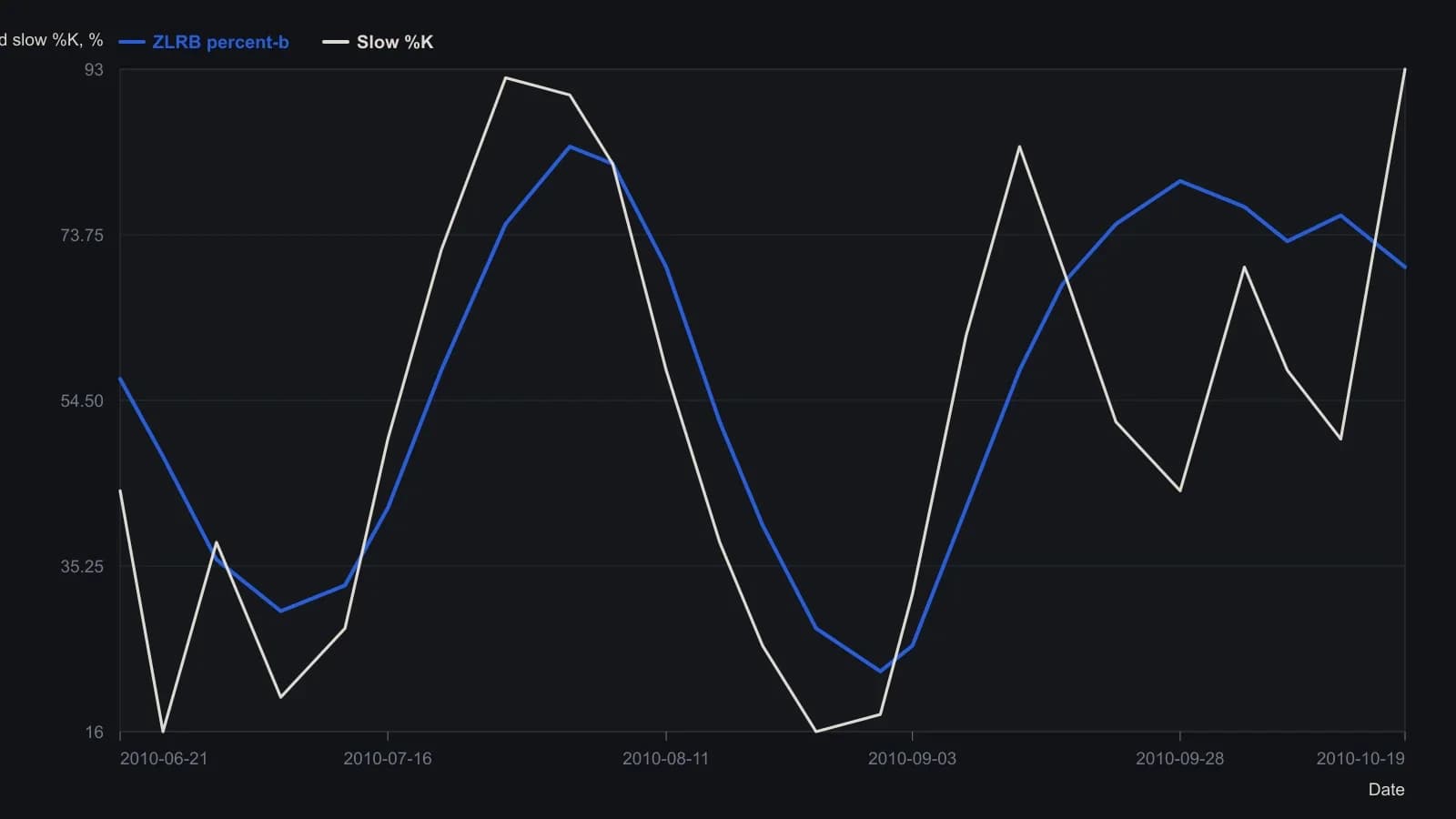
The AmiBroker legend on the last bar reports ZLRBPercB = 70.0586 and SlowK = 93.1946. Intermediate points are digitized from the daily screenshot, so turning levels are only good to a few oscillator units. Averaging length follows the sample chart, not a re-tuned parameter set.
All readings on this track · 35 readings
- 2001Swing trading with trailing stops and fixed loss exits
- 2003Linear regression swing alerts and trailing stops
- 2005Range-width gates for swing entries at base edges
- 2006Beyond setups: a six-factor trading process
- 2007Angle of ascent, chart scale, and style-fit
- 2010Stacking a short-horizon oscillator with a moving average and swing hold rules
- 2010A weekly contest long treated as one swing procedure
- 2011Four-color volume-price states for long-only swing actions
- 2012Classify momentum, velocity, or volatility before the swing signal
- 2013Swing rules as a portable entry and exit procedure
- 2013Constructing paired percent-b and stochastic swing oscillators
- 2013Give the fast band line and the slow stochastic complementary jobs
- 2013Smoothed percent-b divergences for numbered swing-wave rules
- 2013Portable swing rules for candle turns and a 1-2-3 wave count
- 2013A three-average swing and breakout case study
- 2013Constructing swing trades with a fifty-day average and a five-bar exponential average
- 2014From aliasing and dilation to a roofed stochastic swing
- 2014Channel width and trend-filter lookback as separate swing-trading choices
- 2016Constructing volume-confirmed multiday breakout swings
- 2017Constructing swing signals from a volume-weighted average cross
- 2017Golden-cross swing entry with a trailing-stop exit
- 2017One swing procedure: group leadership first, then a volume-price leave
- 2017Four-day green-candle breakout entry as one swing procedure
- 2017Swing pivots need a 100-period crossover and a breakout candle
- 2017Supply and demand zones as bounded swing maps
- 2018Three-bar volume-confirmed swing breakout
- 2018Tight stops first on swing breakouts with a range filter
- 2018Constructing trend and swing rules from horizon to crossover
- 2019Decade-level breakouts as one closed swing procedure
- 2019Inverse-pair swing trading with a shared buy-stop
- 2019Week-range next-day breakout on bitcoin pairs
- 2019Ranking strength before confirming a multi-timeframe breakout
- 2019Forty-five-degree multi-week swing breakout as a closed procedure
- 2020A dual pending-stop pair as one bitcoin swing construction
- 2020High-low activator, directional oscillator, and momentum swing agreement