2000issue C031-3
Lookback length as a construction check for the modified moving average
A published default length of 2 can make a modified moving average plot as the close. A complete build uses a lookback that separates from price and then compares that series with an equal-length simple moving average on the same ordered observations.
- A published default length of 2 for a modified moving average can make the average plot identically to a one-line close-price series.
- A difference between a modified moving average and the underlying price can be recognized once the lookback length is 3 or larger.
- A four-bar simple moving average and a four-bar modified moving average on the same standard price series can reproduce a published construction comparison.
- When platform code does not match published charts, an independent spreadsheet build of the same construction can serve as the verification baseline.
Lookback length is a construction input
A moving average is a lookback smoother of ordered price observations over a defined sampling interval. A modified moving average is a moving-average construction meant to track price more closely than a same-length simple average while remaining a windowed filter rather than the raw close. A simple moving average is an equal-weighted average of ordered price observations over a stated lookback.
Lookback length is the number of sampling intervals in the average window. It is an explicit construction input that can hide or reveal the filter. A published default length of 2 for a modified moving average can make the average plot identically to a one-line close-price series. A difference between a modified moving average and the underlying price can be recognized once the length input is 3 or larger.
A construction check against price and a simple average
A construction check is a side-by-side plot of a candidate average against raw price and against a same-length simple moving average to confirm the smoother is not identical to the close.
A four-bar simple moving average and a four-bar modified moving average applied to the same standard price series can be used to reproduce a published construction comparison. One published illustration of two moving averages used a 10-bar lookback for each series.
Two averages after a mass index flag
After a mass index flags a possible reversal, two moving averages are used to identify the existing trend. In the supplied construction, the mass index is a range-based reversal screen followed by those two averages, which are used to read the existing trend.
A spreadsheet build as the verification baseline
When platform code for a modified moving average does not match published charts, an independent spreadsheet build of the same construction can serve as the verification baseline.
Four-bar modified versus simple average on the standard series
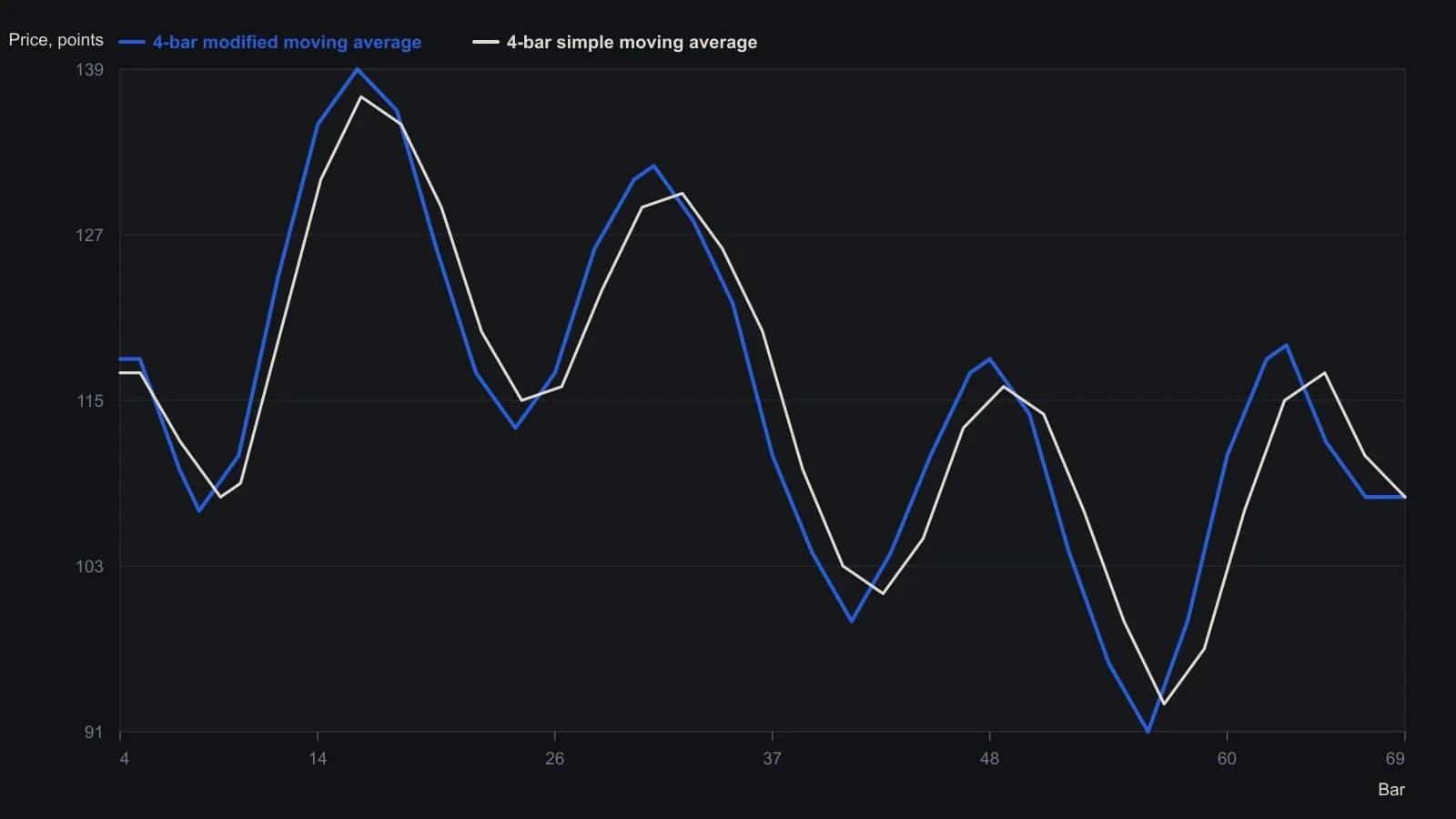
The published default length of 2 makes the modified average plot as the close; this chart uses length 4 so the filter separates from price. The letter notes the two averages in the original Figure 4 were 10-bar.
All readings on this track · 15 readings
- 1990Building a percent-difference moving-average oscillator
- 1991Ease of movement oscillator construction
- 1993A twelve-month moving-average filter for inflation direction
- 1993Constructing two-endpoint JSA moving averages
- 1999Centered moving averages for trend construction
- 2000Constructing a slope-corrected moving average
- 2000Lookback length as a construction check for the modified moving average
- 2001Smoothing balance of market power with a moving average
- 2005Three-state moving-average directional breakout construction
- 2005Constructing a move-adjusted moving average
- 2005Moving-average construction: windows, weights and stops
- 2008Constructing stacked moving-average filters
- 2011Constructing percentage-offset moving-average bands
- 2015Linearity, commutation, and ratio smoothing in moving averages
- 2019Constructing a 50-200 sma-channel for swing entries and exits