1993issue C121-9
Calibrating the weighted-moving-average exponent
A general-weighted-moving-average uses one nonnegative control-parameter-alpha to slide a lookback from equal weights to last-observation reactivity. A historical put-call-ratio series shows why that exponent and the lookback should be chosen together against an explicit statistical target.
- Equal-weight and linearly weighted averages are special cases of one general-weighted-moving-average family.
- The control-parameter-alpha is a nonnegative recency exponent: zero recovers equal weights, one recovers linear weights, and larger values concentrate weight on the newest observation.
- After the lookback is chosen, simple and linear averages freeze the weight schedule, while alpha lets the same family be retuned for a different target, dataset, or market.
- A historical put-call-ratio search selected an optimal-weighted-moving-average by maximizing correlation with the yen-dollar spot rate, and the best alpha changed with lookback.
Equal weights and linear weights in one family
A moving-average is a lookback filter that replaces an ordered run of price, volume, or breadth observations with one summary value at each sampling step. A simple moving average is the arithmetic mean of those observations over a chosen lookback and is equivalent to giving every point the same weight of one divided by that lookback. A linearly weighted moving average assigns integer weights that increase toward the most recent observation and then rescales those weights so they sum to one.
The general-weighted-moving-average contains both recipes as special cases. Each lookback weight is that observation’s index raised to a nonnegative exponent, the control-parameter-alpha, divided by the sum of those powered indexes. The result is still a weighted-moving-average: the lookback points receive explicitly assigned weights rather than a uniform share, and those weights are forced to sum to one.
How the recency exponent tilts the weights
Setting alpha to zero recovers equal weights. Setting it to one recovers linear weights. Setting it to two produces a square-weighted scheme. Setting it to one-half produces a square-root scheme between equal and linear weights. Letting alpha grow without bound concentrates nearly all weight on the newest observation.
For a twenty-period lookback, raising alpha from zero through one-half, one, and two progressively tilts the weight schedule toward more recent data. After the lookback length is chosen, simple and linearly weighted averages freeze that schedule. The extra alpha parameter lets one family be retuned for different targets, datasets, or markets.
How alpha tilts GWMA weights across a 20-period lookback
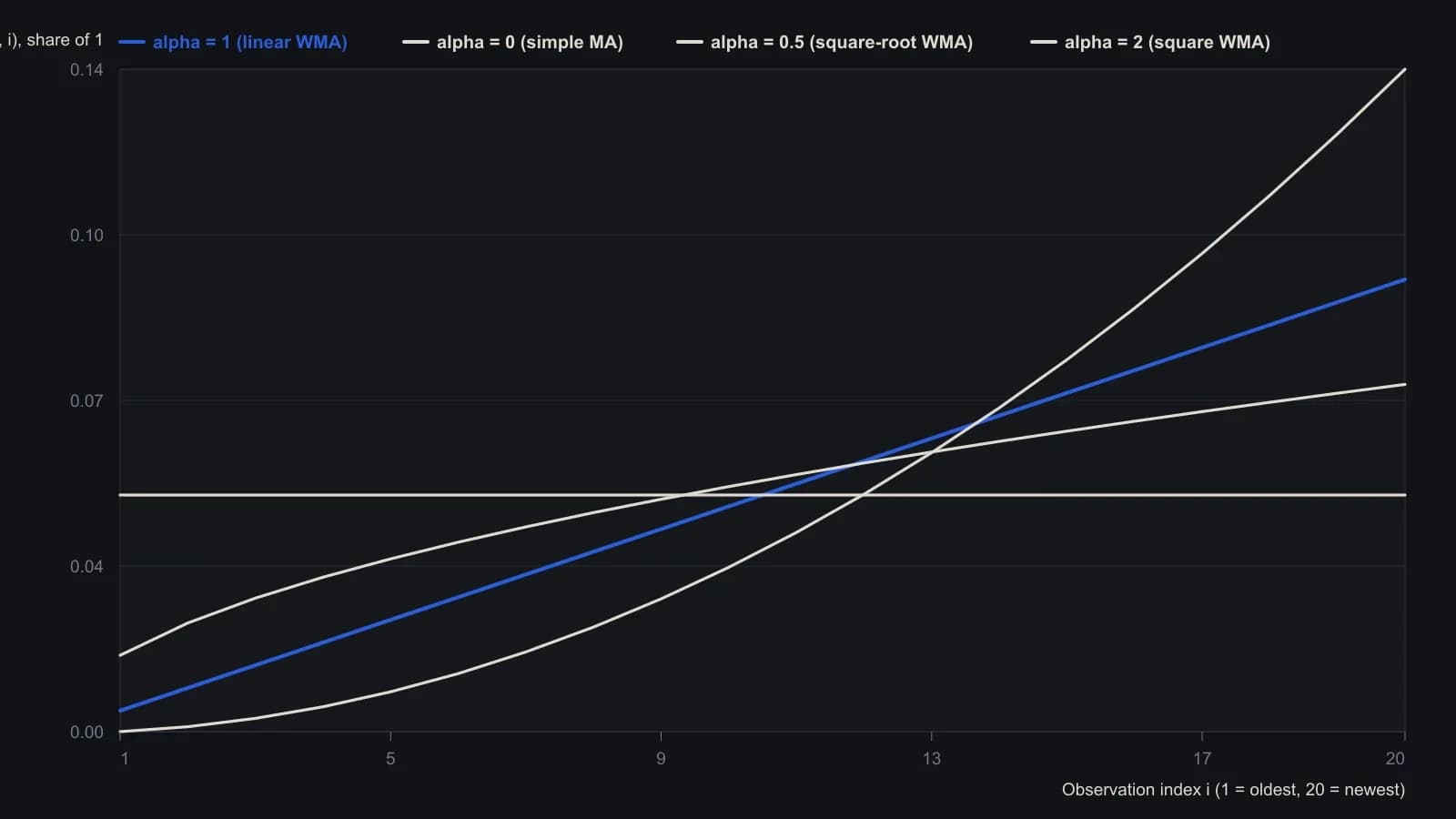
Weights are the closed-form GWMA shares the article defines and plots for n = 20; i = 1 is the oldest bar and i = 20 is the newest. Alpha = 0, 0.5, 1 and 2 are the four special cases drawn (equal, square-root, linear and square weights).
A put-call ratio used to choose alpha
The historical workflow built a put-call-ratio from daily yen-dollar futures option put volume divided by call volume, then searched for the alpha that maximizes the correlation between a general weighted average of that ratio and the yen-dollar spot rate. That search is the construction of an optimal-weighted-moving-average: alpha is selected to maximize a stated objective.
On daily observations from 14 June 1993 through 9 August 1993, a trial-and-error search over alpha for lookbacks of eight, ten, and fifteen periods located peak correlations of 0.7075, 0.6953, and 0.69694 at alpha values of 0.60, 1.3, and 0.2. For those three lookbacks the correlation with the yen-dollar rate rose at small alpha, declined once alpha exceeded 3, and flattened once alpha exceeded 50.
When the same put-call-ratio was averaged at eight, ten, and fifteen periods with alpha held at 0.60, the shorter two traces tracked each other while the fifteen-period trace was smoother. Comparing several lengths was proposed as a way to read possible trend changes.
All readings on this track · 20 readings
- 1988Indicator smoothing: lookback, weight, and scale
- 1990Recency weighting in simple, linear, and exponential moving averages
- 1990Seed and recurrence construction for moving averages
- 1990Constructing a five-day step-weighted moving average
- 1992Constructing simple, weighted, and exponential moving averages
- 1992Constructing moving averages with weighting schemes and extra filters
- 1992Constructing a weighted-average TRIN10 with Bollinger envelopes
- 1992Constructing a banded weighted open-TRIN oscillator
- 1993Evaluating a weighted dual rate-of-change momentum filter
- 1993Constructing equal, linear and exponential moving averages
- 1993Constructing a general weighted moving average from one exponent
- 1993Calibrating the weighted-moving-average exponent
- 1993Constructing an exponent-weighted average of put-call ratios
- 1994Cycle-tuned momentum with spectral peaks
- 1999How a five-bar sine-weighted average is assembled
- 2003Same-scale trend filter from a rolling least-squares endpoint
- 2003How a rolling linear-regression endpoint is assembled as a moving-trend
- 2004Constructing a volume-weighted moving average as a forecast baseline
- 2005Constructing a move, volume and recency weighted average
- 2016MACD as a zero-line filter with dual moving averages