1994issue C081-13
Gold-mining seasonality and bond-fund duration switching
Treat gold-mining share momentum as an inflation-perception state, then convert that state into one duration-switch: long-term bond funds when the state is bond-friendly, and short-term or money-market funds when it is not.
- Individual bonds carry issuer-default risk and interest-rate risk, and longer-maturity issues move more when rates change, while a bond fund has no maturity date that restores principal after a rate-driven decline.
- Gold-mining share prices are treated as an inflation-perception state: rising mining shares coincide with inflation concern that is hostile to bonds, and falling mining shares coincide with a more bond-friendly state.
- The duration-switch buys long-term bond funds when the mining-share 12-month rate of change reaches -35% or stays negative for 13 consecutive weeks, and moves to short-term or money-market funds at +35% or after 13 consecutive positive weeks.
- Funds are screened as no-load vehicles with annual expenses no higher than 1% including 12b-1 fees, compared only inside the same security type and maturity bucket, and ranked on after-expense yield before a two-sleeve rotation.
Bonds, funds, and interest-rate risk
Individual bonds expose holders to both issuer-default risk and interest-rate risk. Longer-maturity issues move more in price than shorter-maturity issues when rates change. That interest-rate risk is why a long-duration sleeve and a short-duration sleeve are not interchangeable holdings.
An individual bond held to maturity can still repay principal if the issuer does not default. A bond fund has no maturity date and therefore does not guarantee recovery after a rate-driven decline. That bond-fund-versus-bond distinction is why the book is switched among funds rather than parked in a single issue that can simply mature.
The intended duration stance is long-term bond funds when rates are expected to fall and short-term or money-market funds when rates are expected to rise.
Mining shares as an inflation-perception state
Gold-mining share prices are treated as a gauge of inflation perceptions. The inflation-perception state is inferred from mining-share price change rather than from a published inflation print. Rising mining shares coincide with inflation concern that is hostile to bonds. Falling mining shares coincide with a more bond-friendly inflation state.
A tabulated 12-month rate-of-change study of the mining-share index versus a 30-year Treasury bond price series is used to associate negative mining-share change with a higher subsequent 12-month frequency of higher bond prices.
The duration-switch rule
The switch procedure buys long-term bond funds when the mining-share 12-month rate of change reaches -35% or stays negative for 13 consecutive weeks. It exits into short-term or money-market funds when that rate of change reaches +35% or stays positive for 13 consecutive weeks.
The large rate-of-change thresholds are the entry and exit triggers. The 13-week run is a persistence test that treats a mining-share rate of change remaining negative or positive for a fixed run of weeks as the chart condition that confirms a duration-switch. Long-term funds are allowed only in the buy state. After a sell-state signal, capital must sit in short-term or money-market funds.
T-bond index 12 months after each GMI 12-month rate-of-change bin
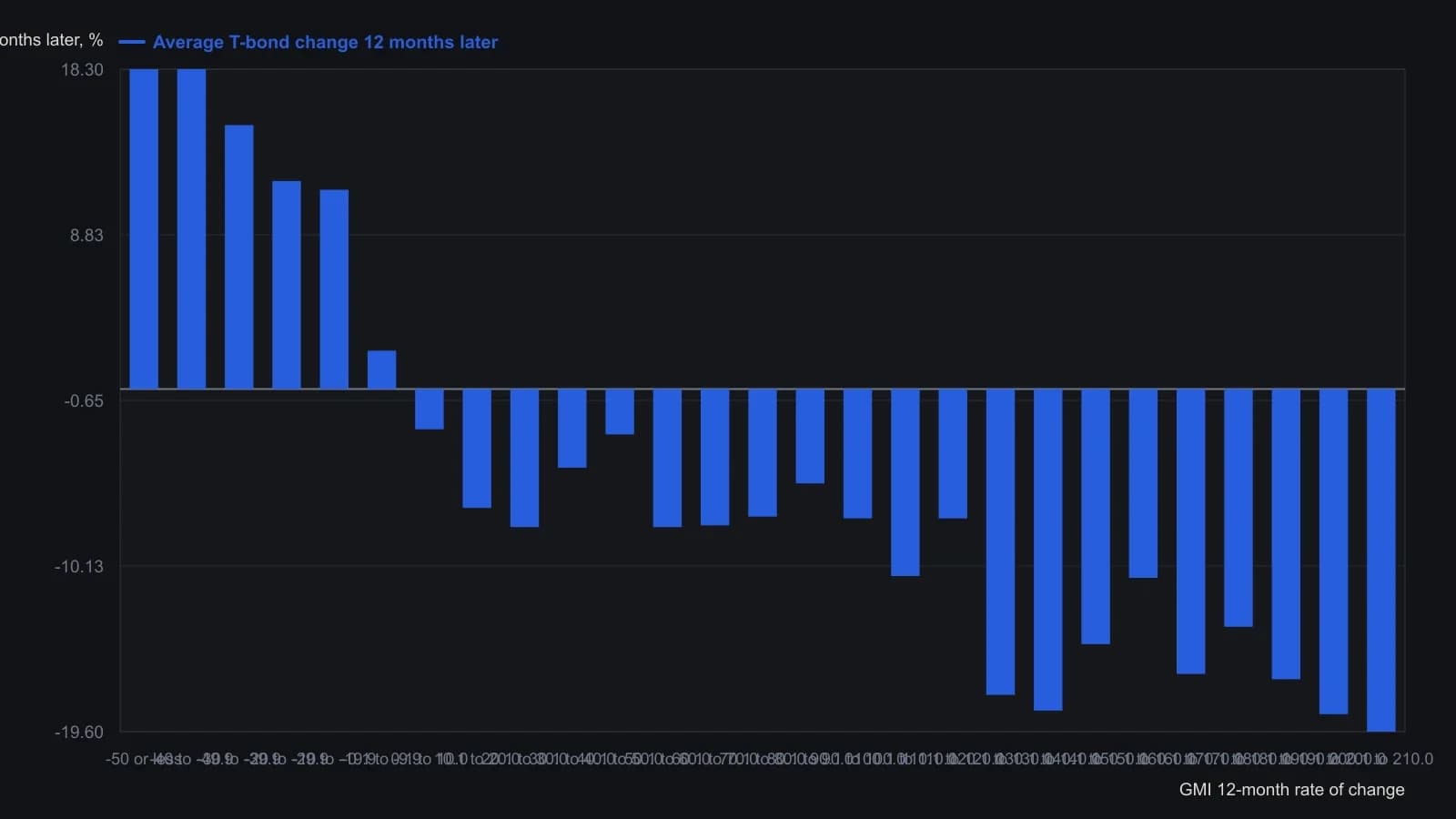
Sample is weekly GMI 12-month rate-of-change readings since 1978 and the T-bond index 12 months later. Bins with few weekly readings (especially the extreme positive tail) have wide sampling error; the article's switch rule uses −35% / +35% or 13 consecutive weeks on one side of zero rather than every bin.
Fund screening and the two-sleeve rotation
Fund screening isolates no-load funds, rejects annual expenses above 1% including 12b-1 fees, compares funds only inside the same security type and maturity bucket, and ranks them on after-expense yield. After-expense yield is current yield reduced by the fund's stated expenses so comparable funds can be ranked on what remains after costs.
The portfolio implementation is a two-sleeve rotation. Hold preselected long-term funds after a buy-state signal and rotate into preselected short-term or money-market funds after a sell-state signal. An optional intermediate or mixed-credit sleeve can be kept for diversification.
What the combination is testing
Editorial note: the procedure is not a forecast of the next inflation print. It is a market-state rule for whether a bond-fund book should sit in long duration or retreat to short duration when recurring inflation-expectation states change.
All readings on this track · 57 readings
- 1988Constructing moving averages: weights, smoothing and crossovers
- 1988Constructing breadth and average trend states
- 1989Evaluating an always-in-the-market moving-average crossover
- 1989Constructing symmetric market-breadth ratio accumulators
- 1989Objective crossover tests of Fibonacci wave ratios
- 1990Volume-adjusted moving average construction
- 1991Constructing a mechanical crossover on a synthetic price series
- 1991A two-speed breadth reading for intermediate market direction
- 1992A Deutschemark yield map with dual-average and relative-strength timing
- 1992Confirming currency-fund trends with a crossover and a filter
- 1992A moving-average slope filter for crossover signals
- 1992Occupancy and split-sample tests for average crossovers
- 1994Gold-mining seasonality and bond-fund duration switching
- 1994Price oscillator from two moving averages
- 1995Explicit exponential weights and binary entry filters
- 1996Currency futures crossover with slope, bond filter, and stop
- 1996Two-market average crossover entry with a fixed stop
- 1997Construction of a filtered three-average crossover
- 1998Two-group exponential average compression as a trend filter
- 1998Constructing r-squared trend filters with dual lookbacks
- 1998Moving-average length is a habit, not a secret
- 1999Solving the close that triggers a moving-average crossover
- 2000Kagi yang and yin control versus crossover noise
- 2000Constructing simple moving average crossover filters
- 2000Building a vertical-horizontal filter to gate trend signals
- 2000Two-average crossover as a check on trend following
- 2003Stacked exponential-average retracement entries and extreme stops
- 2003Evaluating oscillator thresholds against optimized crossovers
- 2004Constructing a semicycle trend-quality filter
- 2004Commodity subgroups labeled by crossover, support, or convergence
- 2004Full-window evaluation of crossover trend systems
- 2004Two-average trend filters as a classroom critique of indicator stacking
- 2005Three-layer confirmation from a moving-average cross, candles, and Q-stick
- 2005Charting put prices beside an equity breakdown
- 2005Range-gated moving-average crossover construction
- 2007Anticipating a simple-average crossover with a threshold-close
- 2007Anticipating moving-average crossovers one bar ahead
- 2007Lead-series moving-average crossovers with a stochastic and relative strength index
- 2007Next-bar SMA crossover hypotheses from theoretical crossing values
- 2007Anticipating a moving-average crossover before confirmation
- 2007A three-horizon moving-average stack as a construction problem
- 2007Confirming trend with regression slope and r-squared
- 2008Constructing a multi-timeframe smoothed crossover
- 2008Best-day clusters versus trend filters
- 2008Allied markets as a confirmation gate for crossover and breakout signals
- 2008Weekly exponential-average crossover as a mechanical trend case study
- 2010Evaluating a 200-day crossover as long, short, and stand-aside rules
- 2010Read a 10-and-40 trend on two neighboring time frames
- 2012Sampling unit as a first-class parameter on dual simple moving averages
- 2012Constructing index-ETF entries from volatility-index persistence
- 2013Moving-average baselines versus crossover signals
- 2013Constructing a typical-price and heikin-ashi crossover as one mechanical procedure
- 2016A three-gate checklist for longs after a sharp drop
- 2016Weekly inflation-ratio crossover for commodity regimes
- 2017Normalized Laguerre zero-axis warning as a two-marker construction
- 2019Range-weighted construction of an adaptive exponential moving average
- 2020Construct a second-pullback entry after a moving-average crossover