1990issue C121-9
Cycle-tested five-year fund rank rotation
A static five-year winner list is a weak construction input because names on it typically leave that list within a few months. This archive article teaches a cycle-aware filter: keep a fund only when it still occupies the top slice of long-window results at both a ranking peak and a ranking trough, then rotate a closed roster by placing already-known window roll-off into the ranks before the next extreme is confirmed.
- A static five-year winner list is a weak construction input, because names on it typically leave that list within a few months.
- A fund is classed as cycle-enduring only if it appears on the top-30 five-year ranking at both a confirmed high turning point and a confirmed low turning point.
- Only names from the last designation remain eligible at the next one, so the next roster is a rank-rotation among a closed 30-name set.
- After the last confirmed designation, the rule switches to adjusted forecast ranks and rotates out names predicted to lose top-30 status before the next extreme is locked.
Why a static winner list is a weak input
A static five-year winner list is treated as a weak construction input because names on it typically leave that list within a few months. The archive workflow therefore does not treat a long-window winner list as a finished roster. It asks whether a name still occupies the top slice of five-year results when the ranking cycle is at a peak and when that same cycle is at a trough.
How a designation pair is locked
A fund is classed as cycle-enduring only if it appears on the top-30 five-year ranking at both a high turning point and a low turning point of that ranking cycle. A ranking extreme is used as a designation date only when it is at least six months from the prior extreme and the reversal has held for three months. Those two most recent confirmed turning points are the designation pair that locks a new roster of cycle-enduring funds. The pair is typically about a year apart.
What the eligible universe includes
The eligible universe is limited to no-load equity funds in aggressive-growth, growth, growth-income, income, and sector groups. Gold funds, international funds, and funds still charging a sales load above 3% are excluded. In this workflow, a cycle-enduring fund is a no-load equity fund that remains inside the top-30 five-year ranking at both the latest confirmed high and the latest confirmed low of that ranking cycle.
Quarterly checks and the disqualification scan
After a designation, status is rechecked at least quarterly. A name that leaves the top 30 is not restored even if it later reappears, because it must remain on the list between turning points. A faster disqualification scan counts every fund with a higher five-year return than the weakest designated winner, including newcomers. More than 29 superior names removes its cycle-enduring status.
Rank rotation inside a closed set
Only names from the last designation’s top 30 remain eligible at the next designation. The next roster is a rank-rotation among a closed 30-name set rather than an open search of the whole universe. Rank rotation drops a name as soon as it loses, or is forecast to lose, top-30 durability and replaces it with a stronger remaining candidate.
Window roll-off and the truncated base
Window roll-off is the known effect of the quarter from five years earlier leaving the five-year record. That historical piece is certain even though the incoming quarter is not. Forecast ranks start from a truncated base after the known five-year-ago quarter is removed, leaving a 57-month figure. That truncated base is then restored with each new month so already-known window roll-off sits in the ranking before the next turning point is confirmed. The adjusted rank forecast is a reranking of the closed 30-name candidate set after the truncated base is restored with newly arriving months, so already-known future window effects sit inside the rank.
Volatility and the path off the list
Higher-volatility names tend to leave the top 30 before ranking lows, and lower-volatility names tend to leave before ranking highs. Later designated winners showed betas from 0.5 to 1.1, versus betas as high as 1.4 in earlier years.
When the construction rule switches
As time passes after the last confirmed designation, the construction rule switches from the old confirmed roster to the adjusted forecast ranks. It then rotates out names predicted to lose top-30 status before the next extreme is locked.
Annualized five-year returns at the August 1988 low and July 1989 high
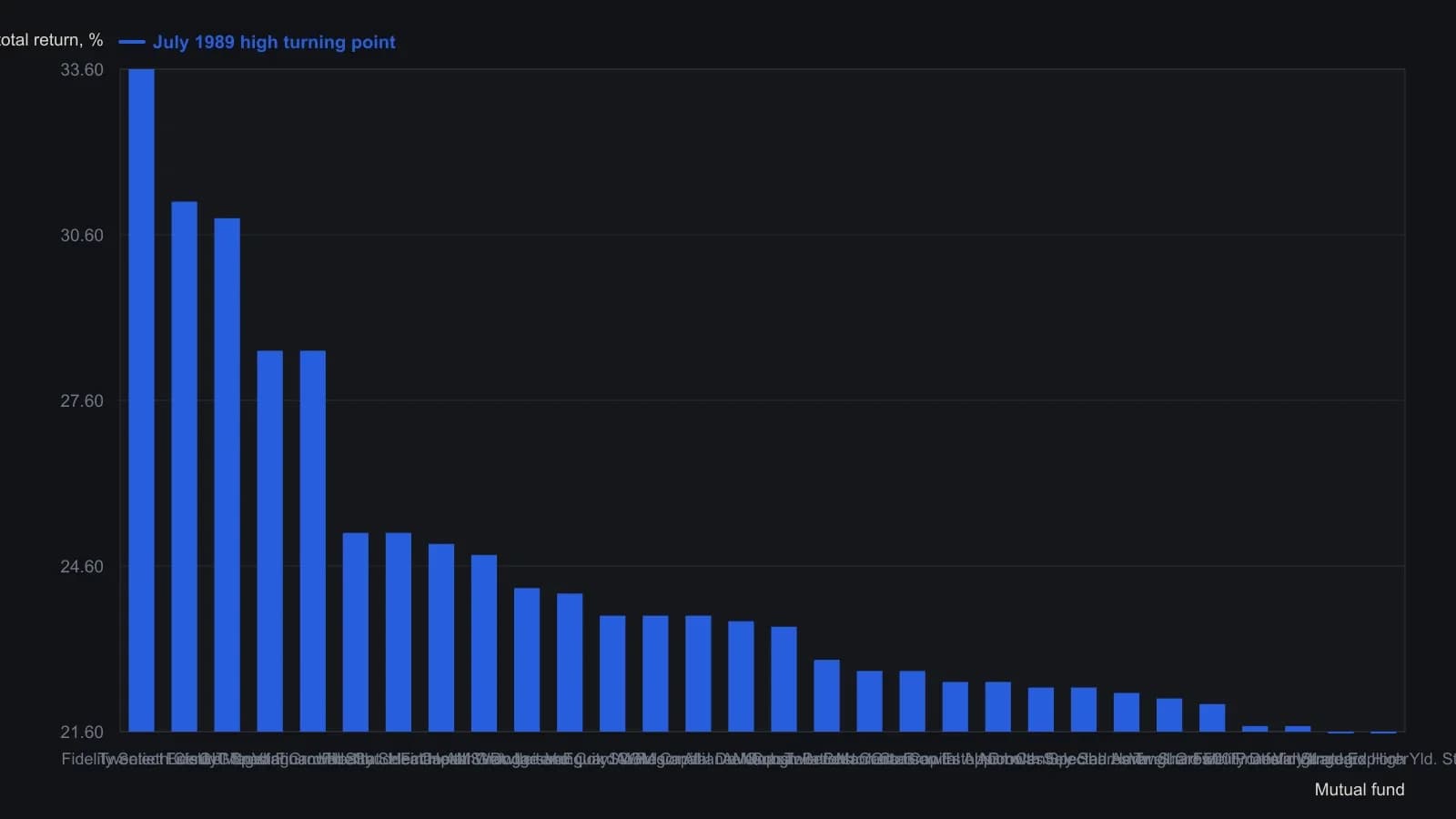
NLFI monthly five-year total returns including reinvested distributions, annualized; gold and international funds excluded; funds still charging a sales load above 3 percent excluded. Turning points required at least six months apart and a three-month confirmation. Asterisks mark funds unavailable to new shareholders or still charging more than 3 percent load; P marks confirmed perennial funds.
All readings on this track · 39 readings
- 1987A mechanical rank-rotation sleeve for monthly fund leaders
- 1989Rank rotation in a five-name no-load sleeve
- 1990Cycle-tested five-year fund rank rotation
- 1991Blue-chip rank rotation by relative-strength-index slope
- 1992Currency rank rotation and intermarket timing
- 1992Rank rotation and relative strength for portfolio construction
- 1994MACD crossovers then short-horizon rank rotation
- 1994A comparable group-trend ledger from published ranks
- 1997Normalized yield rank rotation as a full portfolio procedure
- 1997Constructing an investor preference index from two capitalization-weighted series
- 1998Constructing anchored momentum from a centered average
- 2000Rank rotation, a stop-loss order, and Relative Strength Index in fund switching
- 2003A one-fund daily rank is a two-sleeve construction problem
- 2004Evaluate rank rotation only where persistence already exists
- 2004Sector fund rank rotation with regression and trailing stops
- 2006Evaluating equal-weight annual yield-rank rotation
- 2007Weekly preferred-symbol reselection for mechanical trend systems
- 2011Portfolio capacity and entry pacing for mechanical systems
- 2011Rank rotation as a testable ETF construction procedure
- 2011The inverse-Fisher stochastic is a forecast layer until the book rules can be disabled
- 2012An underwater stretch is a sizing test for rank rotation
- 2015Rule-based ETF rotation as one testable procedure
- 2015MACD crossover evaluation by trend rank rotation
- 2015Persistence and strength as one close-to-close switch
- 2015Evaluating rank rotation after a persistence screen
- 2016Evaluating an annual valuation rank rotation
- 2017A two-step yield and price rank rotation for a five-name sleeve
- 2018Smoothed volatility and the missing rank-rotation exit
- 2018A five-condition scorecard that ranks stocks and can refuse the trade
- 2018Small-cap growth sleeve eligibility with trend and rank rotation
- 2018Evaluating rank-rotation momentum across fund wrappers
- 2019Evaluating an annual equity-gold momentum rank rotation
- 2019Evaluating equity-gold momentum on funds versus indexes
- 2020How a signed comparative-strength oscillator is built for rank rotation
- 2020Which calendar clock changes a gold-versus-equity rotation test
- 2020Four-dimension relative strength as rank rotation
- 2020Portfolio construction as a ranked relative-strength problem
- 2020Two clocks for a Nasdaq put/call sleeve
- 2020Rank, filter, and stop the hedge sleeve as one procedure