1989issue C121-6
Rank rotation in a five-name no-load sleeve
The archive follows a five-name no-load sleeve built from a performance index of one-, three-, six-, and nine-month net-asset-value changes. Rank rotation filled that sleeve from a persistence band and replaced a holding when it left the band, after a separate directional decision.
- A performance index added percentage net-asset-value changes over one-, three-, six-, and nine-month windows to form one ranking score.
- A name entered the sleeve only after three consecutive months in the persistence band, the top 20 percent of the monthly ranked list.
- A holding was sold when it left the top 20 percent of the ranking, and the proceeds were placed in the next eligible top-ranked name not already owned.
- The ranking-and-replacement rules selected a sleeve after a separate directional decision. They were not a market-timing engine.
The archive records a Rank rotation workflow on a small no-load sleeve. The sleeve was filled only with names that had already stayed in a persistence band, and a holding was sold when it left that band.
How the ranking score was formed
A performance index was formed by adding percentage net-asset-value changes over one-, three-, six-, and nine-month windows. Rankings used net asset values adjusted for capital-gain distributions but not for income dividends, so the score tracked portfolio-value change.
How the persistence band worked
The persistence band was the top 20 percent of the monthly ranked list, required for three consecutive months. A name entered the sleeve only after remaining in that band for those three months.
A five-year above-market history filter was tested as an extra gate and was not kept. Only the three-month top-quintile persistence rule remained as the eligibility test.
How the sleeve was filled and replaced
The ranked universe covered 196 load and no-load equity, sector, and balanced funds. Sales-load and high-minimum names were dropped before the five-name sleeve was filled. The opening sleeve was an equal split across five eligible no-load names, with 1,000 currency units in each line.
A holding was sold when it left the top 20 percent of the ranking, and the proceeds were placed in the next eligible top-ranked name not already owned.
What the ranking rules did not do
The ranking-and-replacement rules were not a market-timing engine. They selected a sleeve after a separate directional decision.
What the monthly ranks showed
Monthly ranks from late 1988 through August 1989 show rapid movement through the top quintile. Only two of the original five sleeve members remained for the full eight-month window, which itself contained no large market decline.
No-load sleeve: initial and final account value by fund
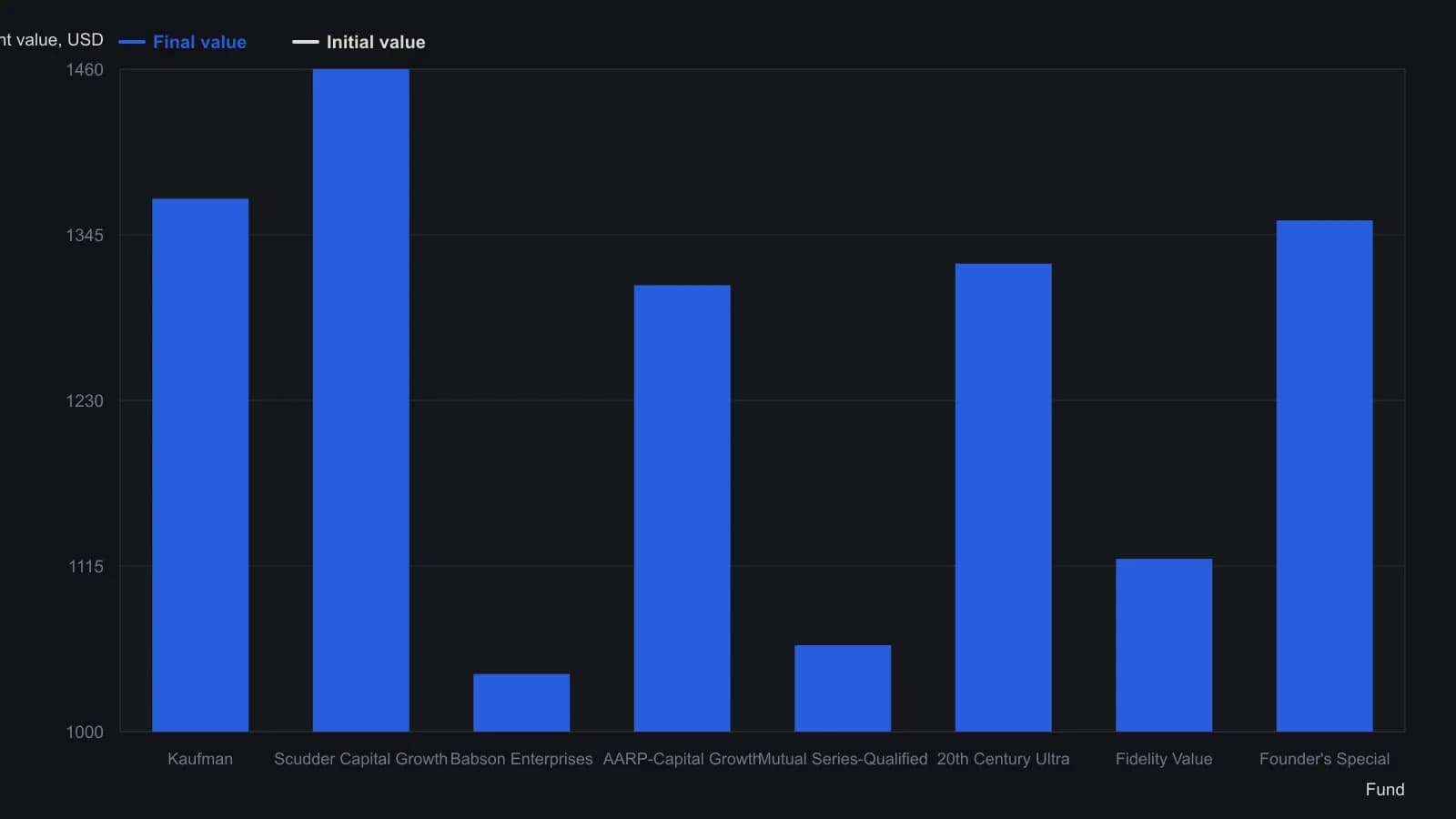
The source fixed $1,000 per name at the end of December 1988, excluded load and high-minimum funds, and ran January–August 1989 through an advance that did not include a substantial decline. The first table row is cropped in the scan; the article identifies that hold-through original as Kaufman. Its printed final (1,370) and August (1,460) figures do not add with the other August marks to the printed 6,820 total.
All readings on this track · 39 readings
- 1987A mechanical rank-rotation sleeve for monthly fund leaders
- 1989Rank rotation in a five-name no-load sleeve
- 1990Cycle-tested five-year fund rank rotation
- 1991Blue-chip rank rotation by relative-strength-index slope
- 1992Currency rank rotation and intermarket timing
- 1992Rank rotation and relative strength for portfolio construction
- 1994MACD crossovers then short-horizon rank rotation
- 1994A comparable group-trend ledger from published ranks
- 1997Normalized yield rank rotation as a full portfolio procedure
- 1997Constructing an investor preference index from two capitalization-weighted series
- 1998Constructing anchored momentum from a centered average
- 2000Rank rotation, a stop-loss order, and Relative Strength Index in fund switching
- 2003A one-fund daily rank is a two-sleeve construction problem
- 2004Evaluate rank rotation only where persistence already exists
- 2004Sector fund rank rotation with regression and trailing stops
- 2006Evaluating equal-weight annual yield-rank rotation
- 2007Weekly preferred-symbol reselection for mechanical trend systems
- 2011Portfolio capacity and entry pacing for mechanical systems
- 2011Rank rotation as a testable ETF construction procedure
- 2011The inverse-Fisher stochastic is a forecast layer until the book rules can be disabled
- 2012An underwater stretch is a sizing test for rank rotation
- 2015Rule-based ETF rotation as one testable procedure
- 2015MACD crossover evaluation by trend rank rotation
- 2015Persistence and strength as one close-to-close switch
- 2015Evaluating rank rotation after a persistence screen
- 2016Evaluating an annual valuation rank rotation
- 2017A two-step yield and price rank rotation for a five-name sleeve
- 2018Smoothed volatility and the missing rank-rotation exit
- 2018A five-condition scorecard that ranks stocks and can refuse the trade
- 2018Small-cap growth sleeve eligibility with trend and rank rotation
- 2018Evaluating rank-rotation momentum across fund wrappers
- 2019Evaluating an annual equity-gold momentum rank rotation
- 2019Evaluating equity-gold momentum on funds versus indexes
- 2020How a signed comparative-strength oscillator is built for rank rotation
- 2020Which calendar clock changes a gold-versus-equity rotation test
- 2020Four-dimension relative strength as rank rotation
- 2020Portfolio construction as a ranked relative-strength problem
- 2020Two clocks for a Nasdaq put/call sleeve
- 2020Rank, filter, and stop the hedge sleeve as one procedure