2008issue C011-2
Constructing a multi-timeframe smoothed crossover
The archive workflow builds a mechanical-trading-system from a triple-smoothed-overlay, a nested-timeframe-entry, and a stop-loss at the middle-line pivot. Alignment-state decides whether the script may hypothesize; a close-confirmed moving-average-crossover is the only license to enter.
- The triple-smoothed-overlay is three displaced lines read as an alignment-state: a clean stack licenses a long or short hypothesis, and entanglement keeps the procedure out.
- A nested-timeframe-entry sets direction on a slower chart, waits for a mid-scale counter-wave, then seeks a with-trend moving-average-crossover on the faster chart.
- Entry is taken only when that crossover is present at the bar close, after the nest is already set, and the stop-loss is then placed at the pivot marked by the middle displaced average.
- The overlay lag both reduces how much of a move can be captured and filters weaker or unconfirmed crosses, so delay is part of the same procedure.
What is being built
The archive workflow is a mechanical-trading-system: a single testable sequence that joins higher-timeframe direction, mid-timeframe counter-wave, lower-timeframe close confirmation, and a predefined stop.
The overlay it inspects is a triple-smoothed-overlay. It is built from three smoothed moving averages of 13, 8 and 5 periods, shifted forward by 8, 5 and 3 bars, and read as the longest, middle, and shortest lines.
Alignment as a stay-out filter
When the three lines are entangled, the procedure treats the market as inactive and stays out. A long hypothesis requires the shortest line above the middle line above the longest line. A short hypothesis requires the opposite stack.
That pairing is the alignment-state: ordered stacking of the three lines as the trend hypothesis, and entanglement of the same lines as the stay-out state.
Alligator lines on daily GBP/USD
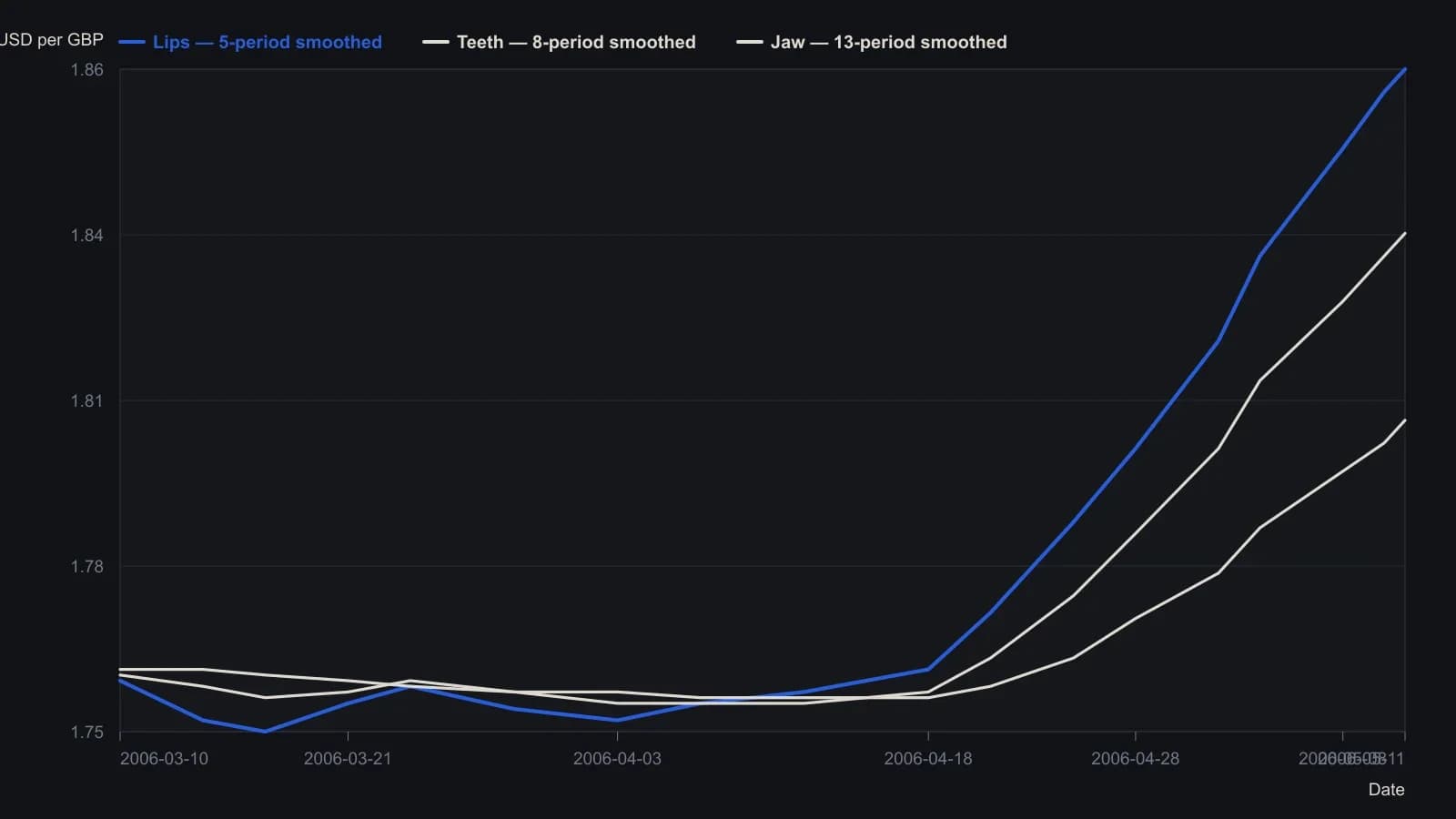
Sabodin’s alligator is three smoothed moving averages of 13, 8 and 5 periods, shifted 8, 5 and 3 bars (blue jaw, red teeth, green lips). Digitized from the raster against the printed 1.7185–1.9045 scale; expect about 0.003 error.
The nested wait
Daily direction is treated as the larger flow. The four-hour chart is then used to wait for a wave moving against that daily direction before a with-trend entry is sought. That nest is the nested-timeframe-entry: a slower chart sets direction, a middle chart waits for a wave against that direction, and a faster chart supplies the with-trend crossover.
The specified long configuration is daily up, four-hour down, and a 30-minute buy after the averages cross and slope higher. The specified short configuration is the inverse. The same nest can be compressed to four-hour direction, one-hour counter-wave, and a five-minute crossover.
Close confirmation
A moving-average-crossover is a close-confirmed cross and restack of the three displaced smoothed averages that licenses an entry only after the higher-timeframe nest is already set.
An entry is taken only if the moving-average-crossover is present at the bar close. Otherwise the next close is awaited.
The middle-line stop
Once a position is open, the stop-loss is placed at the price pivot identified with the middle displaced average. The stop-loss is a loss bound placed after entry at that pivot.
What the lag does
Because the overlay lags price, the same delay both reduces how much of a move can be captured and filters weaker or unconfirmed crossovers.
All readings on this track · 57 readings
- 1988Constructing moving averages: weights, smoothing and crossovers
- 1988Constructing breadth and average trend states
- 1989Evaluating an always-in-the-market moving-average crossover
- 1989Constructing symmetric market-breadth ratio accumulators
- 1989Objective crossover tests of Fibonacci wave ratios
- 1990Volume-adjusted moving average construction
- 1991Constructing a mechanical crossover on a synthetic price series
- 1991A two-speed breadth reading for intermediate market direction
- 1992A Deutschemark yield map with dual-average and relative-strength timing
- 1992Confirming currency-fund trends with a crossover and a filter
- 1992A moving-average slope filter for crossover signals
- 1992Occupancy and split-sample tests for average crossovers
- 1994Gold-mining seasonality and bond-fund duration switching
- 1994Price oscillator from two moving averages
- 1995Explicit exponential weights and binary entry filters
- 1996Currency futures crossover with slope, bond filter, and stop
- 1996Two-market average crossover entry with a fixed stop
- 1997Construction of a filtered three-average crossover
- 1998Two-group exponential average compression as a trend filter
- 1998Constructing r-squared trend filters with dual lookbacks
- 1998Moving-average length is a habit, not a secret
- 1999Solving the close that triggers a moving-average crossover
- 2000Kagi yang and yin control versus crossover noise
- 2000Constructing simple moving average crossover filters
- 2000Building a vertical-horizontal filter to gate trend signals
- 2000Two-average crossover as a check on trend following
- 2003Stacked exponential-average retracement entries and extreme stops
- 2003Evaluating oscillator thresholds against optimized crossovers
- 2004Constructing a semicycle trend-quality filter
- 2004Commodity subgroups labeled by crossover, support, or convergence
- 2004Full-window evaluation of crossover trend systems
- 2004Two-average trend filters as a classroom critique of indicator stacking
- 2005Three-layer confirmation from a moving-average cross, candles, and Q-stick
- 2005Charting put prices beside an equity breakdown
- 2005Range-gated moving-average crossover construction
- 2007Anticipating a simple-average crossover with a threshold-close
- 2007Anticipating moving-average crossovers one bar ahead
- 2007Lead-series moving-average crossovers with a stochastic and relative strength index
- 2007Next-bar SMA crossover hypotheses from theoretical crossing values
- 2007Anticipating a moving-average crossover before confirmation
- 2007A three-horizon moving-average stack as a construction problem
- 2007Confirming trend with regression slope and r-squared
- 2008Constructing a multi-timeframe smoothed crossover
- 2008Best-day clusters versus trend filters
- 2008Allied markets as a confirmation gate for crossover and breakout signals
- 2008Weekly exponential-average crossover as a mechanical trend case study
- 2010Evaluating a 200-day crossover as long, short, and stand-aside rules
- 2010Read a 10-and-40 trend on two neighboring time frames
- 2012Sampling unit as a first-class parameter on dual simple moving averages
- 2012Constructing index-ETF entries from volatility-index persistence
- 2013Moving-average baselines versus crossover signals
- 2013Constructing a typical-price and heikin-ashi crossover as one mechanical procedure
- 2016A three-gate checklist for longs after a sharp drop
- 2016Weekly inflation-ratio crossover for commodity regimes
- 2017Normalized Laguerre zero-axis warning as a two-marker construction
- 2019Range-weighted construction of an adaptive exponential moving average
- 2020Construct a second-pullback entry after a moving-average crossover