1996issue C111-3
Two-market average crossover entry with a fixed stop
A currency long or short is written only when a rising short average, a slower crossover-alert, and a second-market filter are true together. The matching exit uses the reverse moving-average-crossover without rechecking that filter. A pre-set stop-loss and a next-open-fill sit outside the stack.
- A long rule-based-entry fires only when the traded market’s six-period average is rising, a nine-versus-eighteen moving-average-crossover has occurred, and a second market’s three-period average is above its twenty-five-period average.
- The nine-versus-eighteen relationship is a crossover-alert inside the confirmation-stack, not a standalone order, and one encoding keeps that alert valid for a limited number of later bars.
- A long exit is the reverse moving-average-crossover of the eighteen-period average back above the nine-period average and does not recheck the second-market filter. Shorts invert every comparison.
- Both sides carry a stop-loss written as a maximum point loss or a fixed cash-equity drop, and filled orders use a next-open-fill after the signal bar.
A stack of named clauses
This article writes a two-market currency procedure as a list of separately named clauses rather than as one chart story. A rule-based-entry is a long or short order that fires only when every listed test is true on the same bar and is paired with matching exit and abstention clauses.
The confirmation-stack withholds that order until several independent tests agree, including at least one test taken from a second market. Editorial reading: naming each clause is what lets the procedure be kept, dropped, or re-measured without collapsing back into an untestable chart story.
The long confirmation-stack
A long entry is written only when three tests are true together. The traded market’s six-period average is rising. A nine-versus-eighteen moving-average-crossover has occurred. A second market’s three-period average is above its twenty-five-period average.
The second-market averages can be evaluated only after that series is overlaid or date-matched onto the traded market’s bars. Until that overlay exists, the external filter is not an available test.
Swiss franc Pathfinder sample from March through September
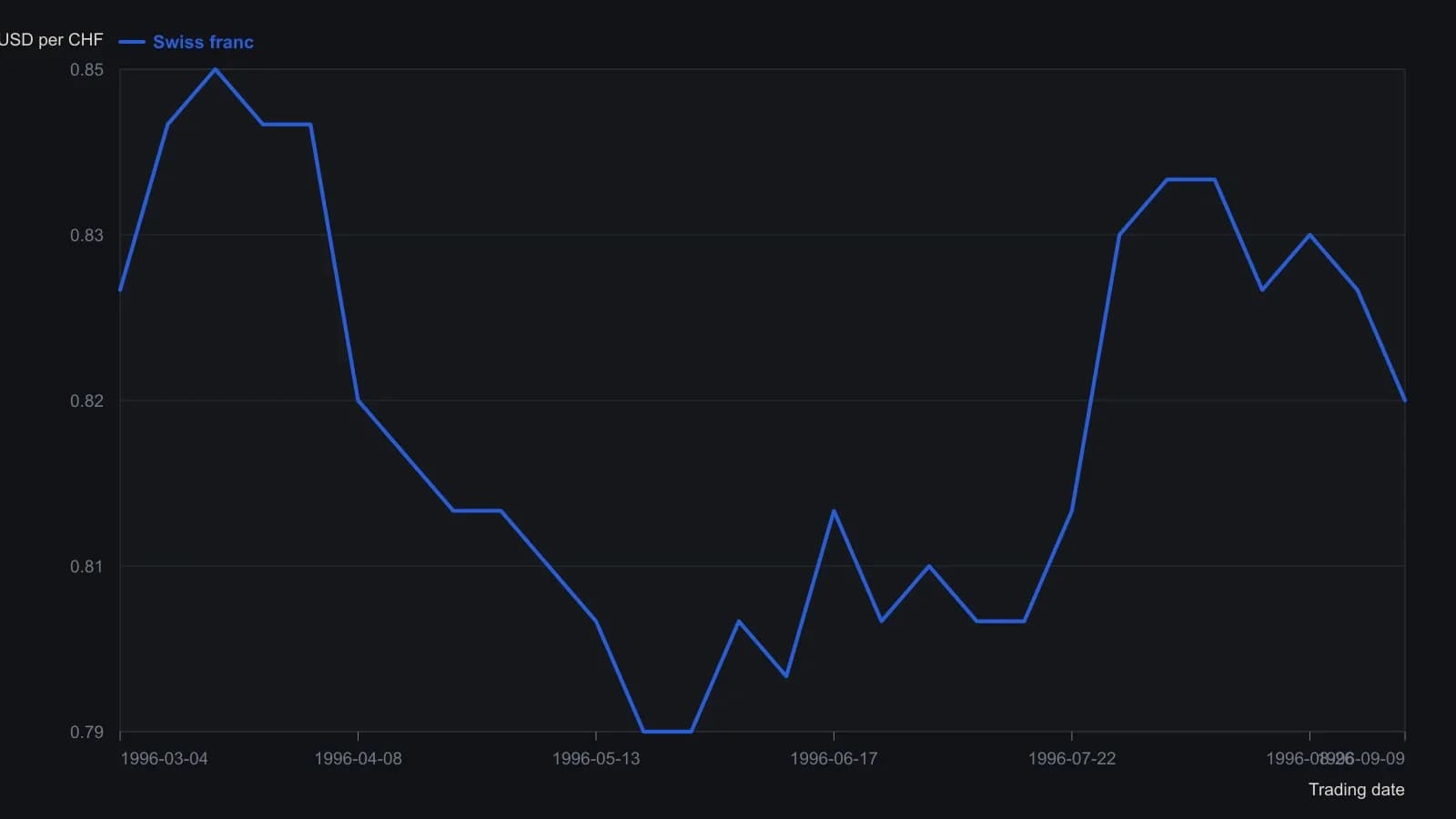
Weekly samples from the daily candlesticks, rounded to the printed 0.005 tick. Dates are week-start marks along the March–September axis, using the 1996 issue year. Arrows on the source pane are trade annotations, not extra series.
The slower cross as a crossover-alert
A moving-average-crossover is a change in rank between two averages of the same series, used here as a permission or exit event rather than as a complete trade.
The nine-versus-eighteen average relationship is one required clause inside the entry stack, not a standalone order. A crossover-alert is a recent slower-average cross that remains a required clause inside the stack instead of placing a trade by itself. One encoding keeps that cross valid as an alert for a limited number of later bars.
Exit without the second-market filter
A long position is closed when the eighteen-period average crosses back above the nine-period average. That reverse moving-average-crossover does not recheck the second-market filter.
Abstention is the complement of the stack: if any long-entry test is false on the signal bar, no long order is written. The exit clause is not used to reopen that filter.
The short side inverts every test
Short entry and short exit invert every comparison used on the long side, including the second-market average filter. The short confirmation-stack is therefore the same list of clauses with each rank test reversed, not a second design.
A stop-loss that does not wait for the averages
A stop-loss is a pre-set point or cash-equity bound that closes a position even if the average rules have not yet reversed. Both long and short positions carry that protective stop, written as a maximum point loss or as a fixed cash-equity drop from the open trade.
The point-loss stop is specified as 0.016 on the worked example and is restated as 0.032 or 0.02 when the same procedure is applied to other currency contracts. The bound is declared before the trade is placed.
Next-open fill after the signal bar
A next-open-fill is an execution convention that places the order on the open after the signal bar. Filled orders are scheduled for the next session’s open, so the written procedure includes a one-bar execution lag after the signal. That lag belongs to the procedure, not to a later discretionary choice.
Editorial reading of the archive workflow
Editorial reading: the archive records a historical workflow. Separating the rising short average, the crossover-alert, the second-market filter, the reverse-cross exit, and the stop-loss is a TradersWeek framing so each clause can be measured on its own. That framing is editorial and is not attributed to the archive.
All readings on this track · 57 readings
- 1988Constructing moving averages: weights, smoothing and crossovers
- 1988Constructing breadth and average trend states
- 1989Evaluating an always-in-the-market moving-average crossover
- 1989Constructing symmetric market-breadth ratio accumulators
- 1989Objective crossover tests of Fibonacci wave ratios
- 1990Volume-adjusted moving average construction
- 1991Constructing a mechanical crossover on a synthetic price series
- 1991A two-speed breadth reading for intermediate market direction
- 1992A Deutschemark yield map with dual-average and relative-strength timing
- 1992Confirming currency-fund trends with a crossover and a filter
- 1992A moving-average slope filter for crossover signals
- 1992Occupancy and split-sample tests for average crossovers
- 1994Gold-mining seasonality and bond-fund duration switching
- 1994Price oscillator from two moving averages
- 1995Explicit exponential weights and binary entry filters
- 1996Currency futures crossover with slope, bond filter, and stop
- 1996Two-market average crossover entry with a fixed stop
- 1997Construction of a filtered three-average crossover
- 1998Two-group exponential average compression as a trend filter
- 1998Constructing r-squared trend filters with dual lookbacks
- 1998Moving-average length is a habit, not a secret
- 1999Solving the close that triggers a moving-average crossover
- 2000Kagi yang and yin control versus crossover noise
- 2000Constructing simple moving average crossover filters
- 2000Building a vertical-horizontal filter to gate trend signals
- 2000Two-average crossover as a check on trend following
- 2003Stacked exponential-average retracement entries and extreme stops
- 2003Evaluating oscillator thresholds against optimized crossovers
- 2004Constructing a semicycle trend-quality filter
- 2004Commodity subgroups labeled by crossover, support, or convergence
- 2004Full-window evaluation of crossover trend systems
- 2004Two-average trend filters as a classroom critique of indicator stacking
- 2005Three-layer confirmation from a moving-average cross, candles, and Q-stick
- 2005Charting put prices beside an equity breakdown
- 2005Range-gated moving-average crossover construction
- 2007Anticipating a simple-average crossover with a threshold-close
- 2007Anticipating moving-average crossovers one bar ahead
- 2007Lead-series moving-average crossovers with a stochastic and relative strength index
- 2007Next-bar SMA crossover hypotheses from theoretical crossing values
- 2007Anticipating a moving-average crossover before confirmation
- 2007A three-horizon moving-average stack as a construction problem
- 2007Confirming trend with regression slope and r-squared
- 2008Constructing a multi-timeframe smoothed crossover
- 2008Best-day clusters versus trend filters
- 2008Allied markets as a confirmation gate for crossover and breakout signals
- 2008Weekly exponential-average crossover as a mechanical trend case study
- 2010Evaluating a 200-day crossover as long, short, and stand-aside rules
- 2010Read a 10-and-40 trend on two neighboring time frames
- 2012Sampling unit as a first-class parameter on dual simple moving averages
- 2012Constructing index-ETF entries from volatility-index persistence
- 2013Moving-average baselines versus crossover signals
- 2013Constructing a typical-price and heikin-ashi crossover as one mechanical procedure
- 2016A three-gate checklist for longs after a sharp drop
- 2016Weekly inflation-ratio crossover for commodity regimes
- 2017Normalized Laguerre zero-axis warning as a two-marker construction
- 2019Range-weighted construction of an adaptive exponential moving average
- 2020Construct a second-pullback entry after a moving-average crossover