2008issue C111-4
Weekly exponential-average crossover as a mechanical trend case study
The archive applied a weekly 10-week and 40-week exponential-average crossover as a long-only mechanical procedure to a diversified mix of sector mutual funds. Entry and exit waited for weekly confirmation, then used the close of the first session after that confirmation. Editorial reading: the testable lesson is sitting out still markets and keeping the rule on one weekly clock.
- The mechanical weekly rule entered and exited only after the 10-week exponential average crossed the 40-week exponential average, then used the close of the first session after that weekly confirmation.
- Trend following was framed as buying after confirmation that a major move was already underway, not as an attempt to call tops, bottoms, or reversal dates.
- Non-trending, cycling, or low-volatility markets were to be skipped, while a diversified mix of sector funds left room to take a trend that appeared in some market.
- The hardest operational demand was waiting for the weekly downside cross, which often meant watching open gains shrink until the 10-week average pierced the 40-week average.
One weekly rule for entry and exit
The archive applied a mechanical weekly rule. The long-only rule entered only after a 10-week exponential average crossed above a 40-week exponential average, then used the close of the first session after that weekly confirmation.
The same procedure exited when the 10-week exponential average crossed back below the 40-week exponential average, again at the close of the first session after weekly confirmation. Those rules were applied to a diversified mix of sector mutual funds over a 63-month window from January 2002 through 6 April 2007.
Buying after the move is already underway
Trend following was framed as buying after a breakout or other confirmation that a major move was already underway, not as an attempt to call tops, bottoms, or reversal dates.
The weekly 10-40 pair was presented as removing the need to judge overbought or oversold conditions because entry waited for momentum already pointing toward the intended side.
Skip still markets, keep a diversified roster
Non-trending, cycling, or low-volatility markets were to be skipped. A range of diversified, noncorrelated sector funds was used so an emerging trend in some market could still be taken.
The write-up suggested confirming a major-index 10-40 weekly crossover before new sector-fund entries, on the observation that many sector funds move with those broad indexes.
Waiting through the weekly exit
The hardest operational demand of the mechanical exit was waiting for the weekly downside cross, which often meant watching open gains shrink until the 10-week average pierced the 40-week average.
The precious-metals example noted that higher volatility than utility or natural-resource funds produced more entry and exit points on the same 10-40 weekly crossover.
Long-only weekly 10/40 EMA trades in Fidelity sector funds
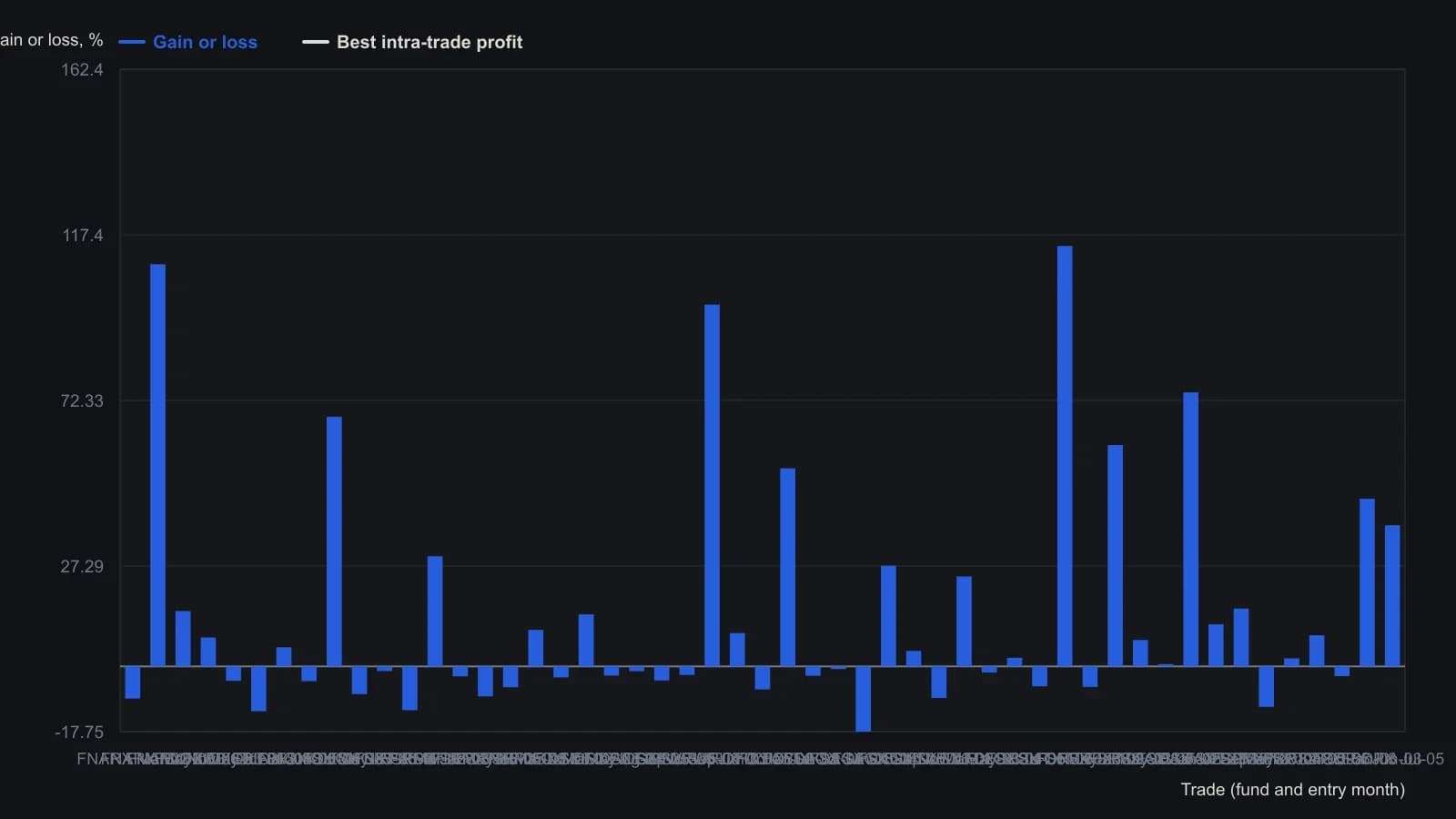
Entries and exits use the close of the first session after the weekly 10/40 exponential-average cross is confirmed. Open trades are marked to 6 April 2007. Three trades never went positive, so they have no MaxProfit bar.
All readings on this track · 57 readings
- 1988Constructing moving averages: weights, smoothing and crossovers
- 1988Constructing breadth and average trend states
- 1989Evaluating an always-in-the-market moving-average crossover
- 1989Constructing symmetric market-breadth ratio accumulators
- 1989Objective crossover tests of Fibonacci wave ratios
- 1990Volume-adjusted moving average construction
- 1991Constructing a mechanical crossover on a synthetic price series
- 1991A two-speed breadth reading for intermediate market direction
- 1992A Deutschemark yield map with dual-average and relative-strength timing
- 1992Confirming currency-fund trends with a crossover and a filter
- 1992A moving-average slope filter for crossover signals
- 1992Occupancy and split-sample tests for average crossovers
- 1994Gold-mining seasonality and bond-fund duration switching
- 1994Price oscillator from two moving averages
- 1995Explicit exponential weights and binary entry filters
- 1996Currency futures crossover with slope, bond filter, and stop
- 1996Two-market average crossover entry with a fixed stop
- 1997Construction of a filtered three-average crossover
- 1998Two-group exponential average compression as a trend filter
- 1998Constructing r-squared trend filters with dual lookbacks
- 1998Moving-average length is a habit, not a secret
- 1999Solving the close that triggers a moving-average crossover
- 2000Kagi yang and yin control versus crossover noise
- 2000Constructing simple moving average crossover filters
- 2000Building a vertical-horizontal filter to gate trend signals
- 2000Two-average crossover as a check on trend following
- 2003Stacked exponential-average retracement entries and extreme stops
- 2003Evaluating oscillator thresholds against optimized crossovers
- 2004Constructing a semicycle trend-quality filter
- 2004Commodity subgroups labeled by crossover, support, or convergence
- 2004Full-window evaluation of crossover trend systems
- 2004Two-average trend filters as a classroom critique of indicator stacking
- 2005Three-layer confirmation from a moving-average cross, candles, and Q-stick
- 2005Charting put prices beside an equity breakdown
- 2005Range-gated moving-average crossover construction
- 2007Anticipating a simple-average crossover with a threshold-close
- 2007Anticipating moving-average crossovers one bar ahead
- 2007Lead-series moving-average crossovers with a stochastic and relative strength index
- 2007Next-bar SMA crossover hypotheses from theoretical crossing values
- 2007Anticipating a moving-average crossover before confirmation
- 2007A three-horizon moving-average stack as a construction problem
- 2007Confirming trend with regression slope and r-squared
- 2008Constructing a multi-timeframe smoothed crossover
- 2008Best-day clusters versus trend filters
- 2008Allied markets as a confirmation gate for crossover and breakout signals
- 2008Weekly exponential-average crossover as a mechanical trend case study
- 2010Evaluating a 200-day crossover as long, short, and stand-aside rules
- 2010Read a 10-and-40 trend on two neighboring time frames
- 2012Sampling unit as a first-class parameter on dual simple moving averages
- 2012Constructing index-ETF entries from volatility-index persistence
- 2013Moving-average baselines versus crossover signals
- 2013Constructing a typical-price and heikin-ashi crossover as one mechanical procedure
- 2016A three-gate checklist for longs after a sharp drop
- 2016Weekly inflation-ratio crossover for commodity regimes
- 2017Normalized Laguerre zero-axis warning as a two-marker construction
- 2019Range-weighted construction of an adaptive exponential moving average
- 2020Construct a second-pullback entry after a moving-average crossover