1987issue C071-8
A mechanical rank-rotation sleeve for monthly fund leaders
A mixed no-load and low-load fund book is scored from overlapping three-, six-, and nine-month net-asset-value changes, then reviewed on a monthly ranking cycle. Equal-dollar units and staged cash make add, hold, exit, and abstain the same calendar procedure.
- A mixed equity and fixed-income fund book can be run as one monthly rank-rotation sleeve, scored from overlapping three-, six-, and nine-month net-asset-value changes after distribution adjustment.
- A holding stays only while it remains inside the top 25 ranks. Names that reach rank one, two, or three are added, and sale proceeds move into the current top-ranked names.
- Equal-dollar units and staged cash keep add, hold, exit, and no-trade months on one monthly clock, including months that still need fresh cash when there are no sales.
- The reconstruction covers an interval in which a leadership trend became established and is explicitly noted as untested in a declining market.
One book, one monthly procedure
This archive note describes a mixed mutual-fund book run as a single monthly procedure rather than as a collection of style labels. Rank rotation keeps, drops, or adds holdings by composite rank. Seasonal trading puts the score and the review on a fixed calendar clock: three-, six-, and nine-month windows plus a monthly ranking cycle, so entry, exit, and no-trade months share one schedule. The mechanical trading system is the complete, repeatable set of add, hold, sell, and cash-add rules, reconstructed as one procedure over the system holding period.
The surveyed universe contained about 85 no-load or low-load funds. It mixed equity and fixed-income names and included an average money-market fund plus three bond funds.
How the composite score is built
Each name received a composite score equal to the sum of three-, six-, and nine-month net-asset-value percentage changes after distribution adjustment. The windows overlap, so later months carry heavier implied weight. That sum is the composite score used when the monthly ranking is issued.
The opening book placed equal-dollar units in the three highest-scoring funds and was reviewed when a new monthly ranking was issued. An equal-dollar unit is a fixed cash increment used to open or add positions so new leaders enter at a comparable size.
Rank rules for add, hold, and exit
A holding stayed in the book if it remained inside the top 25 ranks. It was sold if it fell below that cutoff rank, the standing below which a holding is treated as lackluster and scheduled for exit. Any name that reached rank one, two, or three was added if it was not already held.
The rank-25 exit line was presented as an intuitive mark near one-third of the list, not a uniquely justified threshold, and could be moved with tolerance for weak results. Sale proceeds were redirected into the current top-ranked names. The add-the-leaders rule could still require fresh cash in a month with no sales.
Staged cash when leaders appear without sales
Cash was added in stages across the test years rather than committed as a single lump, because the add-leaders rule can demand new units even when the existing book is intact. Those reserved increments are staged cash, used only when the add-leaders rule fires without offsetting sales.
What the reconstruction recorded
In a 36-month reconstruction the book held 31 different funds, averaged about eight holdings per month, and required no trades in 11 of those months. Thirty-six completed buy-and-sell cycles had an average ownership of 8.2 months, and half of those cycles lasted six to 11 months.
The reconstruction is described as covering an interval in which a leadership trend became established.
Open fund lots marked at the end of 1986
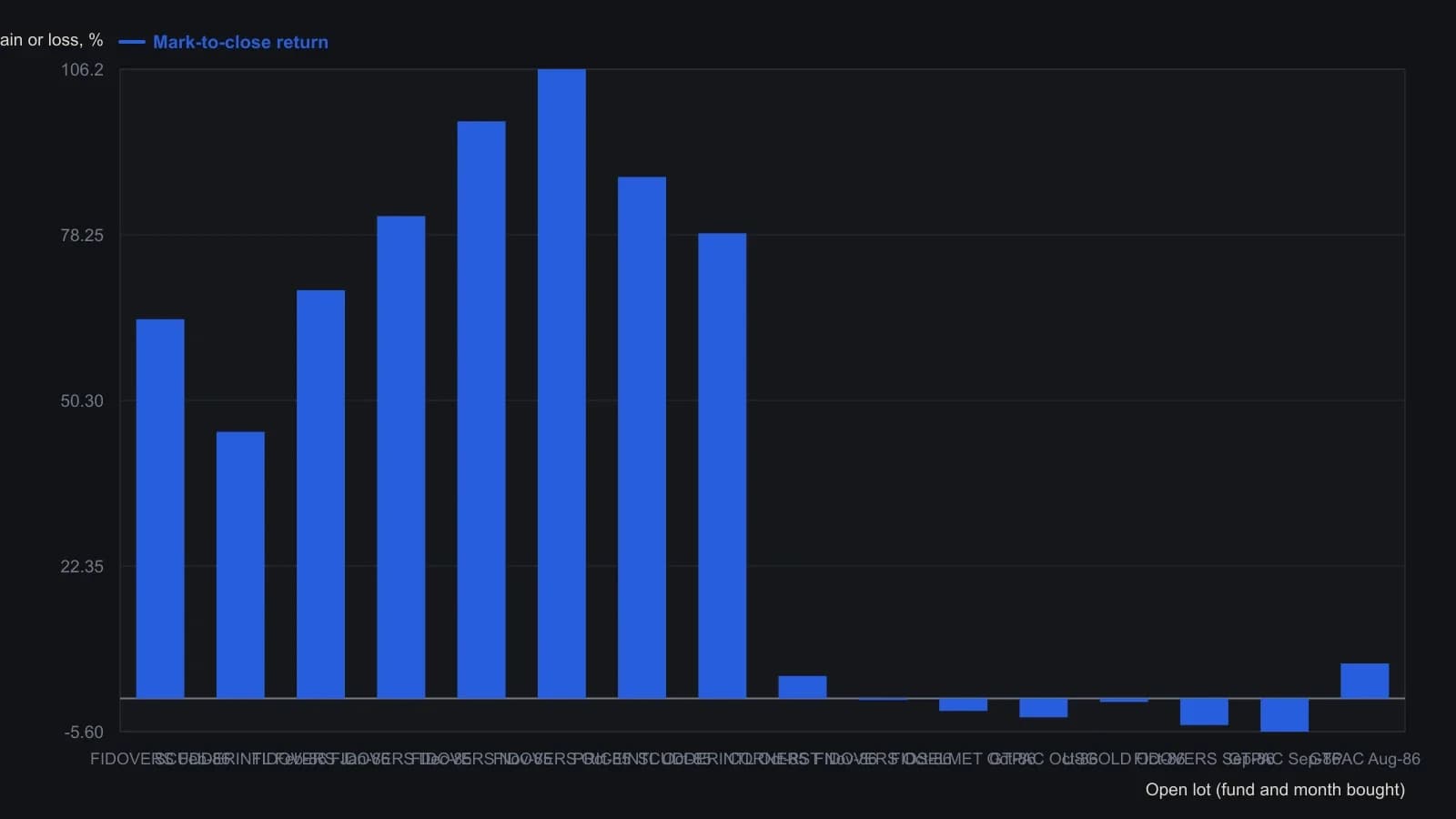
These lots were still open at the study close, so the percentages are marked results, not realized sales. Adjusted proceeds include dividends paid while the lot was held.
All readings on this track · 39 readings
- 1987A mechanical rank-rotation sleeve for monthly fund leaders
- 1989Rank rotation in a five-name no-load sleeve
- 1990Cycle-tested five-year fund rank rotation
- 1991Blue-chip rank rotation by relative-strength-index slope
- 1992Currency rank rotation and intermarket timing
- 1992Rank rotation and relative strength for portfolio construction
- 1994MACD crossovers then short-horizon rank rotation
- 1994A comparable group-trend ledger from published ranks
- 1997Normalized yield rank rotation as a full portfolio procedure
- 1997Constructing an investor preference index from two capitalization-weighted series
- 1998Constructing anchored momentum from a centered average
- 2000Rank rotation, a stop-loss order, and Relative Strength Index in fund switching
- 2003A one-fund daily rank is a two-sleeve construction problem
- 2004Evaluate rank rotation only where persistence already exists
- 2004Sector fund rank rotation with regression and trailing stops
- 2006Evaluating equal-weight annual yield-rank rotation
- 2007Weekly preferred-symbol reselection for mechanical trend systems
- 2011Portfolio capacity and entry pacing for mechanical systems
- 2011Rank rotation as a testable ETF construction procedure
- 2011The inverse-Fisher stochastic is a forecast layer until the book rules can be disabled
- 2012An underwater stretch is a sizing test for rank rotation
- 2015Rule-based ETF rotation as one testable procedure
- 2015MACD crossover evaluation by trend rank rotation
- 2015Persistence and strength as one close-to-close switch
- 2015Evaluating rank rotation after a persistence screen
- 2016Evaluating an annual valuation rank rotation
- 2017A two-step yield and price rank rotation for a five-name sleeve
- 2018Smoothed volatility and the missing rank-rotation exit
- 2018A five-condition scorecard that ranks stocks and can refuse the trade
- 2018Small-cap growth sleeve eligibility with trend and rank rotation
- 2018Evaluating rank-rotation momentum across fund wrappers
- 2019Evaluating an annual equity-gold momentum rank rotation
- 2019Evaluating equity-gold momentum on funds versus indexes
- 2020How a signed comparative-strength oscillator is built for rank rotation
- 2020Which calendar clock changes a gold-versus-equity rotation test
- 2020Four-dimension relative strength as rank rotation
- 2020Portfolio construction as a ranked relative-strength problem
- 2020Two clocks for a Nasdaq put/call sleeve
- 2020Rank, filter, and stop the hedge sleeve as one procedure