1997issue C041-4
Normalized yield rank rotation as a full portfolio procedure
A dividend-yield ranking rule becomes a full portfolio procedure when current yield is scaled by a multi-year estimated yield, the ten highest normalized-yield names are held in equal weight, and the book stays invested through an anniversary cycle even after a year that lagged the industrials.
- The procedure ranks dividend-paying names by current yield divided by a multi-year estimated yield, then selects the ten highest normalized-yield names.
- Index membership and a January 1 anniversary are scoring conventions. The same ranking can use a different menu or anniversary, and official scoring does not apply an optional three-month gap between ranking and execution.
- Normalization became necessary after lower-yield growth names entered the industrials, because raw high yield no longer automatically isolated the most out-of-favor names.
- The published system stays fully invested and rejects unused hybrid timing overlays as not worth the cost of being out of the market.
How the ranking selects the book
The procedure ranks dividend-paying names by current yield divided by a multi-year estimated yield, then selects the ten highest normalized-yield names. Those names are held as a ten-name equal-weight book through the next anniversary.
Scoring conventions are not the only menu
Index membership and a January 1 anniversary are scoring conventions. The same ranking can use a different menu or anniversary. An optional three-month gap between ranking and execution can be used, but official scoring does not apply that gap.
Why raw high yield was no longer enough
Normalization became necessary after lower-yield growth names entered the industrials between 1985 and 1991, because raw high yield no longer automatically isolated the most out-of-favor names.
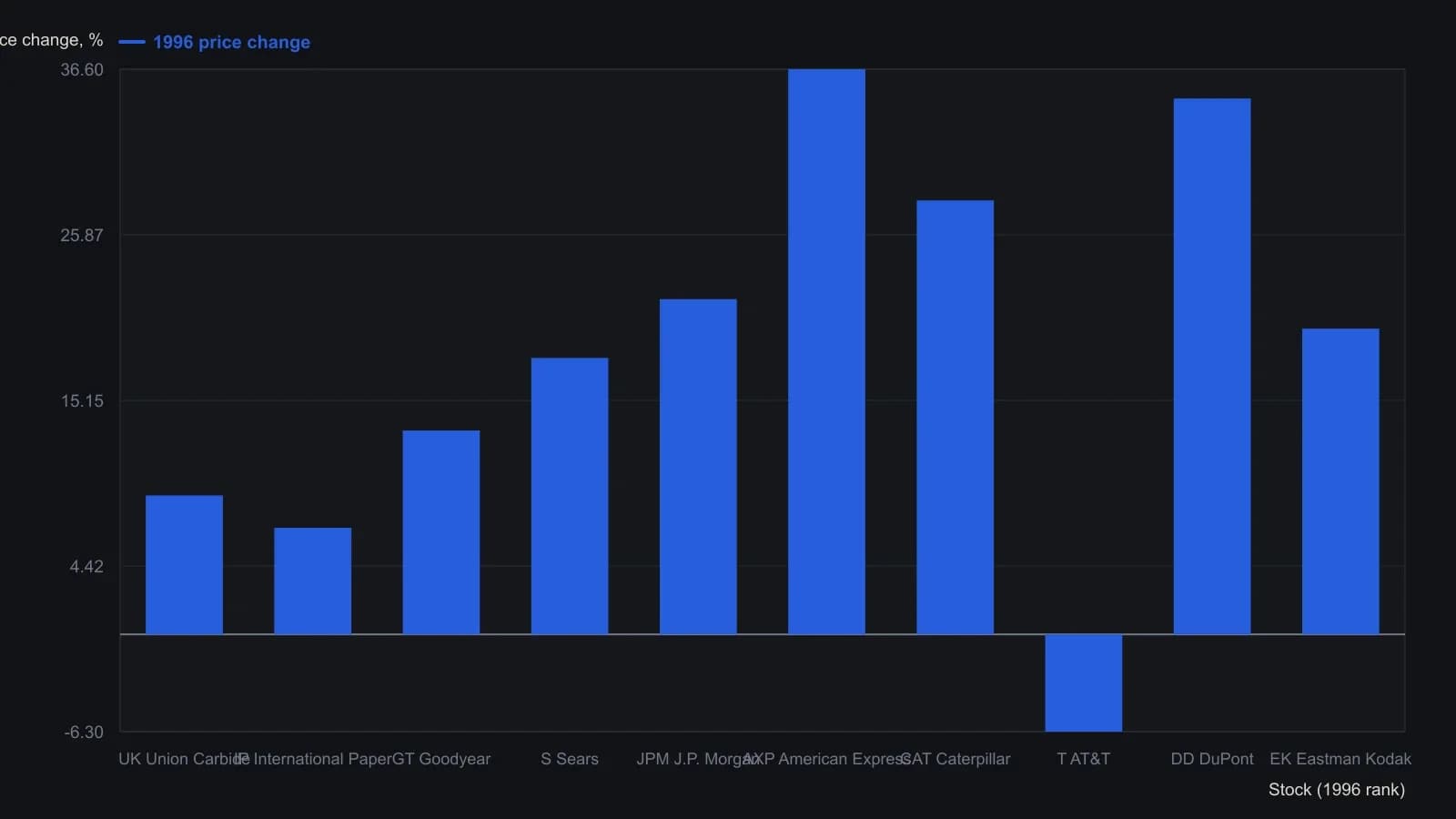
1996 New Dow strategy holdings: price change by rank
An official book that lagged still held to anniversary
In the 1996 official book, nine of ten holdings had positive price change and one large loser was enough to weigh on a ten-name equal-weight book. The 1996 official book returned 20.68 percent total, versus 29.11 percent for the Dow Jones Industrial Average with dividend reinvestment.
From 1985 through 1996 the procedure’s average total return was 24.34 percent versus 19.25 percent for the Dow Jones Industrial Average, with a 22.6 percent compound annual figure presented as the more meaningful long-horizon rate.
A cycle can stall after the rank is set
Before 1996 the procedure lagged the industrials in 1987 and 1990 and then recovered in 1988 and 1991. The archive ties that pattern to a cycle stalling in one phase while the ranking is already set for the next.
How the next book was sized
The 1997 book used 1999-2001 estimated yields and January 2, 1997 prices only to size equal-dollar holdings. Three incoming names posted normalized-yield ratios of 1.0, described as unusually low for a selected book.
The published system stays fully invested
The published system stays fully invested and rejects unused hybrid timing overlays as not worth the cost of being out of the market.
All readings on this track · 39 readings
- 1987A mechanical rank-rotation sleeve for monthly fund leaders
- 1989Rank rotation in a five-name no-load sleeve
- 1990Cycle-tested five-year fund rank rotation
- 1991Blue-chip rank rotation by relative-strength-index slope
- 1992Currency rank rotation and intermarket timing
- 1992Rank rotation and relative strength for portfolio construction
- 1994MACD crossovers then short-horizon rank rotation
- 1994A comparable group-trend ledger from published ranks
- 1997Normalized yield rank rotation as a full portfolio procedure
- 1997Constructing an investor preference index from two capitalization-weighted series
- 1998Constructing anchored momentum from a centered average
- 2000Rank rotation, a stop-loss order, and Relative Strength Index in fund switching
- 2003A one-fund daily rank is a two-sleeve construction problem
- 2004Evaluate rank rotation only where persistence already exists
- 2004Sector fund rank rotation with regression and trailing stops
- 2006Evaluating equal-weight annual yield-rank rotation
- 2007Weekly preferred-symbol reselection for mechanical trend systems
- 2011Portfolio capacity and entry pacing for mechanical systems
- 2011Rank rotation as a testable ETF construction procedure
- 2011The inverse-Fisher stochastic is a forecast layer until the book rules can be disabled
- 2012An underwater stretch is a sizing test for rank rotation
- 2015Rule-based ETF rotation as one testable procedure
- 2015MACD crossover evaluation by trend rank rotation
- 2015Persistence and strength as one close-to-close switch
- 2015Evaluating rank rotation after a persistence screen
- 2016Evaluating an annual valuation rank rotation
- 2017A two-step yield and price rank rotation for a five-name sleeve
- 2018Smoothed volatility and the missing rank-rotation exit
- 2018A five-condition scorecard that ranks stocks and can refuse the trade
- 2018Small-cap growth sleeve eligibility with trend and rank rotation
- 2018Evaluating rank-rotation momentum across fund wrappers
- 2019Evaluating an annual equity-gold momentum rank rotation
- 2019Evaluating equity-gold momentum on funds versus indexes
- 2020How a signed comparative-strength oscillator is built for rank rotation
- 2020Which calendar clock changes a gold-versus-equity rotation test
- 2020Four-dimension relative strength as rank rotation
- 2020Portfolio construction as a ranked relative-strength problem
- 2020Two clocks for a Nasdaq put/call sleeve
- 2020Rank, filter, and stop the hedge sleeve as one procedure