1996issue C081-6
Annual normalized-yield rank rotation for cyclical sleeves
A concentrated sleeve is built from a fixed large-cap menu by ranking names on current yield scaled by a firm-specific expected-yield, then holding only the top third. Entry, hold, exit, and abstention are reviewed together once a year.
- Form the sleeve by ranking a fixed 30-name large-cap menu on normalized-yield and holding the top 10 names.
- Normalized-yield is the ratio of current income yield to a firm-specific expected-yield, not raw current yield alone.
- At the annual review, buy a name that enters the top third, hold it while it stays there, sell it when another name displaces it, and treat names below the top-third-cutoff as abstention.
- The qualitative case requires the business cycle to last at least twice the interval between reviews, so an annual date is presented as adequate when cycles typically last longer than two years.
One testable sleeve rule
Editorial framing: TradersWeek presents the archive workflow as a single sleeve rule that joins value-style cheapness, a multi-year business-cycle-regime, and calendar rank-rotation. The archive itself describes a historical ranking procedure, not that three-part teaching frame.
A concentrated sleeve is formed by ranking a fixed 30-name large-cap menu and holding the top 10 names. The menu is the fixed, diversified list from which the concentrated sleeve is drawn.
How normalized-yield ranks the menu
The ranking input is the ratio of current yield to a firm-specific expected-yield, not raw current yield alone. Normalized-yield is current income yield divided by a firm-specific expected-yield so names with different typical payout levels can share one rank list.
Expected-yield figures covering a two-to-four-year horizon are used as a scaling device. Expected-yield is a two-to-four-year forward income-yield estimate used only as a scale for where a name sits in its own price cycle. Whether those figures later prove accurate is treated as secondary.
Annual rank-rotation and abstention
The sleeve is reviewed once a year on a prechosen date, and where that date falls on the cycle is treated as arbitrary. Rank-rotation is a once-a-year reordering of the menu that funds the names in the top third of normalized-yield and drops those that fall out of that band.
A name is bought when it enters the top third of normalized yields, held while it remains there, and sold when another name displaces it from that band. The top-third-cutoff is the rank line that separates names eligible to be held from names that must be left idle until a later review.
Abstention is the explicit no-position outcome when a name's normalized-yield is below the cutoff at the scheduled review.
A multi-year business-cycle-regime
Every name in the menu is treated as having in-favor and out-of-favor phases, including consumer names usually labeled as growth. Names from different industry groups are assumed to reach cyclic price peaks at different points in a multi-year business cycle.
The business-cycle-regime is the assumption that industry groups reach price peaks at different points on a multi-year cycle, so a calendar rank can rotate exposure across those phases. The qualitative case requires the business cycle to last at least twice the interval between reviews. With cycles typically longer than two years, an annual review is presented as adequate.
Annual total return: new Dow strategy versus DJIA and Dow dividend strategy
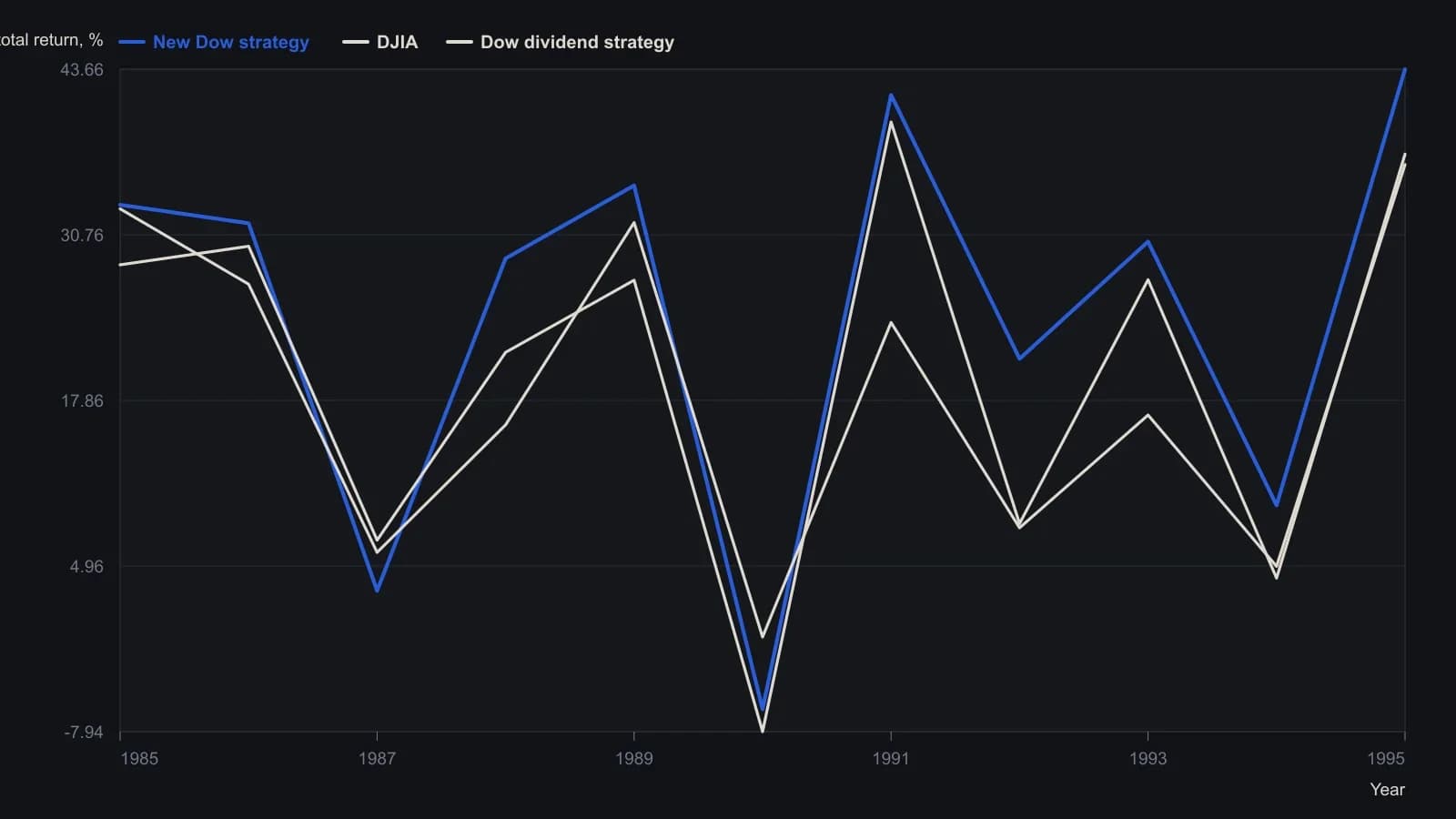
Calendar-year total returns as printed in the source table. The authors selected the 1995 ten-name sleeve on 1 January and ranked names on current yield over Value Line two-to-four-year expected yield. Tests start in 1985, the earliest year they ran the normalized rule. Summary rows (cumulative gain and compound average) are omitted from the plot.
The same cutoff on a larger menu
The same top-third normalized-yield ranking can be applied to a 500-name menu, producing a 166-name sleeve.
All readings on this track · 16 readings
- 1988A two-rule classroom book of cheapness and new highs
- 1995A supermarket-chain case for yield, trendline, and a written checklist
- 1996Annual normalized-yield rank rotation for cyclical sleeves
- 1996Value filter then rank-rotate as one procedure
- 1997Dow high-yield rank rotation as a testable portfolio procedure
- 1998Low relative P/E plus a trendline reversal for regime-aware stock selection
- 1998Rank rotation, value screens, and ten-stock diversification
- 2001Earnback period ranking for growth-adjusted screens
- 2003Stress-testing calendar yield rotation in a declining tape
- 2003A value overlay and strangle hedge during a growth-led regime
- 2005Unfashionable value versus momentum in the book
- 2007Why premove fundamentals rarely flag tenfold-price moves
- 2012Year-end yield rank rotation with a collapse veto
- 2015A five-name January book from yield and price ranks
- 2017Screening value traps with regime-aware overlays
- 2017A pre-trade fail test for the cheap-looking name