2015issue C1234-37
Evaluating rank rotation after a persistence screen
A historical workflow first keeps names whose annual switch-rate stays below 63, then tests a one-name rank-rotation overlay by adding names one at a time. Occupied-day share and the overlay annual figure are read together so coverage can be compared with dilution.
- A name is treated as persistent only when its annual switch-rate stays below 63. In the ten-name window from 30 June 1994 through 1 July 2014, every listed name met that screen.
- Rank-rotation holds only the currently strongest eligible name and stays flat when none qualifies. The one-rank rule was out of the market about half the time, so its occupied-period rate of change exceeded its calendar annual figure.
- In the greedy add-one sequence, days spent flat fell from 53.3 percent with one name to 9.8 percent with ten names, while the overlay annual figure rose through six names and then declined. Every ten-name path ended at the same 54 percent annual figure.
- The two-name overlay accepts a name's next return only through a rule-based-entry gate: that name must be the current leader, and its prior return must clear a near-zero threshold. Apparent best roster size still depends on the add-one path.
Two checks in one procedure
This article treats a persistence screen and a rank-rotation overlay as a single, testable procedure. Editorial framing: first confirm short-term memory with a switch-rate cutoff, then measure whether adding names one at a time improves occupied-day coverage more than it dilutes the overlay figure. Rank-rotation holds only the currently strongest eligible name and stays flat when no name qualifies. The overlay is a momentum-strategy: it conditions participation on recent continuation rather than on a static basket.
Confirm persistence with switch-rate
A name is treated as persistent only when its annual switch count stays below 63. Switch-rate is the annual count of long-to-flat or name-to-name changes used as that screen. The ten-name study window runs from 30 June 1994 through 1 July 2014. Across those ten names, every listed switch-rate is below 63, so each name meets the persistence screen.
Start from the one-rank overlay
One-rank is a single-name persistence rule that is long only after a non-negative prior return and is otherwise out of the market. The one-rank rule is described as being out of the market about half the time, so its occupied-period rate of change is larger than its calendar annual figure. Occupied-day share is the fraction of calendar days the composite is long any eligible name rather than flat.
Dual overlays and the entry gate
Pairing the ten names produces 45 dual combinations, and the strongest dual overlay in that grid is RES with FAST. The two-name overlay accepts a name's next return only when that name currently has the larger prior return and that prior return clears a near-zero threshold. That if-and check is the rule-based-entry gate. Equity and max-drawdown series are then built from the summed accepted returns.
Adding names one at a time
In the greedy add-one sequence, the overlay annual figure rises through six names and then declines toward the full ten-name mix. As names are added in that sequence, days spent flat fall from 53.3 percent with one name to 9.8 percent with ten names, while up-day and down-day shares both rise. Because the overlay depends on the set of names rather than insertion order, every ten-name path ends at the same 54 percent annual figure.
Roster size follows the path
The greedy path peaks at six names, the one-rank descending path at five, an alphabetical path at eight, and the reverse one-rank path only at ten, so the apparent best roster size is path-dependent.
Overlay annual return as names are added one at a time
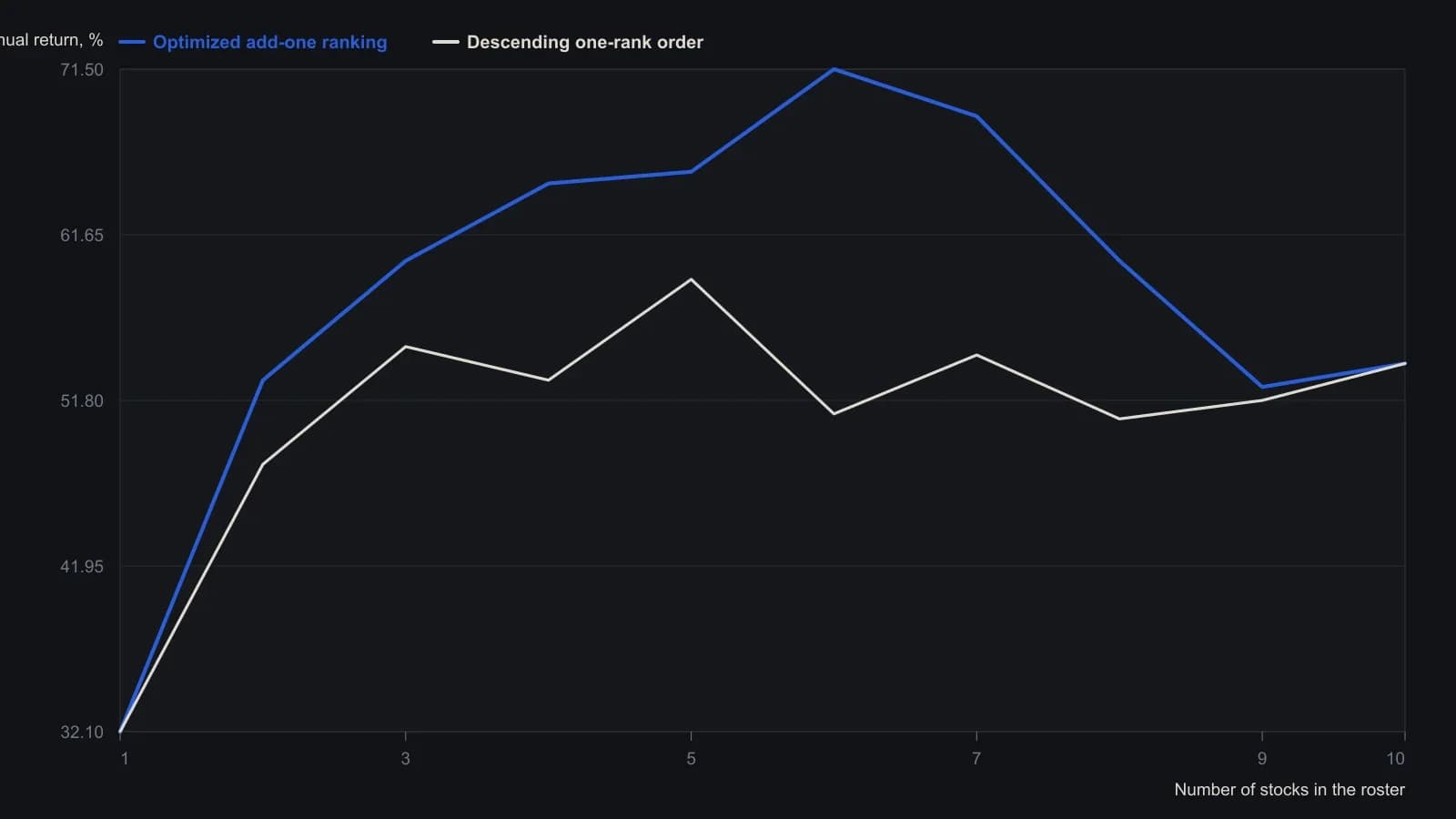
The source treats the upper path as in-sample cherry-picking and offers the one-rank order as the more realistic insertion rule. Both rosters keep only names with fewer than 63 switches per year. Study window 30 June 1994 to 1 July 2014. Alphabetical and reverse-rank paths appear on the printed plot but were not tabled, so they are omitted.
All readings on this track · 39 readings
- 1987A mechanical rank-rotation sleeve for monthly fund leaders
- 1989Rank rotation in a five-name no-load sleeve
- 1990Cycle-tested five-year fund rank rotation
- 1991Blue-chip rank rotation by relative-strength-index slope
- 1992Currency rank rotation and intermarket timing
- 1992Rank rotation and relative strength for portfolio construction
- 1994MACD crossovers then short-horizon rank rotation
- 1994A comparable group-trend ledger from published ranks
- 1997Normalized yield rank rotation as a full portfolio procedure
- 1997Constructing an investor preference index from two capitalization-weighted series
- 1998Constructing anchored momentum from a centered average
- 2000Rank rotation, a stop-loss order, and Relative Strength Index in fund switching
- 2003A one-fund daily rank is a two-sleeve construction problem
- 2004Evaluate rank rotation only where persistence already exists
- 2004Sector fund rank rotation with regression and trailing stops
- 2006Evaluating equal-weight annual yield-rank rotation
- 2007Weekly preferred-symbol reselection for mechanical trend systems
- 2011Portfolio capacity and entry pacing for mechanical systems
- 2011Rank rotation as a testable ETF construction procedure
- 2011The inverse-Fisher stochastic is a forecast layer until the book rules can be disabled
- 2012An underwater stretch is a sizing test for rank rotation
- 2015Rule-based ETF rotation as one testable procedure
- 2015MACD crossover evaluation by trend rank rotation
- 2015Persistence and strength as one close-to-close switch
- 2015Evaluating rank rotation after a persistence screen
- 2016Evaluating an annual valuation rank rotation
- 2017A two-step yield and price rank rotation for a five-name sleeve
- 2018Smoothed volatility and the missing rank-rotation exit
- 2018A five-condition scorecard that ranks stocks and can refuse the trade
- 2018Small-cap growth sleeve eligibility with trend and rank rotation
- 2018Evaluating rank-rotation momentum across fund wrappers
- 2019Evaluating an annual equity-gold momentum rank rotation
- 2019Evaluating equity-gold momentum on funds versus indexes
- 2020How a signed comparative-strength oscillator is built for rank rotation
- 2020Which calendar clock changes a gold-versus-equity rotation test
- 2020Four-dimension relative strength as rank rotation
- 2020Portfolio construction as a ranked relative-strength problem
- 2020Two clocks for a Nasdaq put/call sleeve
- 2020Rank, filter, and stop the hedge sleeve as one procedure