2003issue C011-2
Stress-testing calendar yield rotation in a declining tape
A 30-name industrial average was ranked by dividend yield, the ten highest-yielding members were held for one calendar year, and a tighter overlay kept only the five lowest-priced names. This article scores that full procedure in 2002, after the prior advance had already broken.
- The evaluated procedure ranked a 30-name industrial average by dividend yield, bought the ten highest-yielding members, and held that sleeve for one calendar year before repeating the sort.
- A price-filtered overlay then kept only the five lowest-priced names from that high-yield ten, treating depressed price as an added cheapness filter.
- From 31 December 2001 through 20 September 2002 the price-filtered five declined 25.9 percent, the remaining high-yield five declined 15.9 percent, the industrial average declined 21 percent, and the 500-stock index declined 26 percent.
- From 1996 through 2001 the high-yield rotation did not produce a consistent lead versus those buy-and-hold paths. TradersWeek editorial: the 2002 calendar hold is a regime-transfer test, not late proof of a steady edge.
What the procedure actually did
The evaluated procedure ranked a 30-name industrial average by dividend yield, bought the ten highest-yielding members, and held that sleeve for one calendar year before repeating the sort.
That construction is a rank rotation: a scheduled re-sort of a fixed universe that replaces the held sleeve when the ranking horizon expires. The high-yield screen selects index members with the highest dividend yields at the ranking date as an income-and-value filter. The calendar hold is a one-year holding period aligned to the ranking date rather than to intra-year price or volatility signals.
A tighter value overlay kept only the five lowest-priced names from that high-yield ten, treating depressed price as an added cheapness filter. That second ranking is the price-filtered overlay.
The 2002 high-yield sleeve and the cheap five
The 2002 high-yield ten were Caterpillar, DuPont, Eastman Kodak, ExxonMobil, General Motors, International Paper, JP Morgan Chase, Merck, Philip Morris, and SBC Communications.
The five cheapest names inside that sleeve were Eastman Kodak, ExxonMobil, International Paper, JP Morgan Chase, and SBC Communications.
How the 2002 window scored the hold
From 31 December 2001 through 20 September 2002 the price-filtered five showed a combined decline of 25.9 percent, while the remaining five high-yield names declined 15.9 percent.
Over that same 2002 window a buy-and-hold path in the industrial average was down 21 percent and the broad 500-stock index was down 26 percent.
The 2002 cheap-five group carried an average dividend yield of about 3.46 percent, which did not offset a price decline of more than one quarter over the first three quarters of the year.
The same rule before the tape broke
A year-by-year comparison from 1996 through 2001 showed the high-yield rotation did not produce a consistent lead versus industrial-average or 500-stock buy-and-hold results in the closing years of the prior advance.
High-yield Dow ten versus Dow 30 and S&P 500
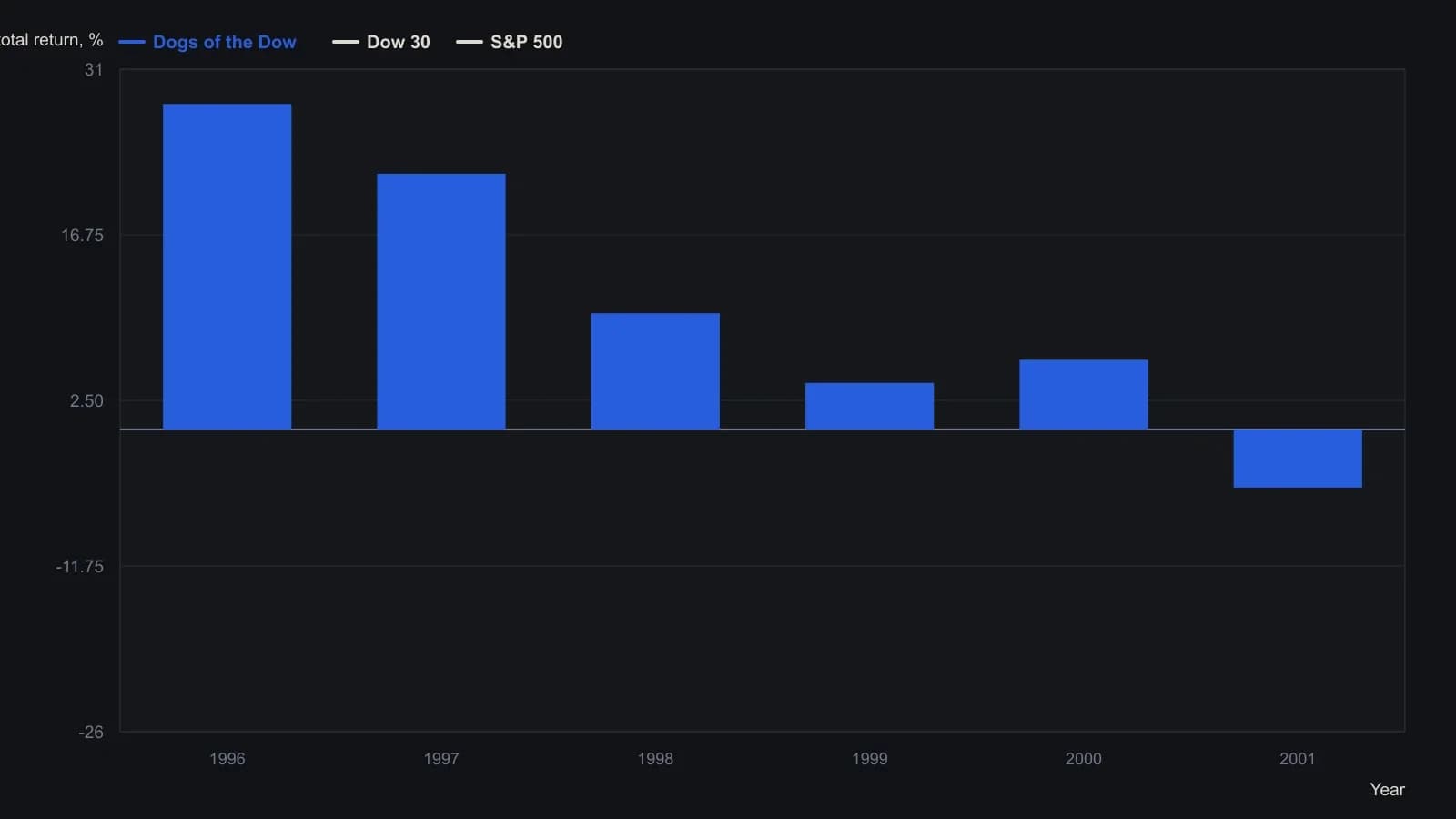
The 2002 observations cover January–October only. The source left the high-yield sleeve blank in that row, so that series stops at 2001.
All readings on this track · 16 readings
- 1988A two-rule classroom book of cheapness and new highs
- 1995A supermarket-chain case for yield, trendline, and a written checklist
- 1996Annual normalized-yield rank rotation for cyclical sleeves
- 1996Value filter then rank-rotate as one procedure
- 1997Dow high-yield rank rotation as a testable portfolio procedure
- 1998Low relative P/E plus a trendline reversal for regime-aware stock selection
- 1998Rank rotation, value screens, and ten-stock diversification
- 2001Earnback period ranking for growth-adjusted screens
- 2003Stress-testing calendar yield rotation in a declining tape
- 2003A value overlay and strangle hedge during a growth-led regime
- 2005Unfashionable value versus momentum in the book
- 2007Why premove fundamentals rarely flag tenfold-price moves
- 2012Year-end yield rank rotation with a collapse veto
- 2015A five-name January book from yield and price ranks
- 2017Screening value traps with regime-aware overlays
- 2017A pre-trade fail test for the cheap-looking name