2019issue C1250-51
Evaluating equity-gold momentum on funds versus indexes
Before treating an equity-versus-gold momentum rotation as one procedure, check whether fund prices and the matching index series generate the same historical path.
- A momentum procedure was tested in parallel on an equity-and-gold fund pair and on the matching equity-index and gold price series.
- Calendar-year results were reported as identical for each year from 2006 through 2018, and the two result series had a reported correlation of 0.998 over the 2004 through 2018 evaluation window.
- Matching average-return and volatility summaries, together with that near-identity, were used to treat the funds as a practical vehicle for the same procedure.
- The evaluation also compared how the momentum procedure behaved during crisis periods with how it behaved in the periods that followed.
A vehicle test, not a new rule
A momentum procedure was tested in parallel on an equity-and-gold fund pair and on the matching equity-index and gold price series. The archive describes those two implementations as the same procedure, run once on fund prices and once on the matching index and gold price series.
The evaluation window cited for the momentum procedure ran from 2004 through 2018.
What the two paths showed
Calendar-year results for those two implementations were reported as identical for each year from 2006 through 2018. Over the 2004 through 2018 window, the correlation between the two result series was reported as 0.998.
Average-return and volatility summaries were reported as the same for the fund-based test and the index-based test. That near-identity was used to treat the funds as a practical vehicle for the same momentum procedure.
Crisis windows and the periods after them
The evaluation compared how the momentum procedure behaved during crisis periods with how it behaved in the periods that followed. The archive reports that comparison as part of the same historical workflow.
Equity-gold momentum annual returns on funds versus indexes
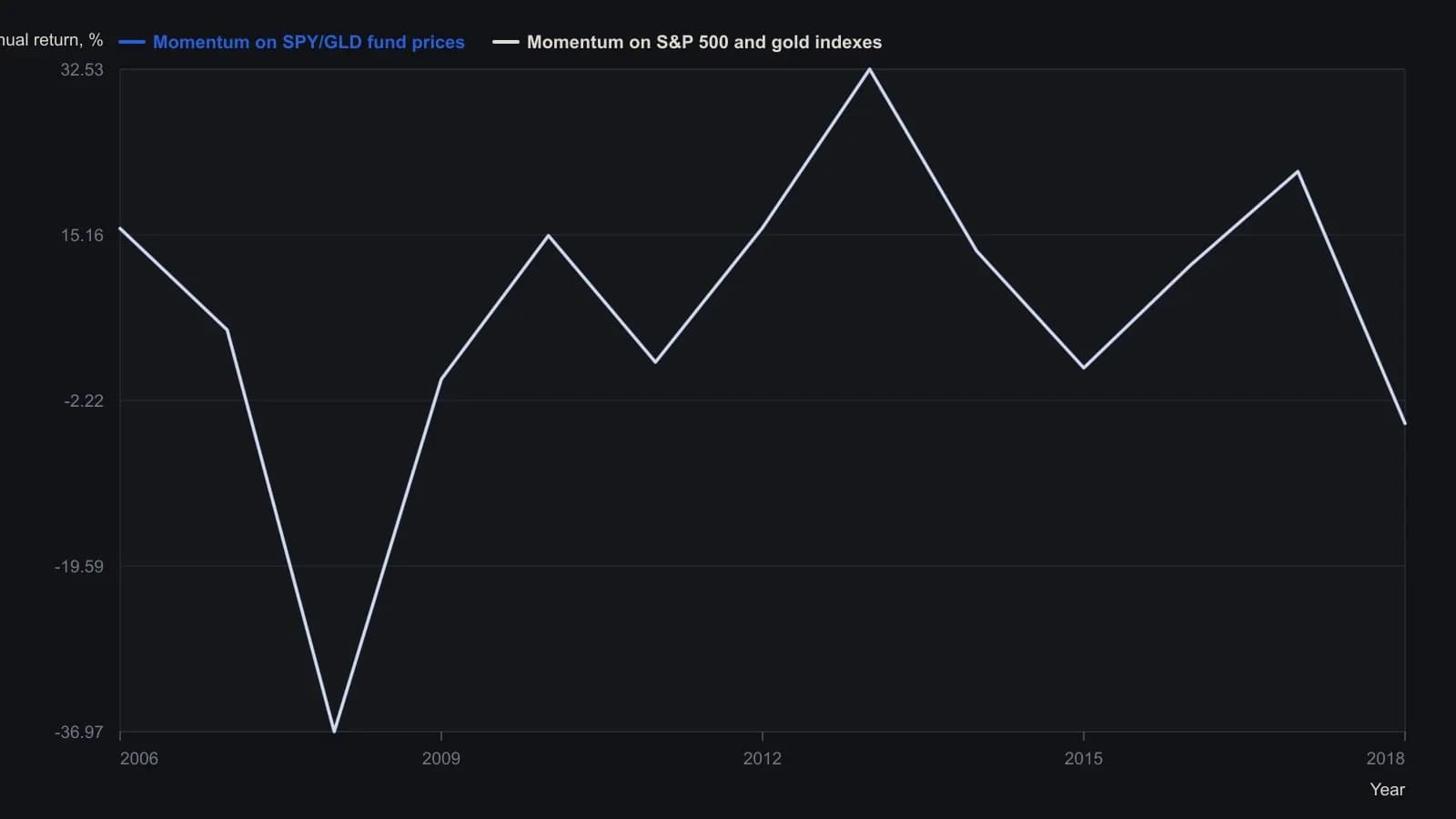
Both columns in the printed table are identical for every year shown. Average return 7.16% and volatility 16.69% are summary rows, not extra years. The article also reports a 0.998 correlation over 2004–2018, two years longer than the yearly list.
How to name the procedure under test
Editorial: TradersWeek treats the object under test as one procedure, not as three separate stories. A momentum strategy is a backtested signal procedure that turns rule inputs, market state, and execution constraints into one testable sequence of entries, exits, and standing aside over the system holding period.
Editorial: the equity-versus-gold choice is a rank rotation, a backtested signal procedure that orders candidates and holds the higher-ranked names for the system holding period, so rotation itself is the trade rule.
Editorial: calendar-year results and the crisis-versus-aftermath comparison keep a seasonal-trading question visible. Seasonal trading is a backtested signal procedure that conditions participation on recurring calendar or cycle windows, keeping entry, exit, and abstention rules testable as one procedure. Those labels are editorial. The archive reports the vehicle comparison.
All readings on this track · 39 readings
- 1987A mechanical rank-rotation sleeve for monthly fund leaders
- 1989Rank rotation in a five-name no-load sleeve
- 1990Cycle-tested five-year fund rank rotation
- 1991Blue-chip rank rotation by relative-strength-index slope
- 1992Currency rank rotation and intermarket timing
- 1992Rank rotation and relative strength for portfolio construction
- 1994MACD crossovers then short-horizon rank rotation
- 1994A comparable group-trend ledger from published ranks
- 1997Normalized yield rank rotation as a full portfolio procedure
- 1997Constructing an investor preference index from two capitalization-weighted series
- 1998Constructing anchored momentum from a centered average
- 2000Rank rotation, a stop-loss order, and Relative Strength Index in fund switching
- 2003A one-fund daily rank is a two-sleeve construction problem
- 2004Evaluate rank rotation only where persistence already exists
- 2004Sector fund rank rotation with regression and trailing stops
- 2006Evaluating equal-weight annual yield-rank rotation
- 2007Weekly preferred-symbol reselection for mechanical trend systems
- 2011Portfolio capacity and entry pacing for mechanical systems
- 2011Rank rotation as a testable ETF construction procedure
- 2011The inverse-Fisher stochastic is a forecast layer until the book rules can be disabled
- 2012An underwater stretch is a sizing test for rank rotation
- 2015Rule-based ETF rotation as one testable procedure
- 2015MACD crossover evaluation by trend rank rotation
- 2015Persistence and strength as one close-to-close switch
- 2015Evaluating rank rotation after a persistence screen
- 2016Evaluating an annual valuation rank rotation
- 2017A two-step yield and price rank rotation for a five-name sleeve
- 2018Smoothed volatility and the missing rank-rotation exit
- 2018A five-condition scorecard that ranks stocks and can refuse the trade
- 2018Small-cap growth sleeve eligibility with trend and rank rotation
- 2018Evaluating rank-rotation momentum across fund wrappers
- 2019Evaluating an annual equity-gold momentum rank rotation
- 2019Evaluating equity-gold momentum on funds versus indexes
- 2020How a signed comparative-strength oscillator is built for rank rotation
- 2020Which calendar clock changes a gold-versus-equity rotation test
- 2020Four-dimension relative strength as rank rotation
- 2020Portfolio construction as a ranked relative-strength problem
- 2020Two clocks for a Nasdaq put/call sleeve
- 2020Rank, filter, and stop the hedge sleeve as one procedure