2017issue C0722-23
A two-step yield and price rank rotation for a five-name sleeve
A rank-rotation sleeve can be limited to five names from a 30-name list by taking a high-yield-first-cut, then a low-price-second-cut, and holding an equal-amount-sleeve for a calendar-year-hold. Editorial reading: the scheduled review makes entry, exit, and abstention one procedure rather than discretionary stock picking.
- The sleeve is limited to five names drawn from a 30-name set of well-known US companies rather than from the full equity market.
- A high-yield-first-cut selects the ten highest-yielding names; a low-price-second-cut then keeps the five lowest-priced names among those ten.
- The five names are bought as an equal-amount-sleeve and held for a calendar-year-hold, then re-ranked on the last trading session of the year or the first trading session of the new year.
- Selection is a mechanical ranking procedure so names are not chosen from product familiarity or sentiment.
A five-name sleeve from a fixed list
The archive describes a rank-rotation sleeve: a scheduled re-ranking of a fixed universe that rebuilds the held sleeve when the ranking date arrives. The sleeve is limited to five names drawn from a 30-name set of well-known US companies rather than from the full equity market.
The five-name sleeve is presented as a lower-outlay alternative to holding all ten high-yield names.
High-yield first, then low price
The first ranking step is a high-yield-first-cut: the ten names with the highest dividend yields on the ranking date.
The second ranking step is a low-price-second-cut: the five lowest-priced names remaining after the high-yield first cut.
Selection is treated as a mechanical ranking procedure so names are not chosen from product familiarity or sentiment.
Equal amounts and a calendar-year hold
The five names are bought as an equal-amount-sleeve, meaning the same dollar amount of each selected name rather than the same share count. They are held for one calendar year, then re-ranked and replaced as the new list requires.
The ranking date is the last trading session of the year or the first trading session of the new year. The calendar-year-hold is a predefined holding period that lasts one calendar year from ranking date to the next review.
The case study notes that this hold period can be hard to leave untouched when individual names rise sharply during the year.
Calendar-year returns of the five-name puppies sleeve, 2011-2016
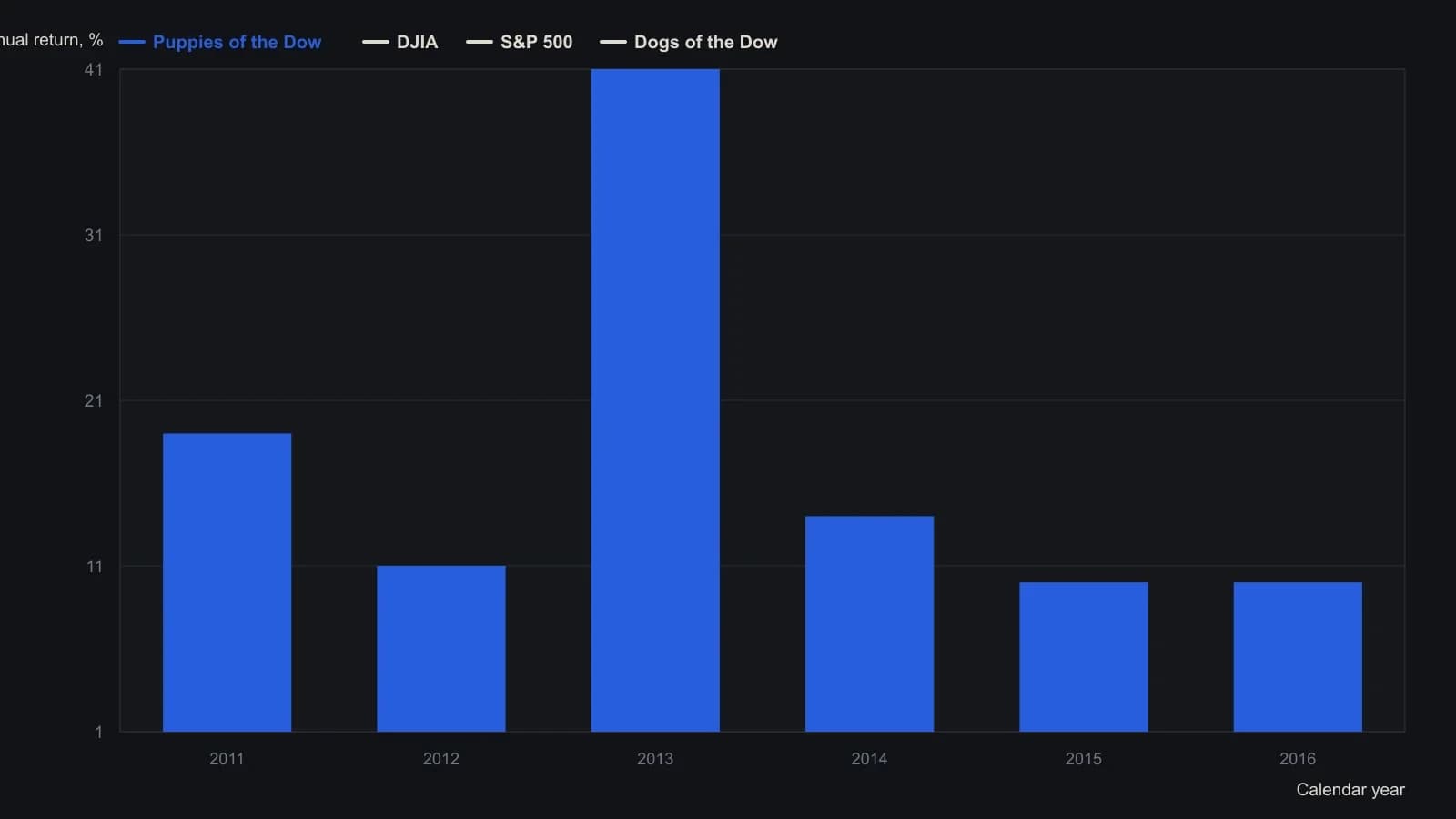
The source reports calendar-year percentage returns only and does not state whether dividends are included in the figures.
The 2017 case-study sleeve
The 2017 case-study sleeve, ranked on 31 December 2016, consisted of Cisco Systems, Pfizer, Coca-Cola, Verizon, and Merck.
All readings on this track · 39 readings
- 1987A mechanical rank-rotation sleeve for monthly fund leaders
- 1989Rank rotation in a five-name no-load sleeve
- 1990Cycle-tested five-year fund rank rotation
- 1991Blue-chip rank rotation by relative-strength-index slope
- 1992Currency rank rotation and intermarket timing
- 1992Rank rotation and relative strength for portfolio construction
- 1994MACD crossovers then short-horizon rank rotation
- 1994A comparable group-trend ledger from published ranks
- 1997Normalized yield rank rotation as a full portfolio procedure
- 1997Constructing an investor preference index from two capitalization-weighted series
- 1998Constructing anchored momentum from a centered average
- 2000Rank rotation, a stop-loss order, and Relative Strength Index in fund switching
- 2003A one-fund daily rank is a two-sleeve construction problem
- 2004Evaluate rank rotation only where persistence already exists
- 2004Sector fund rank rotation with regression and trailing stops
- 2006Evaluating equal-weight annual yield-rank rotation
- 2007Weekly preferred-symbol reselection for mechanical trend systems
- 2011Portfolio capacity and entry pacing for mechanical systems
- 2011Rank rotation as a testable ETF construction procedure
- 2011The inverse-Fisher stochastic is a forecast layer until the book rules can be disabled
- 2012An underwater stretch is a sizing test for rank rotation
- 2015Rule-based ETF rotation as one testable procedure
- 2015MACD crossover evaluation by trend rank rotation
- 2015Persistence and strength as one close-to-close switch
- 2015Evaluating rank rotation after a persistence screen
- 2016Evaluating an annual valuation rank rotation
- 2017A two-step yield and price rank rotation for a five-name sleeve
- 2018Smoothed volatility and the missing rank-rotation exit
- 2018A five-condition scorecard that ranks stocks and can refuse the trade
- 2018Small-cap growth sleeve eligibility with trend and rank rotation
- 2018Evaluating rank-rotation momentum across fund wrappers
- 2019Evaluating an annual equity-gold momentum rank rotation
- 2019Evaluating equity-gold momentum on funds versus indexes
- 2020How a signed comparative-strength oscillator is built for rank rotation
- 2020Which calendar clock changes a gold-versus-equity rotation test
- 2020Four-dimension relative strength as rank rotation
- 2020Portfolio construction as a ranked relative-strength problem
- 2020Two clocks for a Nasdaq put/call sleeve
- 2020Rank, filter, and stop the hedge sleeve as one procedure