2018issue C0646-56
A five-condition scorecard that ranks stocks and can refuse the trade
The archive rating adds five binary technical tests into one scorecard. Four tests carry weight 1, the market-direction-filter carries weight 2, and the same composite can order a universe or leave the mechanical-trading-system standing aside.
- The scorecard is one composite of five binary technical tests, with four tests weighted 1 and the market-direction-filter weighted 2.
- Volume-price confirmation awards its vote only when a smoothed volume-flow series is above zero.
- The same score scans a universe and can fire a next-bar market entry, so rank-rotation can order names or skip them when the gate is not met.
- A composite of 5 is the coded buy threshold, and the heavier index vote can hold the total below that gate so the mechanical-trading-system stands aside.
One composite, five binary tests
The archive rating is a single composite formed by adding five binary technical tests. Four of those tests are weighted 1. The market-direction test is weighted 2.
That weighted sum is the scorecard: the weighted sum of binary technical conditions used both as a rank and as a trigger. Rank-rotation means scoring many symbols on the same rule set so candidates can be ordered, selected, or skipped in one procedure.
Volume-price confirmation as the first vote
Volume-price-analysis is a signed volume-flow test that asks whether volume is confirming the price move before a name earns a vote. Volume-price confirmation is the first vote, and that condition awards its weight only when a smoothed volume-flow series is above zero.
The volume-flow series is specified with a 130-bar summation, a 3-bar smooth, a 0.2 times 30-bar log typical-price deviation cutoff, and volume capped at 2.5 times its average.
Trend quality and stiffness
Trend quality is tested as close above a 100-bar average, that average higher than four bars earlier, and a stiffness count of closes below the average over 63 bars remaining at a threshold of 7.
Stiffness is a count of how often price closed below a long moving average inside a fixed lookback window.
The heavier market-direction-filter
Market direction is read from a separate 100-bar average of a broad index series compared with its value two bars earlier. This market-direction-filter is a separate index-trend test, given extra weight, and that heavier vote can hold the composite below the entry gate.
How the five binary tests are weighted on the scorecard
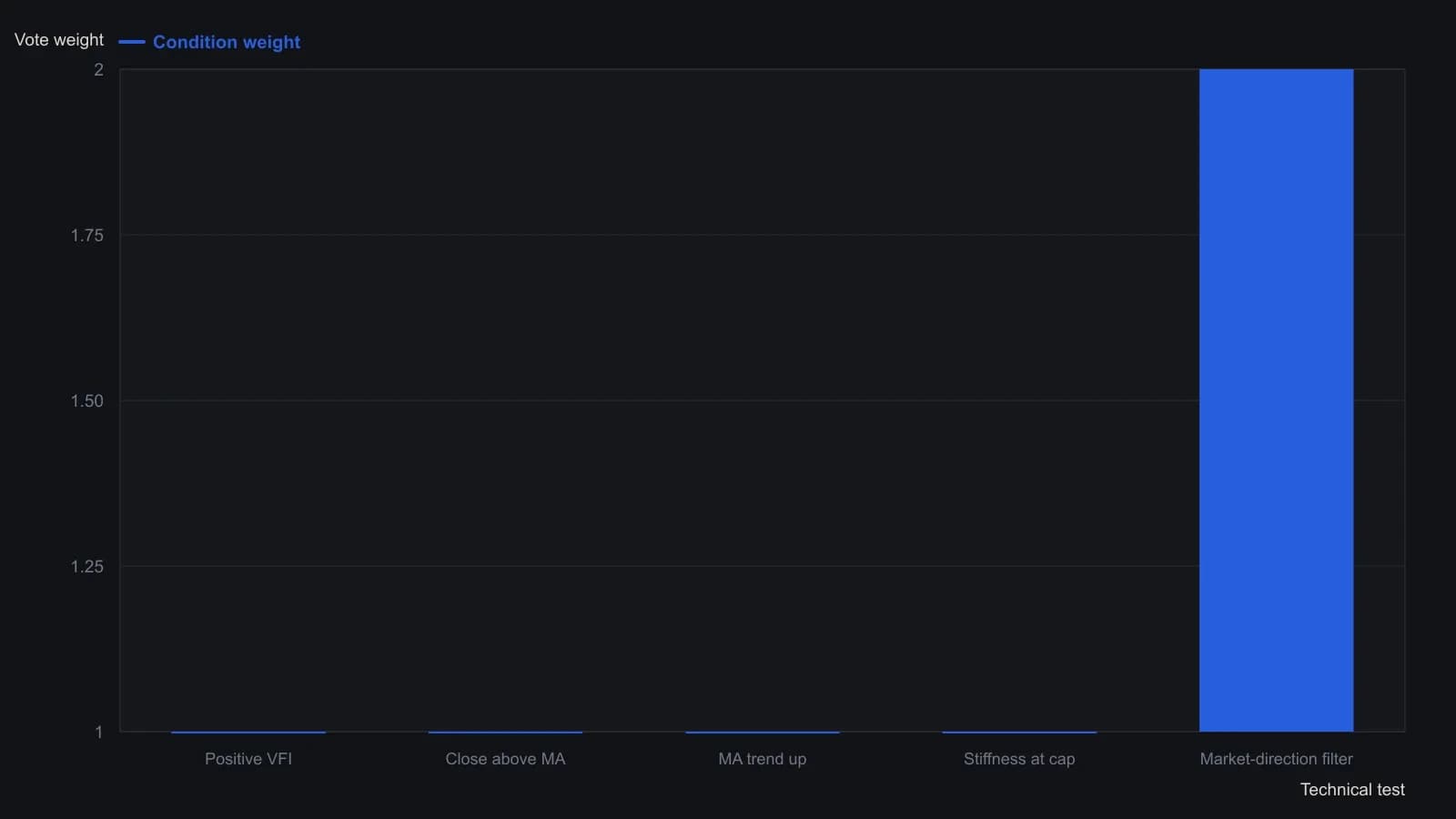
On this worksheet ScoreCrit is 4, while the printed EasyLanguage and AIQ samples use 5. Stiffness is counted over 63 sessions and passes only below 7. VFI uses a 130-bar period, coefficient 0.2 and volume cap 2.5.
Entry, exit, and standing aside
A mechanical-trading-system is a complete coded procedure that states the entry gate, the exit, and when the system must stand aside. Coded implementations treat a composite of 5 as the buy threshold and exit by a fixed bar count, including a 21-bar exit and an exposed 20-to-180-bar time-exit parameter.
The same score is used both to scan a universe and to fire a next-bar market entry, so the procedure can rank names and also abstain when the gate is not met.
What changes the scorecard
Substituting a different benchmark index changes the scorecard for the same stock. Chart walk-throughs noted that a bare threshold touch can still produce whipsaw entries.
All readings on this track · 39 readings
- 1987A mechanical rank-rotation sleeve for monthly fund leaders
- 1989Rank rotation in a five-name no-load sleeve
- 1990Cycle-tested five-year fund rank rotation
- 1991Blue-chip rank rotation by relative-strength-index slope
- 1992Currency rank rotation and intermarket timing
- 1992Rank rotation and relative strength for portfolio construction
- 1994MACD crossovers then short-horizon rank rotation
- 1994A comparable group-trend ledger from published ranks
- 1997Normalized yield rank rotation as a full portfolio procedure
- 1997Constructing an investor preference index from two capitalization-weighted series
- 1998Constructing anchored momentum from a centered average
- 2000Rank rotation, a stop-loss order, and Relative Strength Index in fund switching
- 2003A one-fund daily rank is a two-sleeve construction problem
- 2004Evaluate rank rotation only where persistence already exists
- 2004Sector fund rank rotation with regression and trailing stops
- 2006Evaluating equal-weight annual yield-rank rotation
- 2007Weekly preferred-symbol reselection for mechanical trend systems
- 2011Portfolio capacity and entry pacing for mechanical systems
- 2011Rank rotation as a testable ETF construction procedure
- 2011The inverse-Fisher stochastic is a forecast layer until the book rules can be disabled
- 2012An underwater stretch is a sizing test for rank rotation
- 2015Rule-based ETF rotation as one testable procedure
- 2015MACD crossover evaluation by trend rank rotation
- 2015Persistence and strength as one close-to-close switch
- 2015Evaluating rank rotation after a persistence screen
- 2016Evaluating an annual valuation rank rotation
- 2017A two-step yield and price rank rotation for a five-name sleeve
- 2018Smoothed volatility and the missing rank-rotation exit
- 2018A five-condition scorecard that ranks stocks and can refuse the trade
- 2018Small-cap growth sleeve eligibility with trend and rank rotation
- 2018Evaluating rank-rotation momentum across fund wrappers
- 2019Evaluating an annual equity-gold momentum rank rotation
- 2019Evaluating equity-gold momentum on funds versus indexes
- 2020How a signed comparative-strength oscillator is built for rank rotation
- 2020Which calendar clock changes a gold-versus-equity rotation test
- 2020Four-dimension relative strength as rank rotation
- 2020Portfolio construction as a ranked relative-strength problem
- 2020Two clocks for a Nasdaq put/call sleeve
- 2020Rank, filter, and stop the hedge sleeve as one procedure