2019issue C1226-29
Evaluating an annual equity-gold momentum rank rotation
A two-asset year-end switch is locked as one annual momentum-strategy and rank-rotation. This archive article grades only whether a winner-weight sweep or a research-series versus implementation-vehicle check changes how that procedure should be read.
- The evaluated rule is one yearly procedure: a momentum-strategy and a two-asset rank-rotation that holds only the trailing leader for the next annual-hold.
- The one-year hold was fixed from measured system behavior and tax-year practicality, not from intra-year rebalancing.
- A winner-weight sweep from full leader weight to full laggard weight is one grade of how that locked procedure should be read.
- A research-series versus implementation-vehicle check over the years both exist is the other grade of how the same annual rank rule should be read.
One yearly procedure
The evaluated rule is a yearly momentum-strategy: compare trailing annual total returns of a broad equity index and gold, then hold the leader through the next calendar year. In the fixed terminology, a momentum-strategy is a rule that uses trailing relative strength, here last calendar year's total return, to choose the next holding period's asset.
The same rule is a two-asset rank-rotation: at each year-end the two markets are ordered by that annual return and only the top-ranked name is held for the system holding period. Rank-rotation is a fixed-date ordering of the eligible assets that assigns the system holding period to the higher-ranked name.
The one-year hold was fixed from a mix of measured system behavior and tax-year practicality, not from intra-year rebalancing. That annual-hold is a one-year, year-end-to-year-end window that is both the signal horizon and the rebalance calendar.
The winner-weight sweep
Stability was tested with a winner-weight K: K percent of capital goes to the trailing leader and the rest to the laggard, with K swept from 100 percent down to 0 percent. Winner-weight is the share of capital placed in the trailing leader; the complement stays in the laggard.
In that sweep, K of 50 percent or more was scored as overweighting the leader versus an equity-index baseline, and the highest recorded terminal value of a one-unit stake occurred at K equal to 100 percent.
TradersWeek editorial: the sweep is one of the two grades applied to the locked procedure. It asks whether changing the winner-weight changes how that annual rule should be read.
Case windows and a post-stress interval
Calendar windows around 2000-2002 and 2008 were used as case studies of whether the rank rule had already rotated into gold after gold led in the prior year.
The same yearly rank procedure was also scored over 2009-2018 as a post-stress interval after a long equity advance.
Research-series versus implementation-vehicle
The long evaluation window runs from 1971 through 2018 and begins after official currency-to-gold convertibility ended, so the sample is framed as a post-convertibility market.
That long sample is built from an equity index series and gold spot prices because corresponding exchange-traded fund histories were too short for the full window. Those non-fund histories are the research-series.
An implementation check of the same annual rank rule on index-or-spot data versus exchange-traded fund data over 2004-2018 reported a 0.998 correlation between the two result series. The exchange-traded fund wrapper is the implementation-vehicle compared with the research-series over the years both exist.
TradersWeek editorial: this check is the second grade. It asks whether reading the procedure on the research-series changes once the implementation-vehicle is available.
Terminal value of $1 by winner weight K, 1971–2018
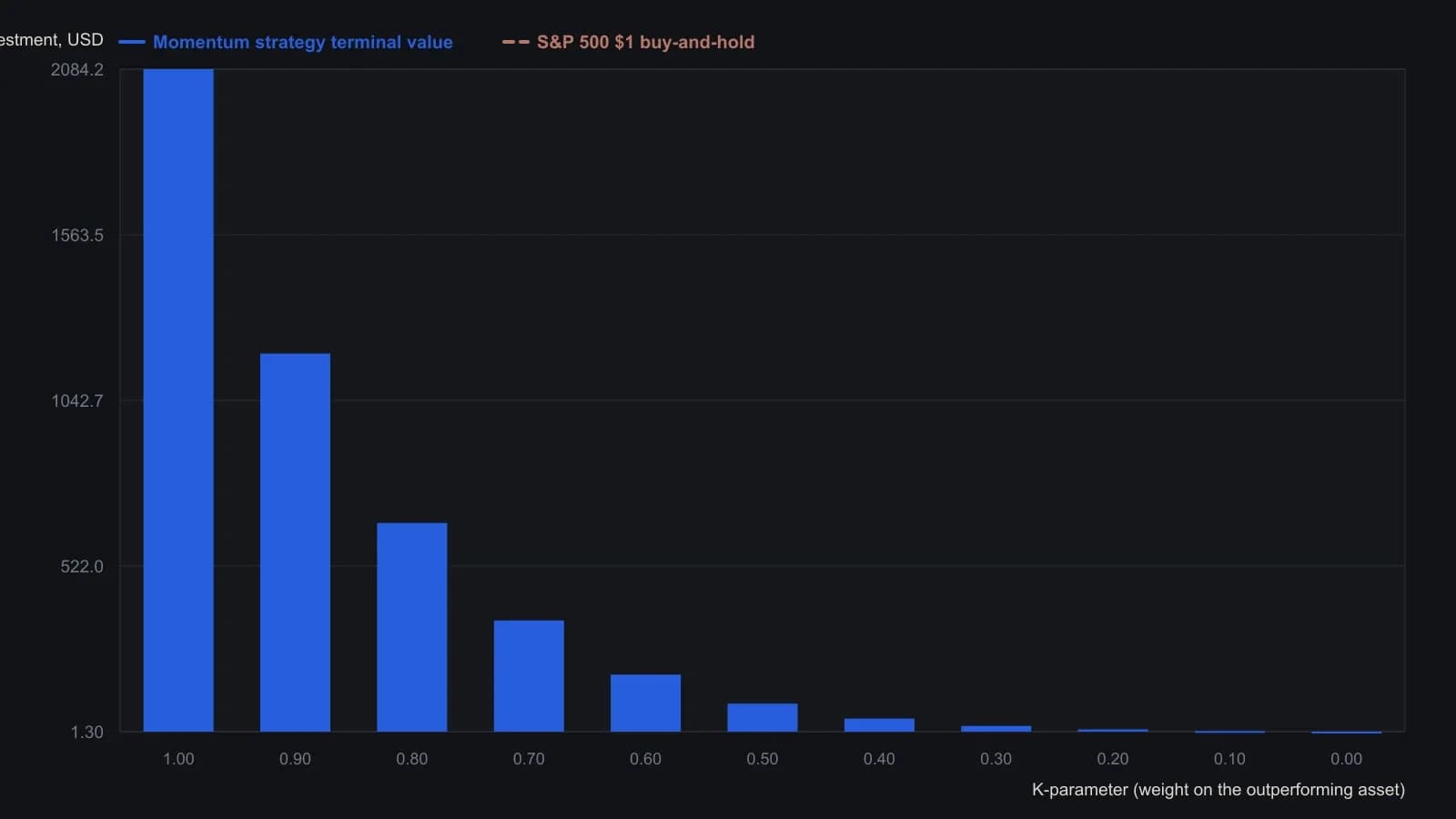
The source draws the vertical axis on a log scale. K is the share allocated to whichever of the S&P 500 index or gold spot had the higher prior-year return; the rest goes to the laggard. Sample is calendar years 1971–2018, not ETF prices. The article’s prose says K at or above 50% beats the index, but the printed 89.5 bar at K=0.50 is below the stated $95.51 baseline.
All readings on this track · 39 readings
- 1987A mechanical rank-rotation sleeve for monthly fund leaders
- 1989Rank rotation in a five-name no-load sleeve
- 1990Cycle-tested five-year fund rank rotation
- 1991Blue-chip rank rotation by relative-strength-index slope
- 1992Currency rank rotation and intermarket timing
- 1992Rank rotation and relative strength for portfolio construction
- 1994MACD crossovers then short-horizon rank rotation
- 1994A comparable group-trend ledger from published ranks
- 1997Normalized yield rank rotation as a full portfolio procedure
- 1997Constructing an investor preference index from two capitalization-weighted series
- 1998Constructing anchored momentum from a centered average
- 2000Rank rotation, a stop-loss order, and Relative Strength Index in fund switching
- 2003A one-fund daily rank is a two-sleeve construction problem
- 2004Evaluate rank rotation only where persistence already exists
- 2004Sector fund rank rotation with regression and trailing stops
- 2006Evaluating equal-weight annual yield-rank rotation
- 2007Weekly preferred-symbol reselection for mechanical trend systems
- 2011Portfolio capacity and entry pacing for mechanical systems
- 2011Rank rotation as a testable ETF construction procedure
- 2011The inverse-Fisher stochastic is a forecast layer until the book rules can be disabled
- 2012An underwater stretch is a sizing test for rank rotation
- 2015Rule-based ETF rotation as one testable procedure
- 2015MACD crossover evaluation by trend rank rotation
- 2015Persistence and strength as one close-to-close switch
- 2015Evaluating rank rotation after a persistence screen
- 2016Evaluating an annual valuation rank rotation
- 2017A two-step yield and price rank rotation for a five-name sleeve
- 2018Smoothed volatility and the missing rank-rotation exit
- 2018A five-condition scorecard that ranks stocks and can refuse the trade
- 2018Small-cap growth sleeve eligibility with trend and rank rotation
- 2018Evaluating rank-rotation momentum across fund wrappers
- 2019Evaluating an annual equity-gold momentum rank rotation
- 2019Evaluating equity-gold momentum on funds versus indexes
- 2020How a signed comparative-strength oscillator is built for rank rotation
- 2020Which calendar clock changes a gold-versus-equity rotation test
- 2020Four-dimension relative strength as rank rotation
- 2020Portfolio construction as a ranked relative-strength problem
- 2020Two clocks for a Nasdaq put/call sleeve
- 2020Rank, filter, and stop the hedge sleeve as one procedure