2020issue C0948-56
Four-dimension relative strength as rank rotation
The four-dimension procedure scores a security against many reference series, collapses those pair tiers into one rank, and compares candidates only from prices retrieved on the same date.
- A four-dimension score is the stacked moving-average state of a price-ratio series, coded as a discrete tier and then averaged across many reference pairs.
- Rank-rotation scores each candidate against a shared basket of market references, ranks those scores, and uses the order to keep, rotate, or skip a holding.
- Shared-date evaluation retrieves every target and every benchmark as of the same calendar date so ranks compare like observations.
- A signal line is a short moving average of the composite score and separates a raw rank from its recent trend.
Score first, then rank
The four-dimension procedure scores a security by pairing it with many reference series rather than with a single index, then collapses those pair scores into one rank.
Rank-rotation, as used here, scores each candidate against a shared basket of market references, ranks the resulting scores, and uses that order to decide which holdings to keep, rotate, or skip.
TradersWeek editorial view: treat portfolio construction as that ranking procedure, not as a single-index residual.
Build each pair the same way
Each pair is formed as the candidate close divided by a reference close, then passed through the same multi-horizon moving-average state machine.
The state machine uses a fast exponential average of the pair series, then medium, slow, and very-slow simple averages of that fast line. It maps the four-line order into discrete tiers of 10, 9, 5, or 0.
Collapse the basket into one composite
The four-dimension score is the stacked moving-average state of a price-ratio series, coded as a discrete tier and then averaged across many reference pairs.
A composite oscillator is the mean of the pair tiers across the reference basket, scaled, then smoothed. A shorter average of that oscillator is plotted as a signal line.
The signal line separates a raw rank from its recent trend. Once the basket is reduced to a single numeric score that can be ranked across candidates, that score is a relative-strength-index: a multi-horizon comparison of a security's price path to several reference series.
Use a cross-context reference basket
Reference baskets in the supplied implementations span large-cap, mid-cap, small-cap, growth, value, emerging-market, real-estate, gold, utility, and bond series. The rank is a cross-context score, not a single-index residual.
Sort many targets on one sheet
A batch ranking sheet evaluates many target symbols against the same benchmark set. It can sort first by one composite field and then by a tie-break field, or the reverse, and still produce the same order.
Same-day RS4r ranking of target funds, 15 July 2020
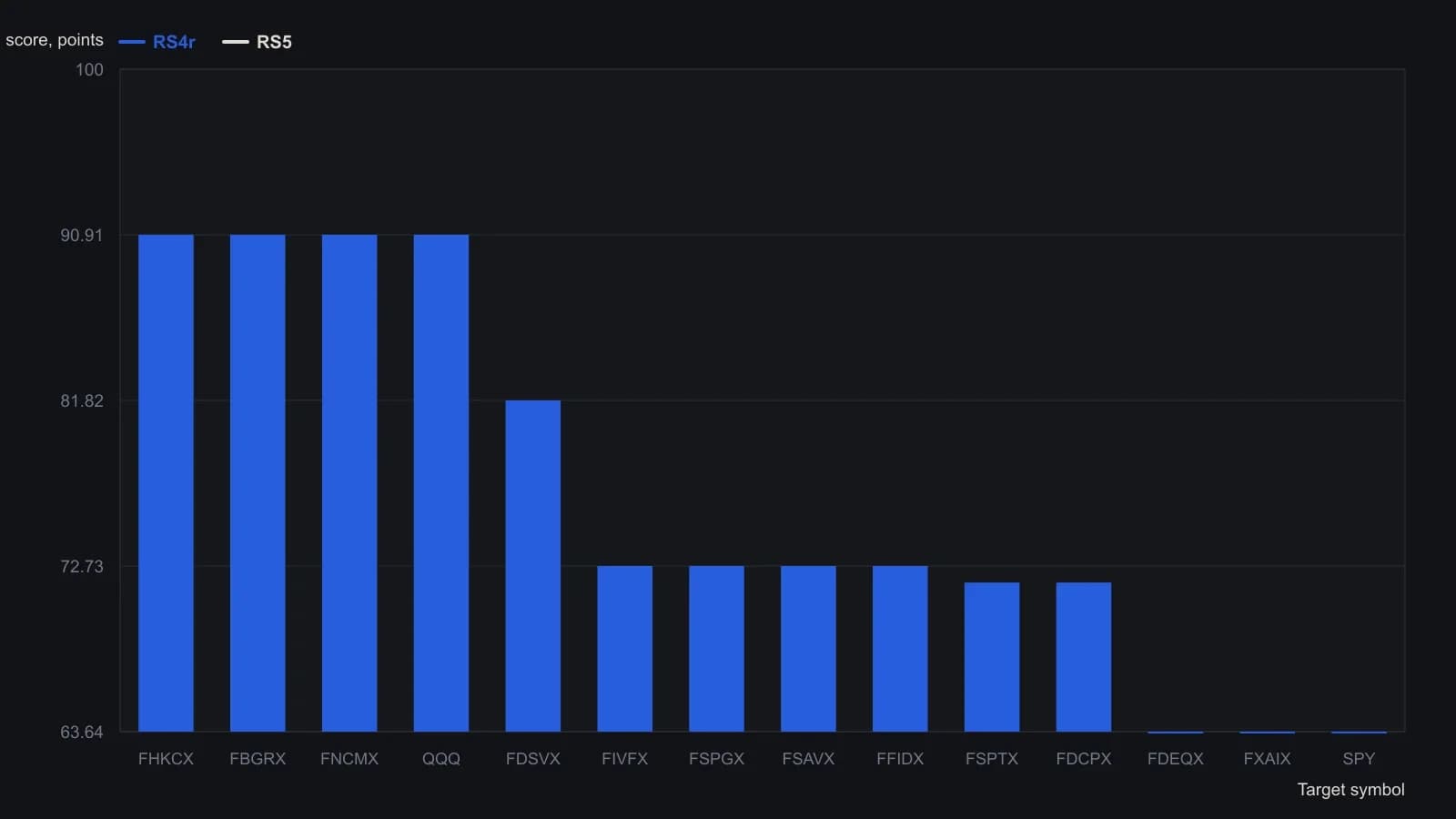
RS4r is the 11-benchmark composite rounded to two decimals. Mutual-fund NAVs for 16 July 2020 had not posted, so every row uses the 15 July close. RS5 is the 10-session share of RS4r readings at or above 80, scaled to 100. Only the rows visible on the rankings sheet are plotted, not the full 31-name list.
Keep every series on the same date
Target and benchmark prices must be retrieved as of the same date. Otherwise the ranks mix unmatched observations.
Shared-date evaluation means retrieving every target and every benchmark as of the same calendar date so ranks compare like observations.
Benchmark history need be pulled only once per evaluation day unless the mix of references changes. Per-symbol scoring after that is treated as inexpensive.
All readings on this track · 39 readings
- 1987A mechanical rank-rotation sleeve for monthly fund leaders
- 1989Rank rotation in a five-name no-load sleeve
- 1990Cycle-tested five-year fund rank rotation
- 1991Blue-chip rank rotation by relative-strength-index slope
- 1992Currency rank rotation and intermarket timing
- 1992Rank rotation and relative strength for portfolio construction
- 1994MACD crossovers then short-horizon rank rotation
- 1994A comparable group-trend ledger from published ranks
- 1997Normalized yield rank rotation as a full portfolio procedure
- 1997Constructing an investor preference index from two capitalization-weighted series
- 1998Constructing anchored momentum from a centered average
- 2000Rank rotation, a stop-loss order, and Relative Strength Index in fund switching
- 2003A one-fund daily rank is a two-sleeve construction problem
- 2004Evaluate rank rotation only where persistence already exists
- 2004Sector fund rank rotation with regression and trailing stops
- 2006Evaluating equal-weight annual yield-rank rotation
- 2007Weekly preferred-symbol reselection for mechanical trend systems
- 2011Portfolio capacity and entry pacing for mechanical systems
- 2011Rank rotation as a testable ETF construction procedure
- 2011The inverse-Fisher stochastic is a forecast layer until the book rules can be disabled
- 2012An underwater stretch is a sizing test for rank rotation
- 2015Rule-based ETF rotation as one testable procedure
- 2015MACD crossover evaluation by trend rank rotation
- 2015Persistence and strength as one close-to-close switch
- 2015Evaluating rank rotation after a persistence screen
- 2016Evaluating an annual valuation rank rotation
- 2017A two-step yield and price rank rotation for a five-name sleeve
- 2018Smoothed volatility and the missing rank-rotation exit
- 2018A five-condition scorecard that ranks stocks and can refuse the trade
- 2018Small-cap growth sleeve eligibility with trend and rank rotation
- 2018Evaluating rank-rotation momentum across fund wrappers
- 2019Evaluating an annual equity-gold momentum rank rotation
- 2019Evaluating equity-gold momentum on funds versus indexes
- 2020How a signed comparative-strength oscillator is built for rank rotation
- 2020Which calendar clock changes a gold-versus-equity rotation test
- 2020Four-dimension relative strength as rank rotation
- 2020Portfolio construction as a ranked relative-strength problem
- 2020Two clocks for a Nasdaq put/call sleeve
- 2020Rank, filter, and stop the hedge sleeve as one procedure