2012issue C1379-84
Year-end yield rank rotation with a collapse veto
A closed blue-chip index was ranked on year-end dividend yield, the ten highest-yielding names were held as a calendar-year book, and a collapse veto with a ranked substitute made funding, skipping, and replacement one rank-rotation signal.
- Value investing ordered a closed blue-chip universe by dividend yield so the shortlist was a relative cheapness screen, not a forecast of any single ticker.
- Seasonal analysis set a year-end ranking and a full-year hold, so the book is judged as a seasonal regime rather than as continuous stock-picking.
- Rank rotation rebuilt a fixed-count list and then funded, skipped, or replaced each name so entry, abstention, and exit shared one holding-period procedure.
- The collapse veto was an annual defensive overlay meant to limit large losses in a few names, not a fitted function built to maximize historical profit.
A closed index as a yearly book
The historical procedure ranked constituents of a closed blue-chip index by dividend yield at the prior year-end and held the ten highest-yielding names as a calendar-year book.
Value investing supplied the rank score. Seasonal analysis fixed the year-end review and the calendar hold. Rank rotation made buy, skip, and substitution the same testable signal instead of three separate habits.
Forward yield as the value score
The rank input used four times the last quarterly dividend over year-end price, not the sum of the prior year's paid dividends. A cut or a hike therefore changed the yield used for selection. That forward yield kept the shortlist a relative cheapness screen inside a closed universe.
Dividends were treated as reinvested each quarter into the same paying name, including odd lots and fractional shares.
The test book was built as 100 shares of each of the ten names at the start of 2000 rather than as a return computed from index levels alone.
Year-end review and a calendar hold
Selection sat at the prior year-end and the book was held for the calendar year that followed. The extra charting step was described as an annual review rather than a continuous overlay.
Seasonal analysis therefore sets the review cycle. The book is judged as a seasonal regime, not as a stream of standalone stock picks.
Collapse veto, reentry, and the ranked substitute
Before a ranked name was funded, a chart was reviewed for a one-to-eight-week collapse on expanding volume, with the heaviest volume at the low. Names that showed that collapse veto were skipped.
A skipped name could re-enter only after the reentry test: price stood above a 50-day average that was trending higher. The empty slot was filled by the ranked substitute, the next name on the yield list, after that name received the same chart check.
Not every name removed for the collapse pattern later deteriorated. At least one skipped highest-yield name later advanced in the same year while its substitute declined.
The collapse filter was framed as a defensive abstention overlay meant to limit large losses in a few names, not as a fitted function built to maximize historical profit. Rank rotation keeps that abstention inside the same holding-period procedure as entry and replacement.
Year-end value of the high-yield Dow book with and without the collapse veto
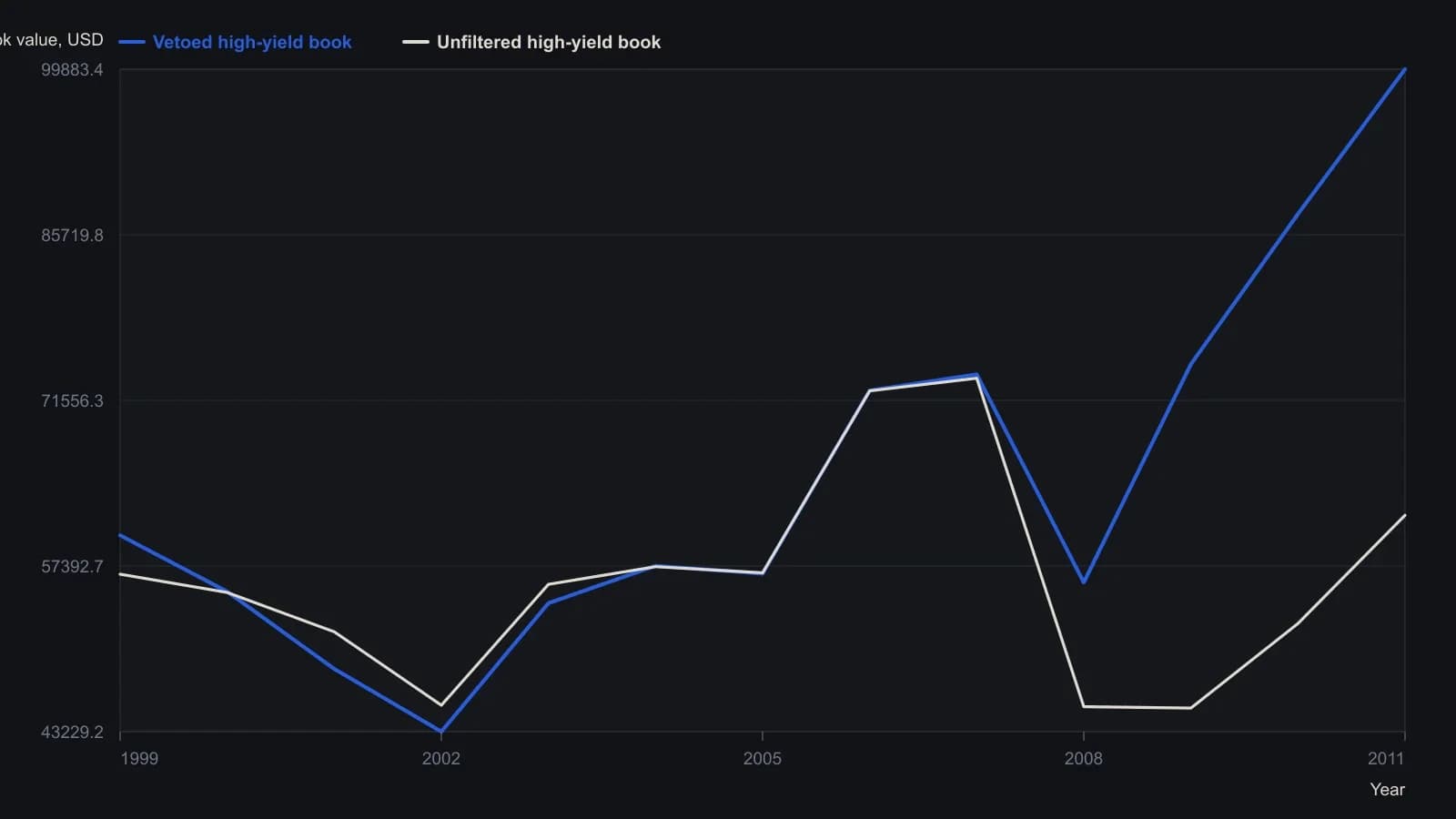
The source buys 100 shares of each of the ten year-end names, so a ranked substitute changes dollars committed at the open. Dividends are reinvested quarterly into the paying stock, including odd lots. The printed 2011 return for the vetoed book (+20.28%) does not reconcile with the adjacent balances; the chart uses the printed year-end balances.
All readings on this track · 16 readings
- 1988A two-rule classroom book of cheapness and new highs
- 1995A supermarket-chain case for yield, trendline, and a written checklist
- 1996Annual normalized-yield rank rotation for cyclical sleeves
- 1996Value filter then rank-rotate as one procedure
- 1997Dow high-yield rank rotation as a testable portfolio procedure
- 1998Low relative P/E plus a trendline reversal for regime-aware stock selection
- 1998Rank rotation, value screens, and ten-stock diversification
- 2001Earnback period ranking for growth-adjusted screens
- 2003Stress-testing calendar yield rotation in a declining tape
- 2003A value overlay and strangle hedge during a growth-led regime
- 2005Unfashionable value versus momentum in the book
- 2007Why premove fundamentals rarely flag tenfold-price moves
- 2012Year-end yield rank rotation with a collapse veto
- 2015A five-name January book from yield and price ranks
- 2017Screening value traps with regime-aware overlays
- 2017A pre-trade fail test for the cheap-looking name