2018issue C1024-27
Evaluating rank-rotation momentum across fund wrappers
Hold one monthly rank-rotation momentum-strategy fixed, score every rank-sleeve against a market baseline, and treat the fund-wrapper as a second experimental factor. A moving-average cash gate is then overlaid so vehicle choice can be separated from the signal in the evaluation.
- Nine sector exchange-traded funds and nine sector mutual funds were run under the same monthly rank-rotation momentum-strategy so the fund-wrapper could be treated as a separate experimental factor.
- Each rank-sleeve was scored on average annual return, the standard deviation of annual returns, and largest-annual-decline against a broad-market exchange-traded fund baseline.
- The fourth-ranked sleeve was the strongest of the nine ranks in both wrappers in that historical comparison.
- After the moving-average cash gate, the fourth-ranked mutual-fund sleeve still compared more favorably than the fourth-ranked exchange-traded-fund sleeve on those three measures.
A second experimental factor
Editorial framing. This article treats the fund-wrapper as a second experimental factor rather than as a detail of implementation. One monthly rank-rotation momentum-strategy is locked. Every rank-sleeve is scored against a market baseline. A moving-average cash gate is then overlaid so the evaluation can ask whether vehicle choice, not the signal, is changing the result.
One locked monthly procedure
A monthly sample from 2000 to 2017 compared nine sector exchange-traded funds with nine sector mutual funds under the same rank-rotation momentum-strategy.
Each month, sectors were ranked by that month's dividend-adjusted percentage price change. The following month's return of each rank from rank1 through rank9 was recorded.
Scoring every rank-sleeve
Each rank was judged by average annual return, the standard deviation of annual returns, and largest-annual-decline. A broad-market exchange-traded fund was used as the baseline.
In that historical comparison, the fourth-ranked sleeve was the strongest of the nine ranks for both the mutual-fund set and the exchange-traded-fund set.
Overlaying a moving-average cash gate
A moving-average filter with lookbacks from two to twelve months allowed the selected sector trade only when price was at or above the average and otherwise held cash.
For the fourth-ranked mutual-fund sleeve, an eight-month moving-average gate reduced annual-return volatility and the largest-annual-decline relative to the ungated version.
For the fourth-ranked exchange-traded-fund sleeve, a three-month moving-average gate produced the most favorable return-and-volatility pairing among the gated exchange-traded-fund ranks in that test.
What the wrapper still changed
Across lookbacks from two to twelve months, average annual returns of the gated fourth-ranked mutual-fund sleeve stayed inside a narrow band. The standard deviation of those lookback-level averages was 0.81%.
After the moving-average gate was applied, the fourth-ranked mutual-fund sleeve still compared more favorably than the fourth-ranked exchange-traded-fund sleeve on average annual return, volatility, and largest-annual-decline in that sample.
Editorial reading
Editorial reading. The archive does not claim that the fourth rank, the eight-month gate, or the three-month gate is a rule for later markets. The useful evaluation point is that a locked rank-rotation momentum-strategy can still change its evaluation picture when the fund-wrapper and the cash-gate lookback are allowed to vary.
Editorial reading. Keep the signal, the vehicle, and the gate as separate factors. Mixing them hides whether the fund-wrapper, not the ranking rule, is doing the work.
Rank-4 sector rotation annual returns by fund wrapper
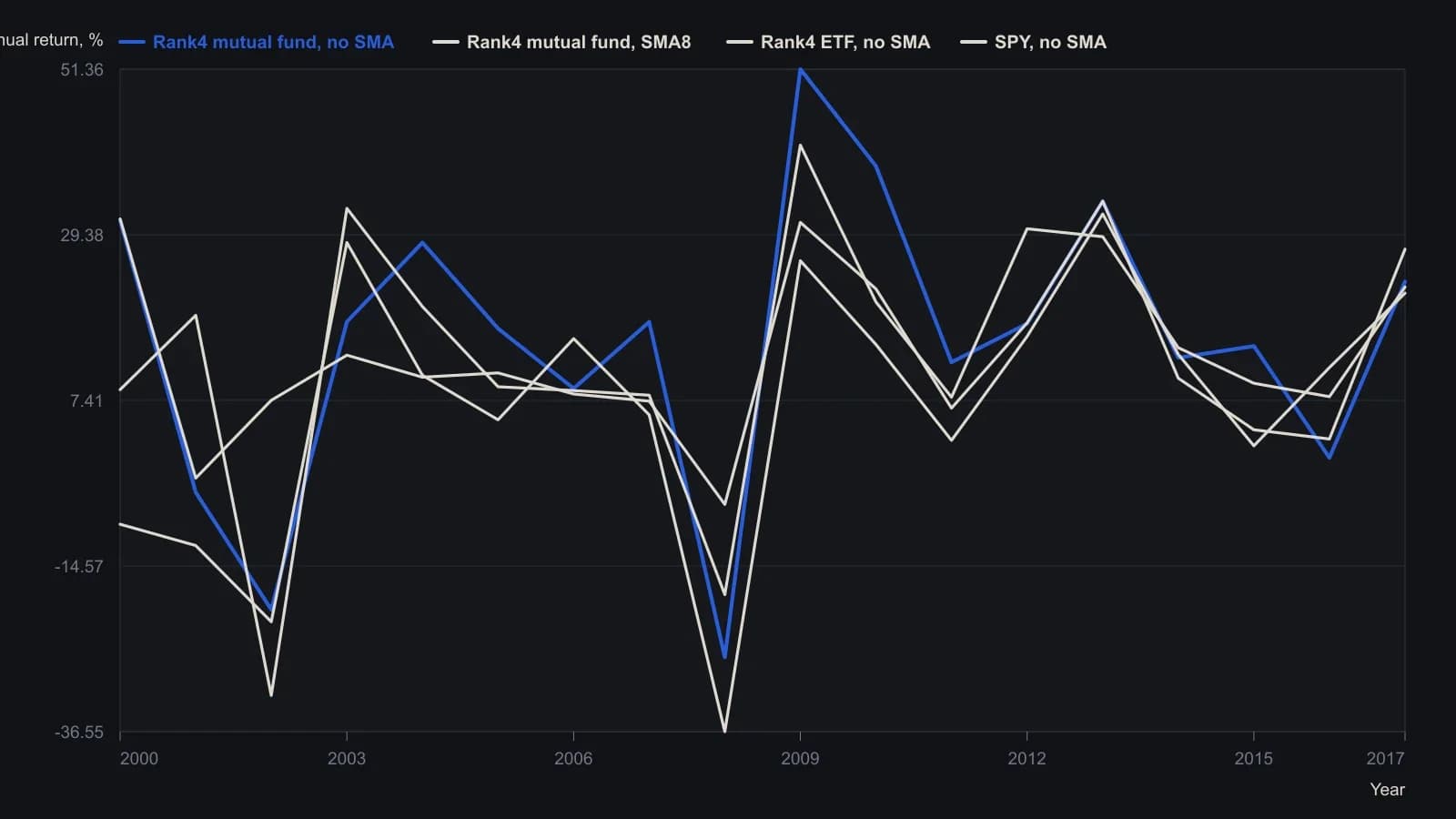
Rank-4 holds the fourth-highest prior-month sector among nine sleeves. SMA8 (mutual fund) and SMA3 (ETF) are the lookbacks the author selected as best; cash is held when price is below the SMA.
All readings on this track · 39 readings
- 1987A mechanical rank-rotation sleeve for monthly fund leaders
- 1989Rank rotation in a five-name no-load sleeve
- 1990Cycle-tested five-year fund rank rotation
- 1991Blue-chip rank rotation by relative-strength-index slope
- 1992Currency rank rotation and intermarket timing
- 1992Rank rotation and relative strength for portfolio construction
- 1994MACD crossovers then short-horizon rank rotation
- 1994A comparable group-trend ledger from published ranks
- 1997Normalized yield rank rotation as a full portfolio procedure
- 1997Constructing an investor preference index from two capitalization-weighted series
- 1998Constructing anchored momentum from a centered average
- 2000Rank rotation, a stop-loss order, and Relative Strength Index in fund switching
- 2003A one-fund daily rank is a two-sleeve construction problem
- 2004Evaluate rank rotation only where persistence already exists
- 2004Sector fund rank rotation with regression and trailing stops
- 2006Evaluating equal-weight annual yield-rank rotation
- 2007Weekly preferred-symbol reselection for mechanical trend systems
- 2011Portfolio capacity and entry pacing for mechanical systems
- 2011Rank rotation as a testable ETF construction procedure
- 2011The inverse-Fisher stochastic is a forecast layer until the book rules can be disabled
- 2012An underwater stretch is a sizing test for rank rotation
- 2015Rule-based ETF rotation as one testable procedure
- 2015MACD crossover evaluation by trend rank rotation
- 2015Persistence and strength as one close-to-close switch
- 2015Evaluating rank rotation after a persistence screen
- 2016Evaluating an annual valuation rank rotation
- 2017A two-step yield and price rank rotation for a five-name sleeve
- 2018Smoothed volatility and the missing rank-rotation exit
- 2018A five-condition scorecard that ranks stocks and can refuse the trade
- 2018Small-cap growth sleeve eligibility with trend and rank rotation
- 2018Evaluating rank-rotation momentum across fund wrappers
- 2019Evaluating an annual equity-gold momentum rank rotation
- 2019Evaluating equity-gold momentum on funds versus indexes
- 2020How a signed comparative-strength oscillator is built for rank rotation
- 2020Which calendar clock changes a gold-versus-equity rotation test
- 2020Four-dimension relative strength as rank rotation
- 2020Portfolio construction as a ranked relative-strength problem
- 2020Two clocks for a Nasdaq put/call sleeve
- 2020Rank, filter, and stop the hedge sleeve as one procedure