2015issue C0834-38
Persistence and strength as one close-to-close switch
Editorial framing: a daily persistence-switch and a two-name momentum-rank are taught as one close-to-close procedure, so persistence, the strength handoff, and abstention are tested together rather than stacked as separate overlays.
- The persistence-switch enters just before the 3:59 close on the first up session and exits at the same clock on the first down session, so each cycle donates two days and a streak-break refuses a second consecutive down session.
- A 252-session year taught as 42 six-day blocks with bias 0.5 leaves 126 sessions flat, which is how abstention sits inside the same rule.
- The persistence-gate admits a series only when switching-rate sits below the random band near 63 switches per 252 sessions; rank-rotation then assigns the next session only to the stronger print above a near-zero floor.
- With bias 0.525 and a unit win-ratio the fully invested match rate is 59.85; a downward tilt in the win-ratio raises that breakeven and compresses both held and switched equity.
Editorial framing: this note teaches a daily trend-following streak rule and a two-name momentum-rank as one close-to-close procedure. Persistence, the strength handoff, and abstention are kept in the same switch rather than stacked as separate overlays.
A close-to-close persistence-switch
The persistence-switch is a close-to-close trend-following rule. It enters on the first up session just before the 3:59 close and exits at the same clock on the first down session.
Because the buy is at the close, the signal up session is not captured. The first exit is also booked as a loss. Each cycle therefore donates two days. Net up days equal bias times session count minus twice the switching-rate.
The rule is written so a losing run cannot extend past one consecutive down session. That streak-break is the stated drawdown-control feature: a mechanical refusal of a second consecutive down session.
Donated days and the six-day sketch
A 252-session year can be taught as 42 repeats of a six-day block with bias 0.5, obtained by dividing session count by switching-rate. Other period, bias, and rate triples can recover the same annualized day count.
In that six-day sketch three sessions are flat, so half the year, 126 sessions, is out of the market. Abstention is the idle half of the same switch, not a later cash overlay.
When the switch can match a fully invested path
The persistence-switch matches a fully invested path when switching-rate equals session count times one minus bias, divided by one plus the win-ratio. With bias 0.525 and win-ratio 1 that rate is 59.85. A round ceiling near 63 is treated as the random-persistence boundary.
The persistence-gate admits a series only when its switching-rate sits below that random band near 63 switches per 252 sessions.
Plotted against bias, with a 1 percent session return and a unit win-ratio, the fully invested line steepens about twice as fast as the persistence-switch line. The rate must fall below that boundary before the switch can keep pace.
How win-ratio tilt moves the breakeven
Win-ratio is average up-move size divided by average down-move size. A downward tilt of the win-ratio below 1, already identified as the suppressor of fully invested equity-stock results, also shrinks persistence-switch outcomes computed at a zero tilt.
A 5 percent drop in the win-ratio raises the breakeven rate to 61.4. A 5 percent rise lowers it to 58.4.
Rank-rotation after the gate
Once a series is eligible, rank-rotation is a conjunction that assigns the next session’s return only to the name that is both the stronger print and above a near-zero floor, then adds the two assigned streams. On an eligible switch, the position is routed to the currently stronger name instead of remaining in a single series.
Momentum-rank is that same-session comparison. It treats the stronger print as the momentum leader for the next holding interval.
One-rank and two-name rank-rotation returns versus buy-and-hold
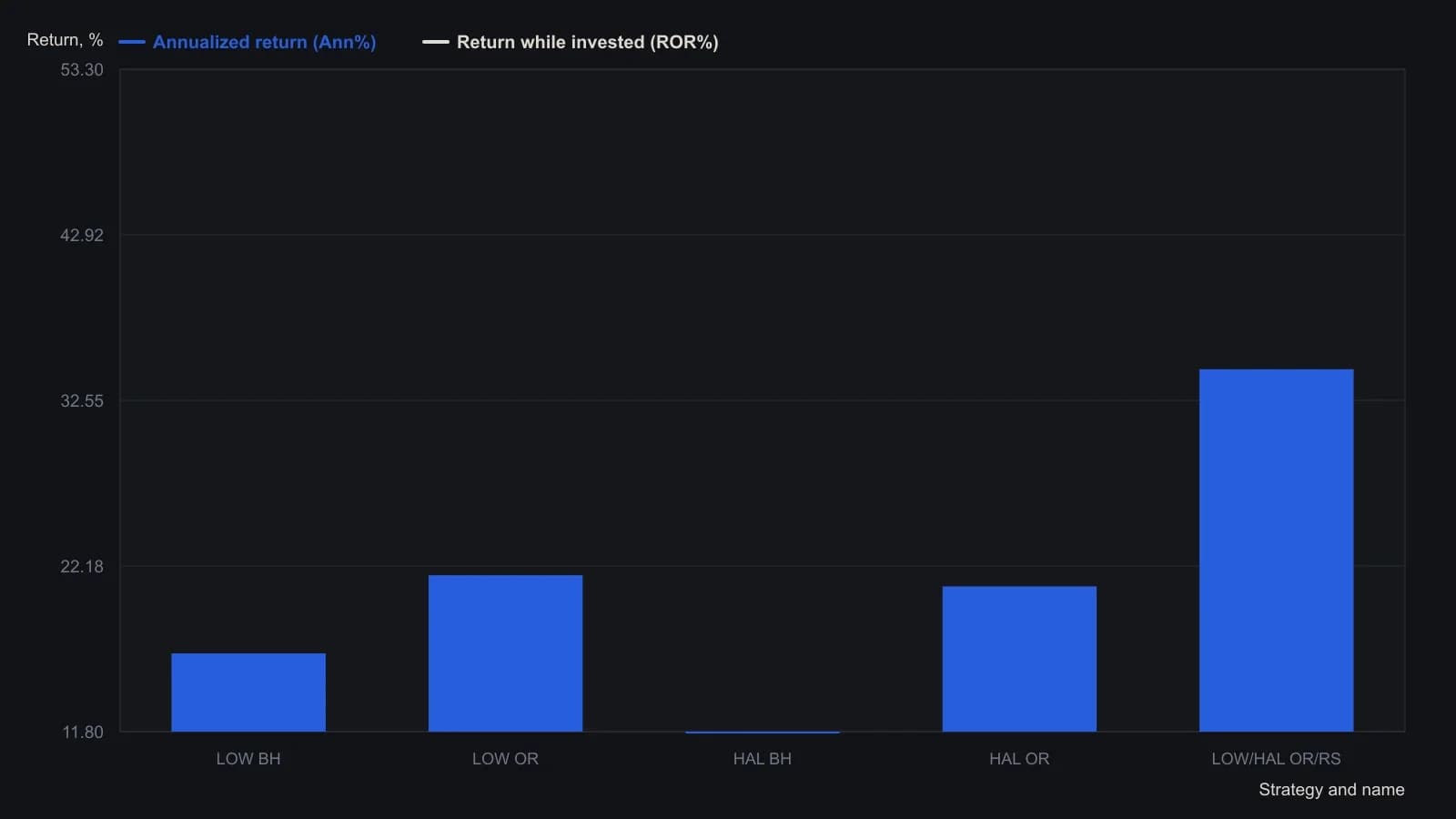
Daily closes from 1 July 1985 to 6 March 2014. Transaction costs are omitted. Buy-and-hold has no switches; the OR/RS switch count includes handoffs between the two names.
Daily clocks, ignored costs, and extensions
The two-name illustration was chosen for low switching rates over a 28.7-year window from 1 July 1985 to 6 March 2014. The composite rate path is described as generally below the 63 random threshold.
Trading costs were ignored at a pace of about 120 switches per year. Finer than daily clocks are flagged as cost-vulnerable. The same procedure is described as extensible to more persistent, less correlated names and to funds or currency vehicles.
All readings on this track · 39 readings
- 1987A mechanical rank-rotation sleeve for monthly fund leaders
- 1989Rank rotation in a five-name no-load sleeve
- 1990Cycle-tested five-year fund rank rotation
- 1991Blue-chip rank rotation by relative-strength-index slope
- 1992Currency rank rotation and intermarket timing
- 1992Rank rotation and relative strength for portfolio construction
- 1994MACD crossovers then short-horizon rank rotation
- 1994A comparable group-trend ledger from published ranks
- 1997Normalized yield rank rotation as a full portfolio procedure
- 1997Constructing an investor preference index from two capitalization-weighted series
- 1998Constructing anchored momentum from a centered average
- 2000Rank rotation, a stop-loss order, and Relative Strength Index in fund switching
- 2003A one-fund daily rank is a two-sleeve construction problem
- 2004Evaluate rank rotation only where persistence already exists
- 2004Sector fund rank rotation with regression and trailing stops
- 2006Evaluating equal-weight annual yield-rank rotation
- 2007Weekly preferred-symbol reselection for mechanical trend systems
- 2011Portfolio capacity and entry pacing for mechanical systems
- 2011Rank rotation as a testable ETF construction procedure
- 2011The inverse-Fisher stochastic is a forecast layer until the book rules can be disabled
- 2012An underwater stretch is a sizing test for rank rotation
- 2015Rule-based ETF rotation as one testable procedure
- 2015MACD crossover evaluation by trend rank rotation
- 2015Persistence and strength as one close-to-close switch
- 2015Evaluating rank rotation after a persistence screen
- 2016Evaluating an annual valuation rank rotation
- 2017A two-step yield and price rank rotation for a five-name sleeve
- 2018Smoothed volatility and the missing rank-rotation exit
- 2018A five-condition scorecard that ranks stocks and can refuse the trade
- 2018Small-cap growth sleeve eligibility with trend and rank rotation
- 2018Evaluating rank-rotation momentum across fund wrappers
- 2019Evaluating an annual equity-gold momentum rank rotation
- 2019Evaluating equity-gold momentum on funds versus indexes
- 2020How a signed comparative-strength oscillator is built for rank rotation
- 2020Which calendar clock changes a gold-versus-equity rotation test
- 2020Four-dimension relative strength as rank rotation
- 2020Portfolio construction as a ranked relative-strength problem
- 2020Two clocks for a Nasdaq put/call sleeve
- 2020Rank, filter, and stop the hedge sleeve as one procedure