2003issue C071-5
A one-fund daily rank is a two-sleeve construction problem
Unused cash between long signals is an idle sleeve, not a neutral rest state. Combined long-and-short rank rotation (ORLS) adds complementary short-sleeve rotation (ORS) to long-only rank rotation (ORL) so the same ranking stays fully invested as a two-state book.
- ORLS is the sum of the ORL sleeve and the ORS sleeve, so the account stays fully invested instead of parking unused capital in cash between long signals.
- On a net-up-day basis the combined book equals total trading days minus four days per streak, because each sleeve spends two days per streak on execution lag.
- ORS adds net-positive days only when the annual streak count stays below a bias-dependent threshold of about 57 streaks at a 0.55 bias over 252 sessions, and the archive marks elevated risk once streaks exceed 63.
- The workflow is daily ranking with same-day execution near the fund close, about two switches a week, a highly correlated surrogate index, and vehicles that can be switched often at negligible cost.
The combined book is two complementary sleeves
Combined long-and-short rank rotation, or ORLS, is defined as the sum of long-only rank rotation (ORL) and complementary short-sleeve rotation (ORS). The account stays fully invested rather than parking unused capital in cash between long signals.
Rank rotation and momentum strategy share that one ranking. The long sleeve is either in the fund or out of it, and the short sleeve is the complement of that state, so unused cash is treated as a second sleeve instead of a vacant rest period.
ORLS versus buy-and-hold annualized return by sector fund
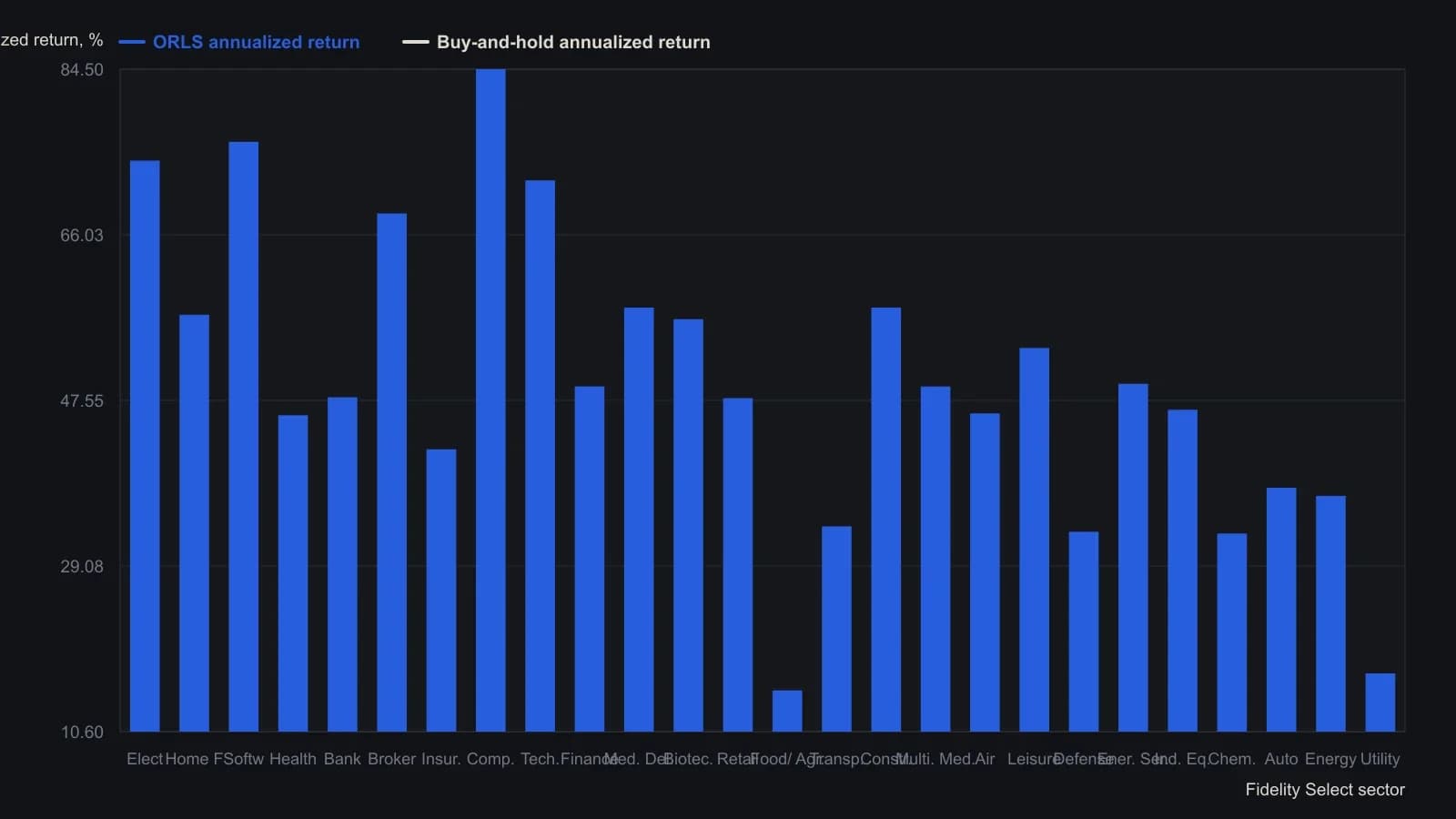
Inverse sleeves were synthesized as daily inverse returns of each long fund in FastTrack because live short products were not in that database window. Only rows with both annual-return columns intact in the supplied excerpt are plotted.
Holding-period math is checked on streak counts
On a net-up-day basis the combined book equals total trading days minus four days per streak, because each sleeve spends two days per streak on execution lag. A streak is a run of same-direction days that sets the switch count.
The short sleeve adds net-positive days only when the annual streak count stays below half the trading-day count times one minus bias. Bias is the share of up days inside each streak period. With a 0.55 bias and 252 sessions that threshold is about 57 streaks.
Compounded gain of the short sleeve can be recovered as long-only gain divided by buy-and-hold gain. Combined gain is then the product of the two sleeves and does not require building a synthetic inverse series first.
At 126 streaks a year the combined book can lose both days in a two-day period. The archive uses that case to mark elevated risk once the streak count exceeds 63.
Daily ranking near the fund close
The procedure is framed as daily ranking plus same-day execution near the fund close, averaging about two switches a week. It is described as unsuitable for casual, low-frequency operation.
Implementation is restricted to vehicles that can be switched often at negligible cost and that exhibit a low annual streak count, cited as fewer than 63. That pairing of cheap frequent switches and a low streak count is described as uncommon among mutual funds.
A same-day, highly correlated surrogate index is required so buy and sell decisions can be placed just before the mutual-fund close. Moving the decision a few minutes earlier is treated as a small operational change, not a different rule set.
All readings on this track · 39 readings
- 1987A mechanical rank-rotation sleeve for monthly fund leaders
- 1989Rank rotation in a five-name no-load sleeve
- 1990Cycle-tested five-year fund rank rotation
- 1991Blue-chip rank rotation by relative-strength-index slope
- 1992Currency rank rotation and intermarket timing
- 1992Rank rotation and relative strength for portfolio construction
- 1994MACD crossovers then short-horizon rank rotation
- 1994A comparable group-trend ledger from published ranks
- 1997Normalized yield rank rotation as a full portfolio procedure
- 1997Constructing an investor preference index from two capitalization-weighted series
- 1998Constructing anchored momentum from a centered average
- 2000Rank rotation, a stop-loss order, and Relative Strength Index in fund switching
- 2003A one-fund daily rank is a two-sleeve construction problem
- 2004Evaluate rank rotation only where persistence already exists
- 2004Sector fund rank rotation with regression and trailing stops
- 2006Evaluating equal-weight annual yield-rank rotation
- 2007Weekly preferred-symbol reselection for mechanical trend systems
- 2011Portfolio capacity and entry pacing for mechanical systems
- 2011Rank rotation as a testable ETF construction procedure
- 2011The inverse-Fisher stochastic is a forecast layer until the book rules can be disabled
- 2012An underwater stretch is a sizing test for rank rotation
- 2015Rule-based ETF rotation as one testable procedure
- 2015MACD crossover evaluation by trend rank rotation
- 2015Persistence and strength as one close-to-close switch
- 2015Evaluating rank rotation after a persistence screen
- 2016Evaluating an annual valuation rank rotation
- 2017A two-step yield and price rank rotation for a five-name sleeve
- 2018Smoothed volatility and the missing rank-rotation exit
- 2018A five-condition scorecard that ranks stocks and can refuse the trade
- 2018Small-cap growth sleeve eligibility with trend and rank rotation
- 2018Evaluating rank-rotation momentum across fund wrappers
- 2019Evaluating an annual equity-gold momentum rank rotation
- 2019Evaluating equity-gold momentum on funds versus indexes
- 2020How a signed comparative-strength oscillator is built for rank rotation
- 2020Which calendar clock changes a gold-versus-equity rotation test
- 2020Four-dimension relative strength as rank rotation
- 2020Portfolio construction as a ranked relative-strength problem
- 2020Two clocks for a Nasdaq put/call sleeve
- 2020Rank, filter, and stop the hedge sleeve as one procedure