2020issue C098-16
Portfolio construction as a ranked relative-strength problem
A relative-strength reading is a ratio, not a score. The archive compresses that ratio through stacked lookbacks, an adaptive divisor, and a 1-to-100 rank so many names can be ordered on one scale.
- A relative-strength reading is a ratio of one security to another security or index, and it has meaning only against earlier values of the same series.
- RS2t stacks four averages on that ratio so short, medium, and long strength can be read as whether each line stays above the next slower one.
- A fixed divisor can flip a time-conditioned score when leadership rotates, so RS3x lets the comparator change before RS4r ranks names on a 1-to-100 scale.
- A high rank on a falling tape can still be only outperformance of a decline unless both the numerator and the denominator show visible strength.
A ratio only means something against itself
A relative-strength reading is a ratio of one security to another security or index. It has no standalone meaning except against earlier values of the same series.
In this archive usage, the phrase relative-strength-index names that ratio, not Wilder's oscillator. The four-layer construction turns the ratio into a ranked score.
Stack four averages to mark three time zones
The first layer, RS1, is the raw relative-strength ratio obtained by dividing the candidate by a second security or index.
The second layer, RS2t, compresses three lookback zones on that raw ratio by stacking four averages: a 10-period exponential average of RS1, a 7-period simple average of that fast line, a 15-period simple average of the same fast line, and a 30-period simple average of the slow line.
Those four averages define the fast-medium-slow-zones. Short-term strength is present when the fast line is above the medium. Medium-term strength is present when the medium is above the slow. Long-term strength is present when the slow is above the very slow.
Let the divisor change, then rank on one scale
A single-index divisor can flip the meaning of a time-conditioned score when leadership rotates. The third layer, RS3x, must let the comparator adapt rather than stay fixed.
The fourth layer, RS4r, rescales the prior measures onto a common 1-to-100 rank so two strong names can be ordered, and so hundreds of equities can be compared without visual inspection.
Rank rotation, as used here, is a selection rule that orders the universe by that compressed RS4r integer and prefers names that stay high as both lookbacks and divisors change.
RS2t scores for two funds against eleven market indexes
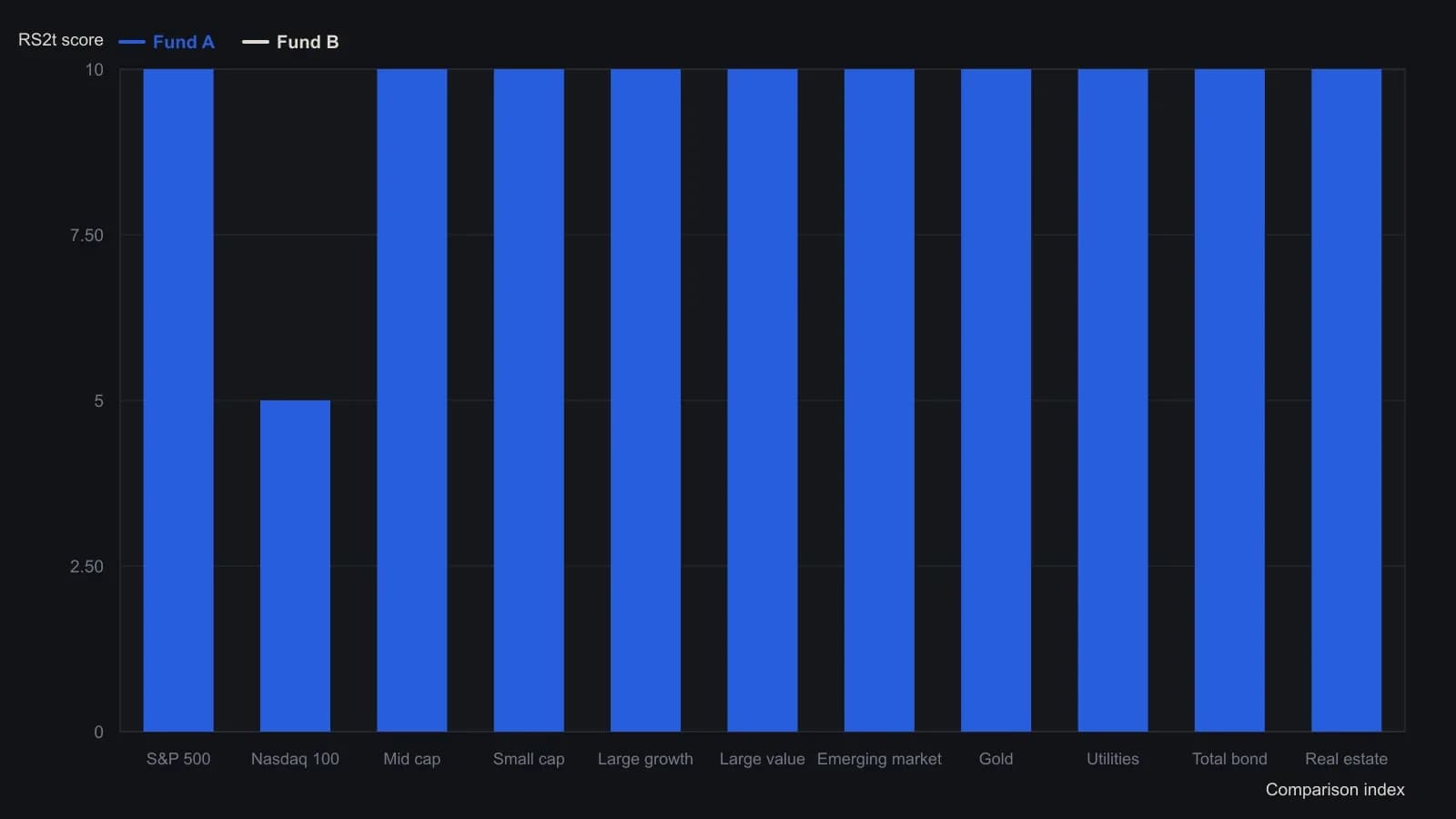
Each cell is one discrete RS2t outcome (10, 9, 5 or 0) against a single Fidelity index proxy, not a sum of conditions. The article then adds the eleven cells into RS3x (105 vs 70) and ranks them as RS4r = (RS3x / 11) × 10, rounding to 95 versus 64.
A published chart of maintained high rank
In the published China-region versus S&P example, a score of 10 occurs when every signal line sits above its slower average at the start, middle, and end of the chart, with color bands marking scores of 10, 9, 5, and 0.
Plotting the ranked value as a zero-to-100 oscillator with a cutoff at 80 is used to mark stretches of maintained high rank, including three labeled gold-fund episodes in 2019 Q1, 2019 Q3, and 2020 Q1.
All readings on this track · 39 readings
- 1987A mechanical rank-rotation sleeve for monthly fund leaders
- 1989Rank rotation in a five-name no-load sleeve
- 1990Cycle-tested five-year fund rank rotation
- 1991Blue-chip rank rotation by relative-strength-index slope
- 1992Currency rank rotation and intermarket timing
- 1992Rank rotation and relative strength for portfolio construction
- 1994MACD crossovers then short-horizon rank rotation
- 1994A comparable group-trend ledger from published ranks
- 1997Normalized yield rank rotation as a full portfolio procedure
- 1997Constructing an investor preference index from two capitalization-weighted series
- 1998Constructing anchored momentum from a centered average
- 2000Rank rotation, a stop-loss order, and Relative Strength Index in fund switching
- 2003A one-fund daily rank is a two-sleeve construction problem
- 2004Evaluate rank rotation only where persistence already exists
- 2004Sector fund rank rotation with regression and trailing stops
- 2006Evaluating equal-weight annual yield-rank rotation
- 2007Weekly preferred-symbol reselection for mechanical trend systems
- 2011Portfolio capacity and entry pacing for mechanical systems
- 2011Rank rotation as a testable ETF construction procedure
- 2011The inverse-Fisher stochastic is a forecast layer until the book rules can be disabled
- 2012An underwater stretch is a sizing test for rank rotation
- 2015Rule-based ETF rotation as one testable procedure
- 2015MACD crossover evaluation by trend rank rotation
- 2015Persistence and strength as one close-to-close switch
- 2015Evaluating rank rotation after a persistence screen
- 2016Evaluating an annual valuation rank rotation
- 2017A two-step yield and price rank rotation for a five-name sleeve
- 2018Smoothed volatility and the missing rank-rotation exit
- 2018A five-condition scorecard that ranks stocks and can refuse the trade
- 2018Small-cap growth sleeve eligibility with trend and rank rotation
- 2018Evaluating rank-rotation momentum across fund wrappers
- 2019Evaluating an annual equity-gold momentum rank rotation
- 2019Evaluating equity-gold momentum on funds versus indexes
- 2020How a signed comparative-strength oscillator is built for rank rotation
- 2020Which calendar clock changes a gold-versus-equity rotation test
- 2020Four-dimension relative strength as rank rotation
- 2020Portfolio construction as a ranked relative-strength problem
- 2020Two clocks for a Nasdaq put/call sleeve
- 2020Rank, filter, and stop the hedge sleeve as one procedure