2004issue C081-4
Evaluate rank rotation only where persistence already exists
A mechanical rank-rotation system is a testable set of entry, exit, and abstention rules. Daily ranking across a fund family is useful only when the candidates already show persistence, and a larger roster or a short sleeve should be judged by those rules rather than by headline return.
- A one-rank rule buys a single fund when that day’s return is positive and sells when the day’s return is negative. Multiple-fund ranking stays invested only in the current top-ranked fund and exits when that name loses the top rank.
- A random fund series was described with a square-root standard-deviation time rate of 0.5, about 63 switches per year, and an offset-correlation of zero. Persistence is usable only when an individual fund’s yearly switching-rate sits well below 63.
- The software test used a one-day rank period and zero delay so buys and sells occurred on the same day, but daily sector-fund rotation was treated as a research design because penalty restrictions blocked that execution.
- Momentum-style one-rank and multiple-fund ranking were not useful on near-zero-persistence broad averages such as the Dow Jones Industrial Average or the S&P 500.
What the mechanical rules specify
A one-rank mechanical rule looks at a single fund each day. It buys when that day’s return is positive and sells when the day’s return is negative. That is the momentum-strategy form of the procedure: stay invested after a positive return and exit after a negative return.
Multiple-fund ranking, the rank-rotation form, assigns a daily rank to each fund in a predefined family and stays invested only in the current top-ranked fund. It exits when that fund loses the top rank.
Both forms are a mechanical-trading-system: a fully specified set of entry, exit, and abstention rules that can be tested as one procedure. The long-short one-rank construction was summarized with net up days equal to 252 market days minus four times the yearly switch count.
Persistence is the gate, not family size
Persistence is a fund’s tendency to keep the same sign of daily return more often than a random series would. A random fund series was described as having a square-root standard-deviation time rate of 0.5, about 63 switches per year, and an offset-correlation of zero.
Offset-correlation is the persistence diagnostic plotted against switching-rate to separate persistent funds from random ones. To use persistence in either one-rank or multiple-fund ranking, an individual fund’s yearly switch count needed to sit well below 63.
How the family tests were specified
The software test set rank period to one day and delay to zero so buys and sells occurred on the same day across a multi-fund family. Across 19 family-composition runs spanning 2 September 1988 to 12 September 2003, most candidate sets were sector funds chosen because they showed some persistence.
Daily-rank rotation returns across 19 fund-family tests
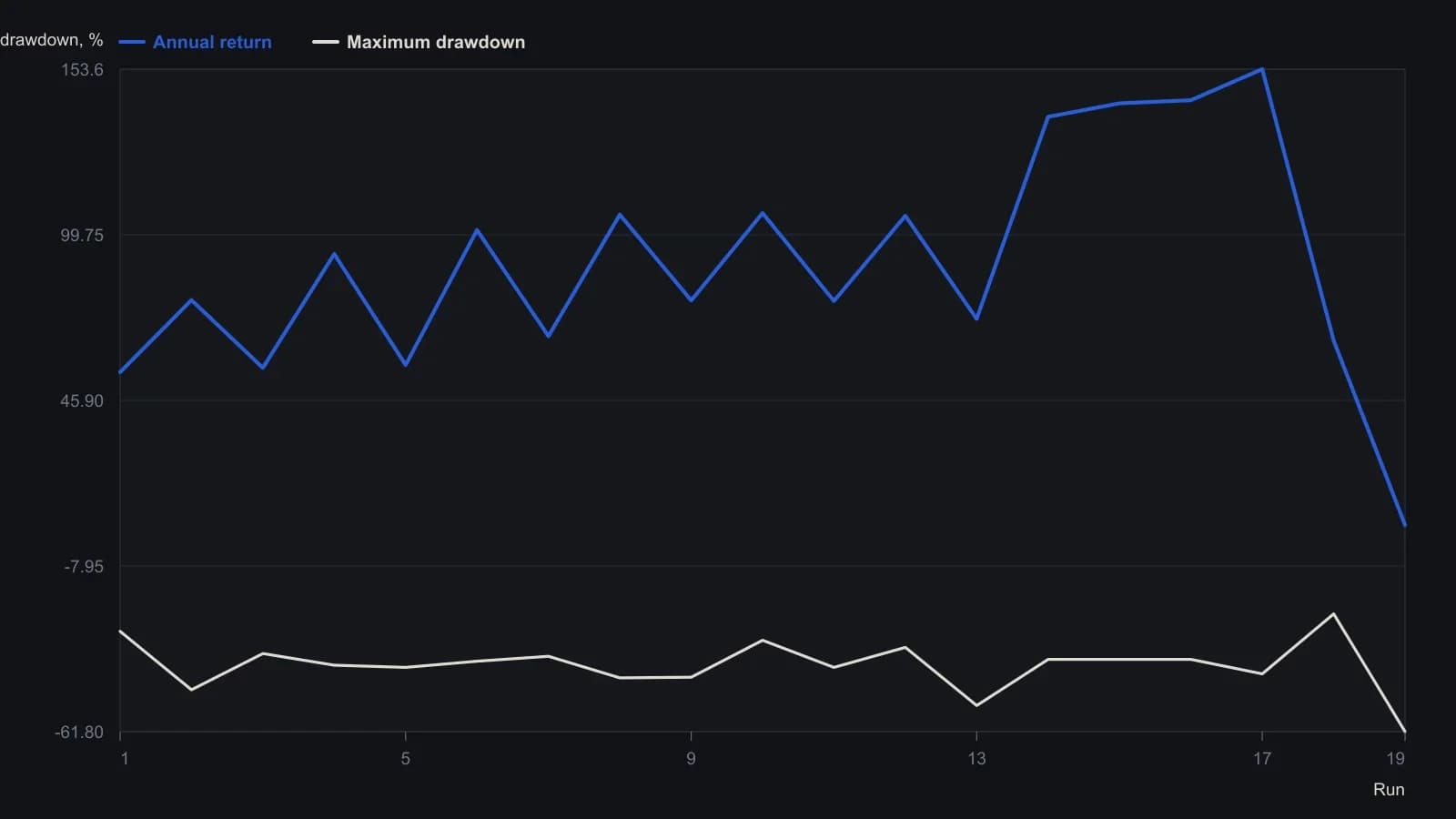
Names were selected after the fact from prior one-rank persistence tests. FastBreak used a one-day rank and zero delay. Fidelity Selects could not be switched daily without penalties. Run 18 holds 50 percent in VMFXX; run 19 uses DJIA, S&P 500, ATINX and shorts.
Research design is not a live rotation
Daily switching of the sector-fund families was treated as a research design, not a tradable procedure, because penalty restrictions blocked same-day rotation in those vehicles. End-of-day rank-rotation rules required execution in a narrow window just before the close, and some funds needed a highly correlated real-time surrogate to decide whether a trade was required.
Where momentum-style ranking failed the test
The evaluation concluded that momentum-style variants of one-rank or multiple-fund ranking were not useful on near-zero-persistence broad averages such as the Dow Jones Industrial Average or the S&P 500.
All readings on this track · 39 readings
- 1987A mechanical rank-rotation sleeve for monthly fund leaders
- 1989Rank rotation in a five-name no-load sleeve
- 1990Cycle-tested five-year fund rank rotation
- 1991Blue-chip rank rotation by relative-strength-index slope
- 1992Currency rank rotation and intermarket timing
- 1992Rank rotation and relative strength for portfolio construction
- 1994MACD crossovers then short-horizon rank rotation
- 1994A comparable group-trend ledger from published ranks
- 1997Normalized yield rank rotation as a full portfolio procedure
- 1997Constructing an investor preference index from two capitalization-weighted series
- 1998Constructing anchored momentum from a centered average
- 2000Rank rotation, a stop-loss order, and Relative Strength Index in fund switching
- 2003A one-fund daily rank is a two-sleeve construction problem
- 2004Evaluate rank rotation only where persistence already exists
- 2004Sector fund rank rotation with regression and trailing stops
- 2006Evaluating equal-weight annual yield-rank rotation
- 2007Weekly preferred-symbol reselection for mechanical trend systems
- 2011Portfolio capacity and entry pacing for mechanical systems
- 2011Rank rotation as a testable ETF construction procedure
- 2011The inverse-Fisher stochastic is a forecast layer until the book rules can be disabled
- 2012An underwater stretch is a sizing test for rank rotation
- 2015Rule-based ETF rotation as one testable procedure
- 2015MACD crossover evaluation by trend rank rotation
- 2015Persistence and strength as one close-to-close switch
- 2015Evaluating rank rotation after a persistence screen
- 2016Evaluating an annual valuation rank rotation
- 2017A two-step yield and price rank rotation for a five-name sleeve
- 2018Smoothed volatility and the missing rank-rotation exit
- 2018A five-condition scorecard that ranks stocks and can refuse the trade
- 2018Small-cap growth sleeve eligibility with trend and rank rotation
- 2018Evaluating rank-rotation momentum across fund wrappers
- 2019Evaluating an annual equity-gold momentum rank rotation
- 2019Evaluating equity-gold momentum on funds versus indexes
- 2020How a signed comparative-strength oscillator is built for rank rotation
- 2020Which calendar clock changes a gold-versus-equity rotation test
- 2020Four-dimension relative strength as rank rotation
- 2020Portfolio construction as a ranked relative-strength problem
- 2020Two clocks for a Nasdaq put/call sleeve
- 2020Rank, filter, and stop the hedge sleeve as one procedure