2020issue C0314-23
How a signed comparative-strength oscillator is built for rank rotation
A raw price ratio of one security to another has no shared neutral level across names. This article shows how a signed lookback oscillator is constructed so a name can be ranked, rotated, and read against an index or an intermarket pair.
- A conventional comparative-relative-strength reading is a price ratio, usually a stock over a broad index, and that raw ratio has no shared neutral level across names.
- RSMK is a signed lookback oscillator: a short exponential average of the lookback-change in the log price ratio, scaled so a reading above zero means outperformance and a reading below zero means underperformance at any price level.
- The signed construction is intended to remove lag, the inability to rank names on one scale, screen-size-dependent visuals, subjectivity, and the lack of buy or sell reference levels for a system.
- A rank-rotation book can use a zero-line-state cross as the long entry, hold for a fixed window under a name cap, and optionally apply a peak-retreat-exit when a zero-line sell would lag a sharp correction.
Why a raw price ratio is hard to rank
A conventional comparative-relative-strength reading is a price ratio of one security to another, usually a stock over a broad index. That raw ratio has no shared neutral level across names, so one chart cannot be lined up with another on a common long-or-short scale.
The same ratio construction can be applied to an intermarket pair, such as stocks versus bonds or gold versus a dollar index. In that use the ratio describes a cross-market regime rather than only a stock-versus-index spread.
How the signed oscillator is built
RSMK is a lookback-based comparative-strength oscillator. It recenters the log price ratio over a finite window, then smooths the change so the sign of the reading is a shared long-or-short-of-the-benchmark state.
The oscillator is computed as a short exponential average of the lookback-change in the log price ratio, then scaled. The value reflects a finite window rather than only the latest print.
Zero-line-state is the construction rule that a positive oscillator reading means the security is beating the comparison series and a negative reading means it is lagging, independent of the raw price level of either series. A reading above zero means the security is outperforming the comparison series. A reading below zero means it is underperforming. That sign holds for any price level.
What the signed reading is meant to correct
That signed construction is intended to remove several ratio-chart defects: lag, inability to rank names on one scale, screen-size-dependent visuals, subjectivity, and the lack of buy or sell reference levels for a system.
Signed RSMK oscillator for Align Technology versus the S&P 500
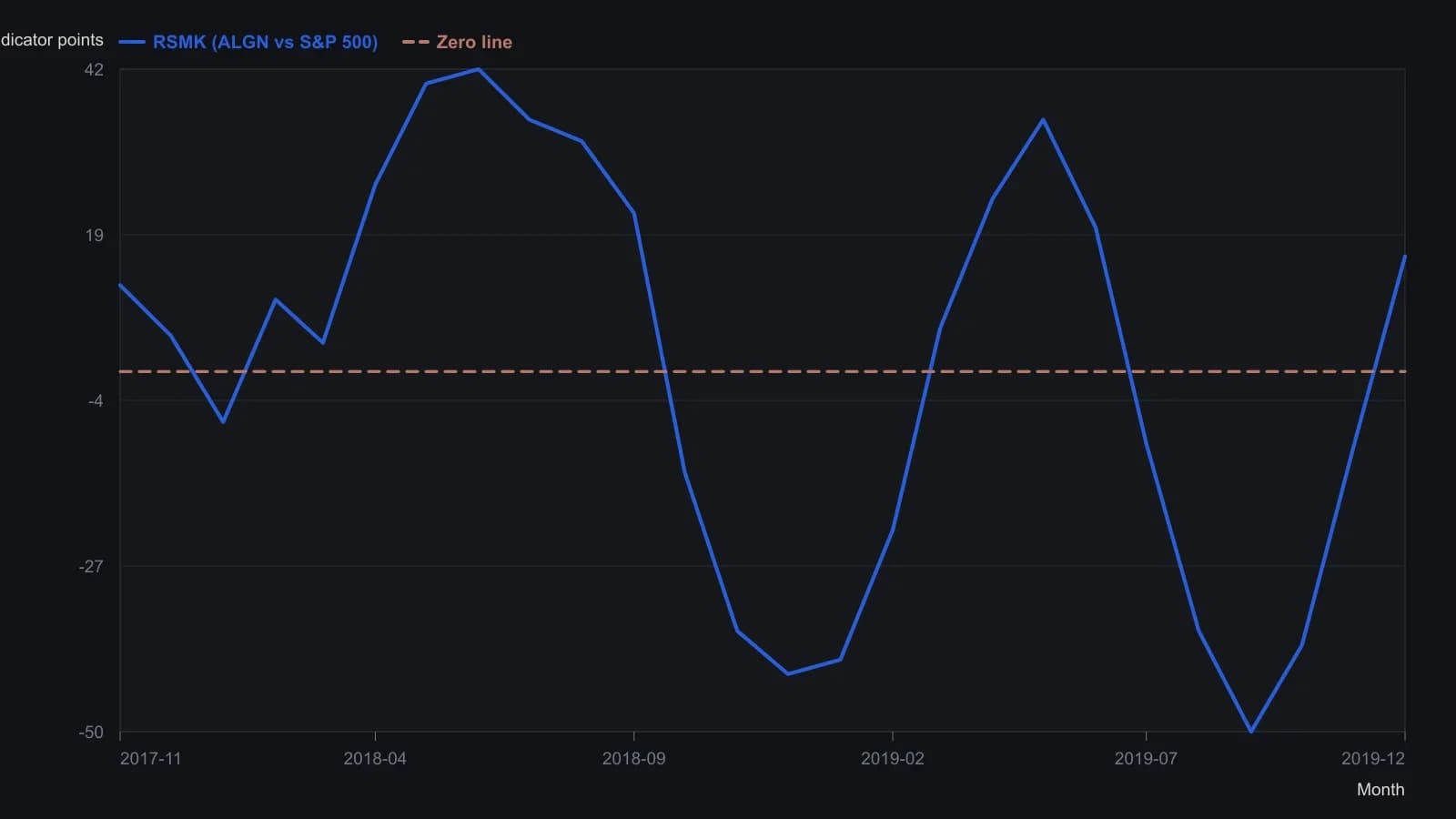
Katsanos’s default RSMK uses a 90-day log-ratio lookback, a 3-period EMA, and a times-100 scale. These readings are approximate because they were taken from the histogram pane, not a printed table.
A testable long rule and an earlier exit
A testable long rule is a cross of the oscillator up through zero. An optional peak-retreat-exit closes the long when the reading has fallen a stated number of points from its recent peak, because zero-line sell turns can lag sharp corrections.
From one reading to a rank-rotation book
Rank rotation is a portfolio procedure that scores many names on the same signed comparative-strength reading, then admits, holds, and later replaces positions according to that ranking and a fixed holding window.
A rank-rotation procedure using that zero-line entry, a fixed holding window, a name cap, next-open execution, and a parameter-selection window was specified for a historical comparison against both a passive book and a moving-average rule on the unsigned ratio.
Prior relative-strength ranking studies treated intermediate-term leaders as more likely to keep leading over a subsequent window, and treated grouped sorts of intermediate and longer-term appreciation as a long-sample ranking design.
All readings on this track · 39 readings
- 1987A mechanical rank-rotation sleeve for monthly fund leaders
- 1989Rank rotation in a five-name no-load sleeve
- 1990Cycle-tested five-year fund rank rotation
- 1991Blue-chip rank rotation by relative-strength-index slope
- 1992Currency rank rotation and intermarket timing
- 1992Rank rotation and relative strength for portfolio construction
- 1994MACD crossovers then short-horizon rank rotation
- 1994A comparable group-trend ledger from published ranks
- 1997Normalized yield rank rotation as a full portfolio procedure
- 1997Constructing an investor preference index from two capitalization-weighted series
- 1998Constructing anchored momentum from a centered average
- 2000Rank rotation, a stop-loss order, and Relative Strength Index in fund switching
- 2003A one-fund daily rank is a two-sleeve construction problem
- 2004Evaluate rank rotation only where persistence already exists
- 2004Sector fund rank rotation with regression and trailing stops
- 2006Evaluating equal-weight annual yield-rank rotation
- 2007Weekly preferred-symbol reselection for mechanical trend systems
- 2011Portfolio capacity and entry pacing for mechanical systems
- 2011Rank rotation as a testable ETF construction procedure
- 2011The inverse-Fisher stochastic is a forecast layer until the book rules can be disabled
- 2012An underwater stretch is a sizing test for rank rotation
- 2015Rule-based ETF rotation as one testable procedure
- 2015MACD crossover evaluation by trend rank rotation
- 2015Persistence and strength as one close-to-close switch
- 2015Evaluating rank rotation after a persistence screen
- 2016Evaluating an annual valuation rank rotation
- 2017A two-step yield and price rank rotation for a five-name sleeve
- 2018Smoothed volatility and the missing rank-rotation exit
- 2018A five-condition scorecard that ranks stocks and can refuse the trade
- 2018Small-cap growth sleeve eligibility with trend and rank rotation
- 2018Evaluating rank-rotation momentum across fund wrappers
- 2019Evaluating an annual equity-gold momentum rank rotation
- 2019Evaluating equity-gold momentum on funds versus indexes
- 2020How a signed comparative-strength oscillator is built for rank rotation
- 2020Which calendar clock changes a gold-versus-equity rotation test
- 2020Four-dimension relative strength as rank rotation
- 2020Portfolio construction as a ranked relative-strength problem
- 2020Two clocks for a Nasdaq put/call sleeve
- 2020Rank, filter, and stop the hedge sleeve as one procedure