2011issue C1255-66
Rank rotation as a testable ETF construction procedure
Historical tools could rank a ten-ETF portfolio over a six-month window, compare any fund with a cash-equivalent short-term bond benchmark, and combine Rank rotation with Moving average inputs. Editorial reading keeps Seasonal analysis and down-day context after those rules so construction stays checkable.
- A relative-strength reader can array each holding in a ten-ETF portfolio by rank over a six-month window and compare any selected fund with a cash-equivalent short-term bond benchmark.
- Rotation among those ETFs can be displayed in bimonthly intervals for the latest six months, with an advanced replay of prior rotations up to six months.
- Historical modules combine relative-strength ranking with Moving average inputs and allow at most two relative-strength lookback periods to be tested together.
- Editorial reading inspects Seasonal analysis and down-day context only after ranks and the Moving average gate are fixed.
Construction as one procedure
This archive note describes a historical relative-strength workflow for a ten-ETF book. TradersWeek editorial reading presents that workflow as Rank rotation: rank first, gate entries with a Moving average, and only then inspect Seasonal analysis or down-day context.
The aim of that editorial order is to keep construction choices checkable. Ranking, the cash-equivalent comparison, and the Moving average gate form one procedure. Context modules come later so they do not replace the rotation rules.
Rank the book and replay the rotation
A relative-strength reader can array each holding in a ten-ETF portfolio by rank over a six-month window and compare any selected fund with a cash-equivalent short-term bond benchmark.
The same reader can display rotation among those ETFs in bimonthly intervals for the latest six months, with an advanced replay of prior rotations up to six months.
Editorial reading treats the cash-equivalent short-term bond benchmark as the abstention sleeve of Rank rotation, and treats the replay window as the holding period the reader can inspect.
Gate entries with a Moving average
Historical backtesting modules combine relative-strength ranking with Moving average inputs and allow at most two relative-strength lookback periods to be tested together.
Editorial reading uses those Moving average inputs as a regime gate after the ranks are set. An entry, an exit, or an abstention then stays inside the same Rank rotation procedure.
Read context after the ranks are fixed
A correlation module reports the coefficient between any two ETF tickers over a user-set span, using a volatility window that can be set from 10 to 120 days.
A volatility module compares up to five ETFs on a line chart and reports maximum, minimum, and latest volatility percentage for windows from 20 days to 12 months.
A down-day association module counts up and down days, average daily performance, worst and best days, and correlation to the benchmark for each ETF when that benchmark falls by a user-set amount such as 3 percent in one day.
Gold replaces energy at the top of the ten-ETF rank book
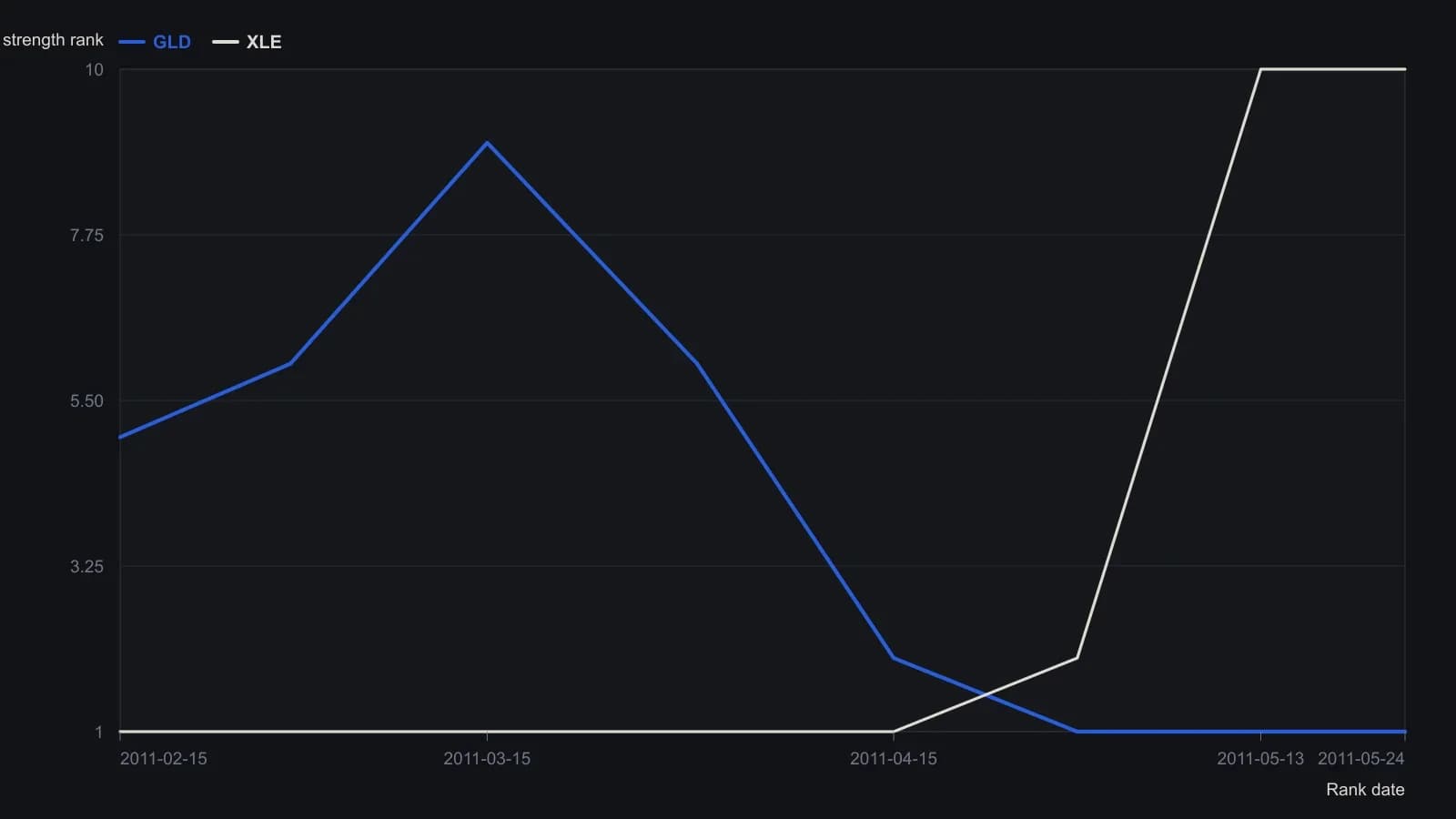
Ranks use the screen’s fixed mix of 60% three-month strength, 20% six-month strength and 20% 20-day volatility. The companion backtest in this review left the moving-average filter off, so these are raw strength ranks, not a gated entry list.
All readings on this track · 39 readings
- 1987A mechanical rank-rotation sleeve for monthly fund leaders
- 1989Rank rotation in a five-name no-load sleeve
- 1990Cycle-tested five-year fund rank rotation
- 1991Blue-chip rank rotation by relative-strength-index slope
- 1992Currency rank rotation and intermarket timing
- 1992Rank rotation and relative strength for portfolio construction
- 1994MACD crossovers then short-horizon rank rotation
- 1994A comparable group-trend ledger from published ranks
- 1997Normalized yield rank rotation as a full portfolio procedure
- 1997Constructing an investor preference index from two capitalization-weighted series
- 1998Constructing anchored momentum from a centered average
- 2000Rank rotation, a stop-loss order, and Relative Strength Index in fund switching
- 2003A one-fund daily rank is a two-sleeve construction problem
- 2004Evaluate rank rotation only where persistence already exists
- 2004Sector fund rank rotation with regression and trailing stops
- 2006Evaluating equal-weight annual yield-rank rotation
- 2007Weekly preferred-symbol reselection for mechanical trend systems
- 2011Portfolio capacity and entry pacing for mechanical systems
- 2011Rank rotation as a testable ETF construction procedure
- 2011The inverse-Fisher stochastic is a forecast layer until the book rules can be disabled
- 2012An underwater stretch is a sizing test for rank rotation
- 2015Rule-based ETF rotation as one testable procedure
- 2015MACD crossover evaluation by trend rank rotation
- 2015Persistence and strength as one close-to-close switch
- 2015Evaluating rank rotation after a persistence screen
- 2016Evaluating an annual valuation rank rotation
- 2017A two-step yield and price rank rotation for a five-name sleeve
- 2018Smoothed volatility and the missing rank-rotation exit
- 2018A five-condition scorecard that ranks stocks and can refuse the trade
- 2018Small-cap growth sleeve eligibility with trend and rank rotation
- 2018Evaluating rank-rotation momentum across fund wrappers
- 2019Evaluating an annual equity-gold momentum rank rotation
- 2019Evaluating equity-gold momentum on funds versus indexes
- 2020How a signed comparative-strength oscillator is built for rank rotation
- 2020Which calendar clock changes a gold-versus-equity rotation test
- 2020Four-dimension relative strength as rank rotation
- 2020Portfolio construction as a ranked relative-strength problem
- 2020Two clocks for a Nasdaq put/call sleeve
- 2020Rank, filter, and stop the hedge sleeve as one procedure