1992issue C051-9
Currency rank rotation and intermarket timing
A currency book can be tested as one procedure: vote a multi-horizon timing-model, rotate into the strongest averaged rate-of-change ranks, and overlay foreign stocks, bonds or cash only when rate differentials agree.
- Average percentage rate of change across several lookbacks to rank currencies, then pair that table with a separate timing-model.
- A majority-vote timing-model can keep intermediate turnover modest even when member indicators fire often, which fits currency trends that last longer than typical equity or gold swings.
- Use intermarket-analysis, including the real-rate-differential, before overlaying foreign stocks, bonds or cash on the currency book.
- Stack interest-rate momentum ranks with currency and equity ranks to see which rate is most helped by rising yields and which foreign stock market looks strongest in dollar terms.
Why the currency book needs a procedure
Major currency trends often last longer than typical equity or gold swings. An intermediate holding period can reduce how often a book must trade to stay aligned with the dollar trend.
Large one-day moves were far less frequent in the trade-weighted dollar than in the Dow Jones Industrial Average or gold, and the dollar also posted fewer large cumulative swings than those markets. Buy-and-hold in currencies was still a weak standalone plan: a long passive dollar holding finished nearly flat, and only a minority of major currencies rewarded a passive holder.
Vote the trend with a timing-model
A timing-model is a majority vote of several technical indicators that issues one buy, sell or hold reading instead of relying on a single chart. That vote can keep intermediate turnover modest even when the member indicators fire much more often.
The currency models group indicators into moving-average crossovers, slope and momentum reversals, and the same techniques applied to a relative-strength-line. The relative-strength-line is the ratio of one currency to a currency composite, used so signals reflect leadership versus the basket rather than isolated price.
A Deutschemark example mixes week-scale simple, exponential and front-weighted averages with long momentum smoothings and two relative-strength constructions so the book is not late the way an all-long-average stack would be. This is momentum-strategy work: rate-of-change, moving-average slope and relative-strength reversals mark when a currency trend is starting, persisting or fading.
Rotate into the strongest rate-of-change ranks
Rank-rotation orders currencies by averaged percentage rate of change so capital can move toward the strongest names and away from the weakest. Currency ranks can be built by averaging percentage rate of change across several lookbacks and then pairing that table with separate timing models.
Editorial reading: once the vote says the book may be active, the averaged lookbacks decide which currencies carry the exposure and which stay out of the book.
Confirm the dollar with a broader regime
Intermarket-analysis reads one currency against interest-rate spreads, inflation-adjusted carry, trade balances and other markets so a single FX position sits in a broader regime.
External confirmation includes nominal and real interest-rate differentials, yield-curve, inflation and production comparisons versus a country composite, plus trade balances and purchasing-power parity. A real-rate-differential is the gap between one country's inflation-adjusted short-term rates and a foreign composite, used as an external check on dollar direction. A higher U.S. real T-bill rate versus foreign real rates historically coincided with a firmer trade-weighted dollar.
U.S. real T-bill rate minus foreign real rates, 1966–1991
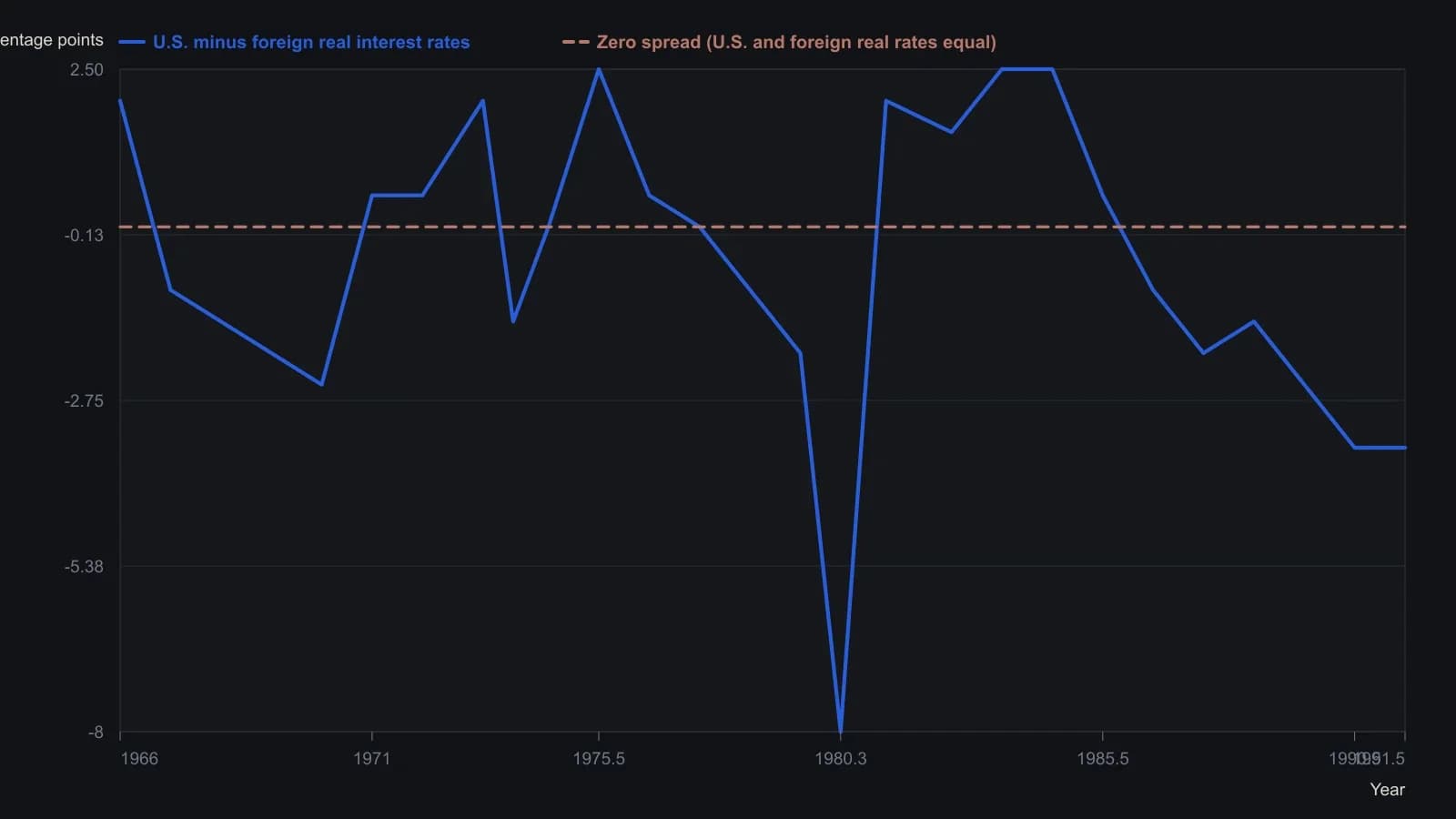
Monthly panel, 31 December 1965 through 30 November 1991. Foreign composite is the United Kingdom, Germany, Canada, Japan, France, Italy and Switzerland. The 1980 plunge prints below the −6 scale tick, so that low is estimated. Values are approximate raster readings.
Stack ranks for rates and foreign stocks
Rank tables can be stacked. Interest-rate momentum ranks flag which currency is most helped by rising rates, and combining currency ranks with equity-market ranks identifies which foreign stock market looks strongest in dollar terms.
Editorial reading: foreign stocks, bonds or cash join the book only when those stacked ranks and the rate differential point the same way as the currency vote.
All readings on this track · 39 readings
- 1987A mechanical rank-rotation sleeve for monthly fund leaders
- 1989Rank rotation in a five-name no-load sleeve
- 1990Cycle-tested five-year fund rank rotation
- 1991Blue-chip rank rotation by relative-strength-index slope
- 1992Currency rank rotation and intermarket timing
- 1992Rank rotation and relative strength for portfolio construction
- 1994MACD crossovers then short-horizon rank rotation
- 1994A comparable group-trend ledger from published ranks
- 1997Normalized yield rank rotation as a full portfolio procedure
- 1997Constructing an investor preference index from two capitalization-weighted series
- 1998Constructing anchored momentum from a centered average
- 2000Rank rotation, a stop-loss order, and Relative Strength Index in fund switching
- 2003A one-fund daily rank is a two-sleeve construction problem
- 2004Evaluate rank rotation only where persistence already exists
- 2004Sector fund rank rotation with regression and trailing stops
- 2006Evaluating equal-weight annual yield-rank rotation
- 2007Weekly preferred-symbol reselection for mechanical trend systems
- 2011Portfolio capacity and entry pacing for mechanical systems
- 2011Rank rotation as a testable ETF construction procedure
- 2011The inverse-Fisher stochastic is a forecast layer until the book rules can be disabled
- 2012An underwater stretch is a sizing test for rank rotation
- 2015Rule-based ETF rotation as one testable procedure
- 2015MACD crossover evaluation by trend rank rotation
- 2015Persistence and strength as one close-to-close switch
- 2015Evaluating rank rotation after a persistence screen
- 2016Evaluating an annual valuation rank rotation
- 2017A two-step yield and price rank rotation for a five-name sleeve
- 2018Smoothed volatility and the missing rank-rotation exit
- 2018A five-condition scorecard that ranks stocks and can refuse the trade
- 2018Small-cap growth sleeve eligibility with trend and rank rotation
- 2018Evaluating rank-rotation momentum across fund wrappers
- 2019Evaluating an annual equity-gold momentum rank rotation
- 2019Evaluating equity-gold momentum on funds versus indexes
- 2020How a signed comparative-strength oscillator is built for rank rotation
- 2020Which calendar clock changes a gold-versus-equity rotation test
- 2020Four-dimension relative strength as rank rotation
- 2020Portfolio construction as a ranked relative-strength problem
- 2020Two clocks for a Nasdaq put/call sleeve
- 2020Rank, filter, and stop the hedge sleeve as one procedure