2018issue C0938-41
Small-cap growth sleeve eligibility with trend and rank rotation
A 2018 case study compared six small-cap growth exchange-traded funds that shared one benchmark, then used moving-average regime, MACD confirmation, and rank rotation to decide when the sleeve was eligible.
- Six funds stayed comparable by sharing one small-cap growth benchmark and dropping a wider growth index.
- 50-, 100-, and 200-day simple moving averages marked short, medium, and long-term regime before any sleeve exposure was eligible.
- A confluence-breakout on the sleeve’s largest fund was treated as incomplete until a MACD positive crossover agreed.
- Three- or six-month relative strength rotated cap-size sleeves and ranked which growth funds could be entered, held, or skipped after liquidity and a fresh composition review.
Two stages, not a permanent favorite
Editorial reading. TradersWeek treats a small-cap growth allocation as a two-stage construction drill. The first stage freezes a single-benchmark exchange-traded fund universe so members are comparable. The second stage lets moving-average regime, MACD confirmation, and rank rotation decide when the sleeve is eligible, rather than naming a permanent favorite.
The paragraphs that follow restate the 2018 archive workflow. They are not a present-day ranking of funds.
Sleeve-comparability first
The 2018 case study built its small-cap growth comparison from six exchange-traded funds that shared one small-cap growth benchmark and dropped a wider growth index so sleeve members stayed comparable.
Sleeve-comparability is the rule that every fund in the style sleeve share the same benchmark and capitalization mandate so differences in weighting, holdings, and liquidity can be isolated.
Five of the six funds were capitalization-weighted and held only US listings. One used custom weights and a global book.
Liquidity and composition as separate inputs
Inside that single style box the funds still differed in assets, holding count, listed-options availability, and average daily volume, so construction recorded liquidity and composition as inputs separate from the style label.
One fund’s selection rules mixed three-, six-, and 12-month price momentum with sales-to-price, one-year sales growth, and four value factors, then reconstituted on a quarterly calendar as an explicit alternative to plain cap weighting.
Regime from stated lookbacks
A moving-average is a sampled mean of ordered prices over a stated lookback. Here the 50-, 100-, and 200-day simple averages mark short, medium, and long-term regime before any sleeve exposure is eligible.
Short-, medium-, and long-term regime was specified with those 50-, 100-, and 200-day simple moving averages rather than a discretionary trend read.
A joint, falsifiable chart condition
A worked candlestick example treated moving-average confluence plus a MACD positive crossover as a joint, falsifiable entry condition for the sleeve’s largest fund.
A confluence-breakout is a joint chart condition in which several moving averages cluster and price clears that cluster, treated as incomplete until a MACD crossover agrees.
MACD is a price-derived momentum reading that converts a crossover at chart scale into a confirm-or-reject signal once moving averages have already clustered.
Rank rotation among comparable funds
Because capitalization leadership was treated as unknowable in advance, three- or six-month relative strength was used to rotate among cap-size sleeves and to rank which growth funds were eligible.
Rank-rotation is a single procedure that orders candidate funds by multi-month relative strength and by construction constraints such as liquidity, then allows entry, hold, or abstention together.
A fresh composition review
Sector mix and the split among small-, mid-, and micro-cap holdings were described as time-varying, so the construction checklist included a fresh composition review before any new exposure.
VBK versus VUG and VOT, cumulative percent from August 2006
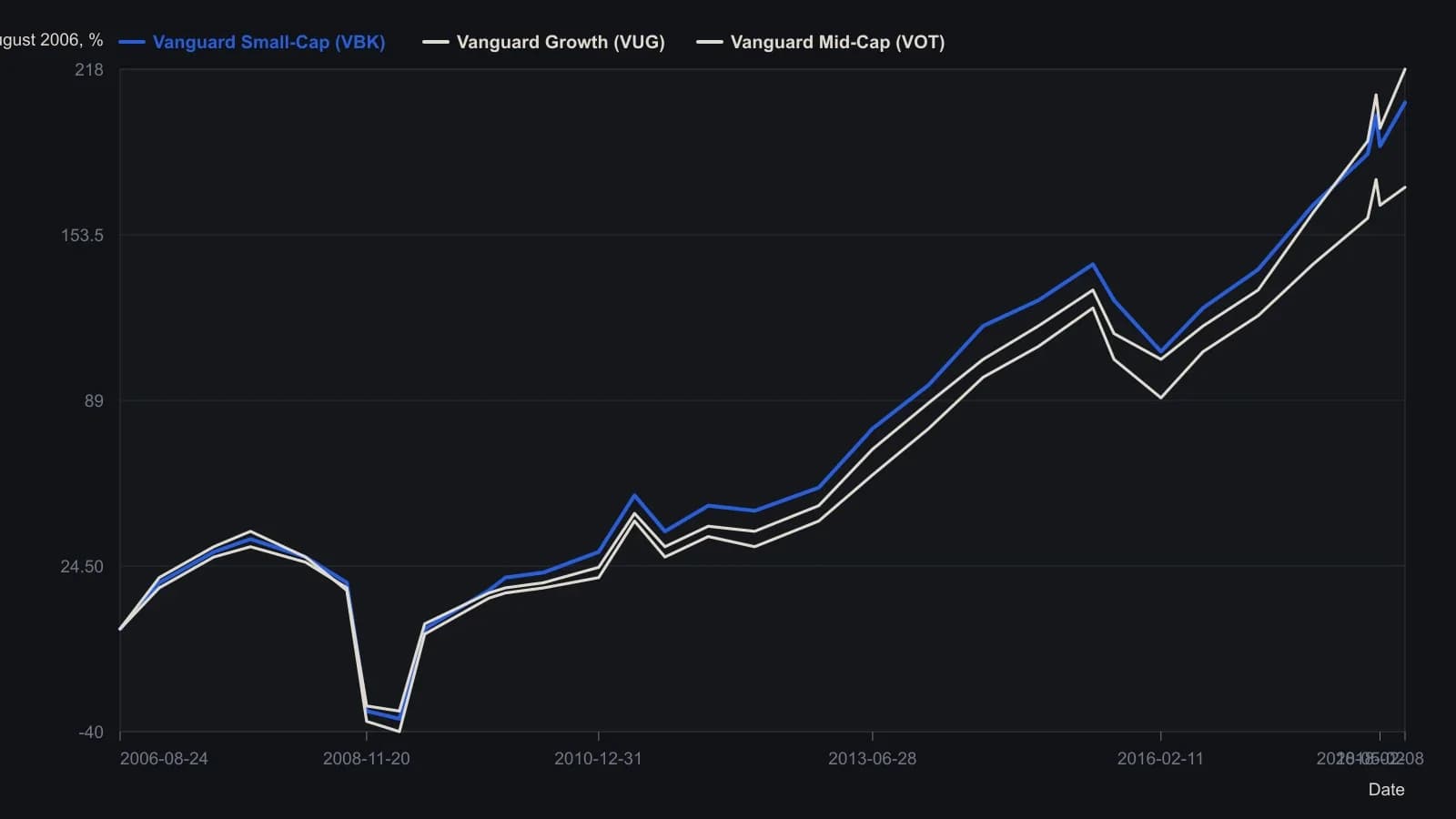
Digitized from a 2,942-day percent-performance chart (24 August 2006–2 May 2018). Levels are approximate to the labeled 10 percent grid. The article rounds the May 2018 finish for VBK and VUG to about 215 percent. These three cap-weighted Vanguard funds are not the six S&P SmallCap 600 Growth ETFs compared in the sleeve table.
All readings on this track · 39 readings
- 1987A mechanical rank-rotation sleeve for monthly fund leaders
- 1989Rank rotation in a five-name no-load sleeve
- 1990Cycle-tested five-year fund rank rotation
- 1991Blue-chip rank rotation by relative-strength-index slope
- 1992Currency rank rotation and intermarket timing
- 1992Rank rotation and relative strength for portfolio construction
- 1994MACD crossovers then short-horizon rank rotation
- 1994A comparable group-trend ledger from published ranks
- 1997Normalized yield rank rotation as a full portfolio procedure
- 1997Constructing an investor preference index from two capitalization-weighted series
- 1998Constructing anchored momentum from a centered average
- 2000Rank rotation, a stop-loss order, and Relative Strength Index in fund switching
- 2003A one-fund daily rank is a two-sleeve construction problem
- 2004Evaluate rank rotation only where persistence already exists
- 2004Sector fund rank rotation with regression and trailing stops
- 2006Evaluating equal-weight annual yield-rank rotation
- 2007Weekly preferred-symbol reselection for mechanical trend systems
- 2011Portfolio capacity and entry pacing for mechanical systems
- 2011Rank rotation as a testable ETF construction procedure
- 2011The inverse-Fisher stochastic is a forecast layer until the book rules can be disabled
- 2012An underwater stretch is a sizing test for rank rotation
- 2015Rule-based ETF rotation as one testable procedure
- 2015MACD crossover evaluation by trend rank rotation
- 2015Persistence and strength as one close-to-close switch
- 2015Evaluating rank rotation after a persistence screen
- 2016Evaluating an annual valuation rank rotation
- 2017A two-step yield and price rank rotation for a five-name sleeve
- 2018Smoothed volatility and the missing rank-rotation exit
- 2018A five-condition scorecard that ranks stocks and can refuse the trade
- 2018Small-cap growth sleeve eligibility with trend and rank rotation
- 2018Evaluating rank-rotation momentum across fund wrappers
- 2019Evaluating an annual equity-gold momentum rank rotation
- 2019Evaluating equity-gold momentum on funds versus indexes
- 2020How a signed comparative-strength oscillator is built for rank rotation
- 2020Which calendar clock changes a gold-versus-equity rotation test
- 2020Four-dimension relative strength as rank rotation
- 2020Portfolio construction as a ranked relative-strength problem
- 2020Two clocks for a Nasdaq put/call sleeve
- 2020Rank, filter, and stop the hedge sleeve as one procedure