1992issue C051-6
Rank rotation and relative strength for portfolio construction
Portfolio construction can be written as a rank-rotation procedure: score every holding against a market benchmark, treat a turn in that ranking as one stay, rotate, or abstain signal, and keep a rising index in the market-state column so it cannot override which names are actually leading.
- Score every holding by relative movement versus a market benchmark and treat a leadership handoff as one stay, rotate, or abstain signal over the holding period.
- A leadership handoff can proceed while a broad index is still making new highs, so index direction alone cannot confirm that current holdings remain in the leading group.
- A rising relative-strength series marks outperformance versus the chosen benchmark; a falling series marks underperformance even if the name's own price has not collapsed.
- Keep index direction in the market-state column so it can condition a stay-rotate-or-abstain rule without substituting for the ranking itself.
Score holdings against a benchmark
Rank rotation is a construction procedure that ranks holdings by relative movement versus a benchmark and converts a leadership handoff into one stay, rotate, or abstain signal over the system holding period.
Editorially, that is the construction job. Score every holding against a market benchmark. Treat a turn in the ranking as one signal for staying with the current names, rotating into the new leaders, or abstaining, rather than as three disconnected rules.
Index direction does not confirm leadership
A leadership handoff can proceed while a broad index is still making new highs, so index direction alone cannot confirm that current holdings remain in the leading group.
A less visible form of market deterioration is a change in industry leadership rather than a repeated break of prior lows. Sector rotation is that change in which industry group leads. Leadership change is the replacement of one industry group by another as the relatively stronger set of holdings.
What relative strength isolates
Relative strength is the scaled change in a name-to-benchmark price ratio over a defined window. It isolates relative movement instead of standalone price direction and detects outperformance and underperformance independently of headline index direction.
A rising relative-strength series marks outperformance versus the chosen benchmark. A falling series marks underperformance. Underperformance is a falling relative-strength reading, showing that a name is lagging the chosen benchmark even if its own price has not collapsed.
How a rank rotation appears
Rank rotation can appear as a simultaneous fade in consumer-group relative strength and a rise in technology-group relative strength.
An earlier energy-to-consumer leadership change was visible in relative strength before a later earnings explanation became available, so the ranking signal can precede the fundamental narrative.
Stay, rotate, or abstain as one procedure
A usable market-state input for a stay-rotate-or-abstain rule is an index advance paired with price declines in former leadership names.
Pairing a price pane with a relative-strength pane versus a broad index makes the rank-rotation signal inspectable as one procedure across the holding window.
This TradersWeek reading is editorial: the inspectable object is the ranking turn conditioned by market state, not a claim about which group should be owned now.
Pepsico relative strength versus the S&P 500
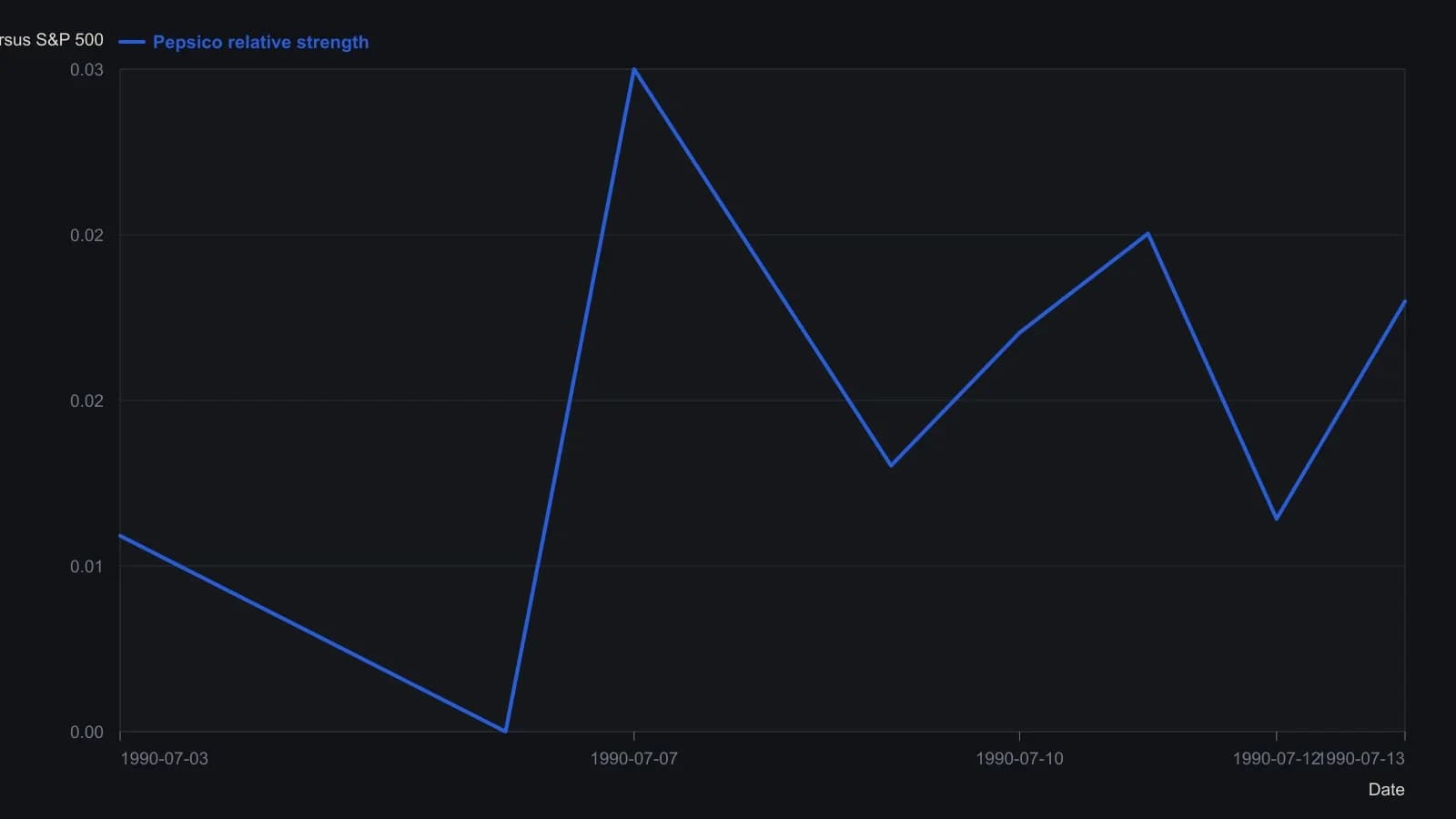
Relative strength is (today’s Pepsico/S&P ratio minus the 2 July 1990 ratio) divided by that same 2 July 1990 ratio. A2 and B2 are held constant while each later close is substituted.
All readings on this track · 39 readings
- 1987A mechanical rank-rotation sleeve for monthly fund leaders
- 1989Rank rotation in a five-name no-load sleeve
- 1990Cycle-tested five-year fund rank rotation
- 1991Blue-chip rank rotation by relative-strength-index slope
- 1992Currency rank rotation and intermarket timing
- 1992Rank rotation and relative strength for portfolio construction
- 1994MACD crossovers then short-horizon rank rotation
- 1994A comparable group-trend ledger from published ranks
- 1997Normalized yield rank rotation as a full portfolio procedure
- 1997Constructing an investor preference index from two capitalization-weighted series
- 1998Constructing anchored momentum from a centered average
- 2000Rank rotation, a stop-loss order, and Relative Strength Index in fund switching
- 2003A one-fund daily rank is a two-sleeve construction problem
- 2004Evaluate rank rotation only where persistence already exists
- 2004Sector fund rank rotation with regression and trailing stops
- 2006Evaluating equal-weight annual yield-rank rotation
- 2007Weekly preferred-symbol reselection for mechanical trend systems
- 2011Portfolio capacity and entry pacing for mechanical systems
- 2011Rank rotation as a testable ETF construction procedure
- 2011The inverse-Fisher stochastic is a forecast layer until the book rules can be disabled
- 2012An underwater stretch is a sizing test for rank rotation
- 2015Rule-based ETF rotation as one testable procedure
- 2015MACD crossover evaluation by trend rank rotation
- 2015Persistence and strength as one close-to-close switch
- 2015Evaluating rank rotation after a persistence screen
- 2016Evaluating an annual valuation rank rotation
- 2017A two-step yield and price rank rotation for a five-name sleeve
- 2018Smoothed volatility and the missing rank-rotation exit
- 2018A five-condition scorecard that ranks stocks and can refuse the trade
- 2018Small-cap growth sleeve eligibility with trend and rank rotation
- 2018Evaluating rank-rotation momentum across fund wrappers
- 2019Evaluating an annual equity-gold momentum rank rotation
- 2019Evaluating equity-gold momentum on funds versus indexes
- 2020How a signed comparative-strength oscillator is built for rank rotation
- 2020Which calendar clock changes a gold-versus-equity rotation test
- 2020Four-dimension relative strength as rank rotation
- 2020Portfolio construction as a ranked relative-strength problem
- 2020Two clocks for a Nasdaq put/call sleeve
- 2020Rank, filter, and stop the hedge sleeve as one procedure