2006issue C041-3
Evaluating equal-weight annual yield-rank rotation
Editorial reading: a once-a-year yield rank reset is a classroom stress test for portfolio construction. The object to evaluate is the full equal-weight rotation, including the next signal that still names a holding a discretionary overlay would drop.
- The mechanical-trading-system buys an equal-weight basket of the ten highest-yielding members of a major blue-chip index on the final trading session of the year and holds that book until the next annual reset.
- Equal weighting is required because a single name can lose more than half its value in one holding period, so the rules do not allow concentrating in whichever name later moves most.
- Rule adherence takes every name the yield rank screen produces, including a name that declined in two consecutive holding periods and still ranked first at the following reset.
- Across three completed holding years the mix of advancers and decliners was uneven, and the evaluation treated that window as long enough for a reader to judge whether the full rule set fit them.
What the procedure specifies
The mechanical-trading-system examined here is a rank-rotation rule. At each annual reset, members of a major blue-chip index are ordered by yield rank and the book is rotated into an equal-weight basket of the ten highest-yielding names. Selection and replacement occur on the final trading session of the calendar year, and that basket is held until the next year-end reset.
Why the basket is equal weight
Equal weighting is required by the procedure because a single name can lose more than half its value in one holding period. The equal-weight basket assigns the same stake to every selected name so later dispersion cannot be treated as a reason to have sized one name larger. The rules do not allow concentrating in whichever name later moves most.
How each holding year was checked
The historical check compared each selected name's purchase price with its price at the end of the same holding year. That comparison was treated as the test of whether the rules chose names that finished higher.
Advancers and decliners across three years
Across the three completed holding years examined, the mix of names that finished above versus below purchase price was uneven. One year had more decliners than advancers, one year was split five and five, and one year had seven advancers and three decliners. Two names finished each of the three completed holding years above their purchase prices, while several other names appeared as both advancers and decliners depending on the year.
2005 Dogs of the Dow holding-year returns
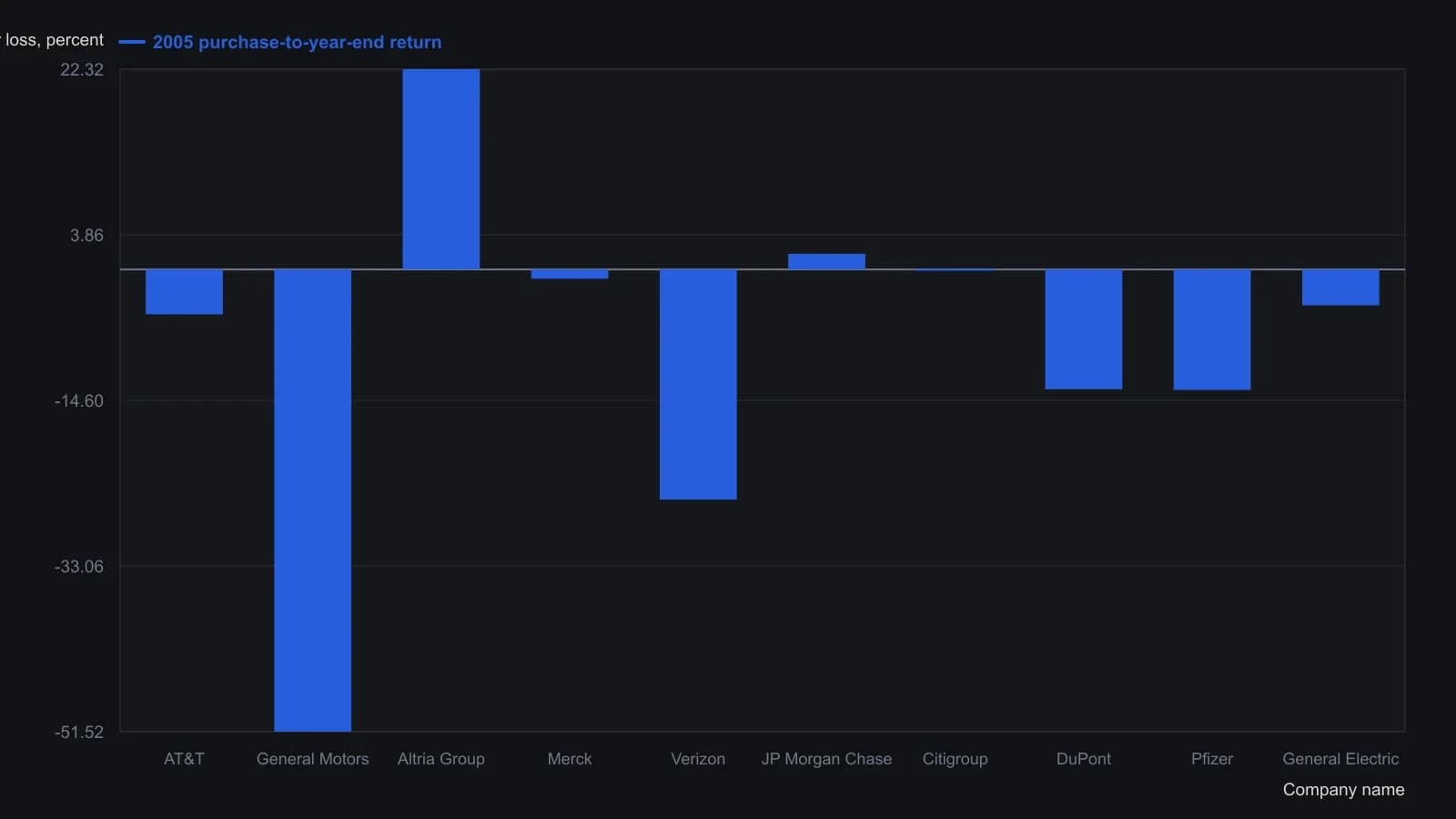
Y values are the printed gain/loss percentages, not recomputed from the purchase and year-end prices. For AT&T, Citigroup, and Pfizer those two columns do not match a simple price ratio. SBC Communications merged into AT&T during 2005.
The next reset and rule adherence
The candidate list for the next holding year reused the same ten names as the prior basket, aside from a merger that folded one former constituent into another listed name. Stated yields changed but membership did not. A name that declined in two consecutive holding periods still ranked first by yield on the following reset date. Omitting that name was treated as abandoning the procedure rather than as a permitted overlay. Rule adherence means every name the rank screen produces is taken, including those that just posted large declines.
How long the window is
The evaluation treated a three-year window as long enough for a reader to judge whether the full rule set fit them, while noting that others may regard that sample as too short.
All readings on this track · 39 readings
- 1987A mechanical rank-rotation sleeve for monthly fund leaders
- 1989Rank rotation in a five-name no-load sleeve
- 1990Cycle-tested five-year fund rank rotation
- 1991Blue-chip rank rotation by relative-strength-index slope
- 1992Currency rank rotation and intermarket timing
- 1992Rank rotation and relative strength for portfolio construction
- 1994MACD crossovers then short-horizon rank rotation
- 1994A comparable group-trend ledger from published ranks
- 1997Normalized yield rank rotation as a full portfolio procedure
- 1997Constructing an investor preference index from two capitalization-weighted series
- 1998Constructing anchored momentum from a centered average
- 2000Rank rotation, a stop-loss order, and Relative Strength Index in fund switching
- 2003A one-fund daily rank is a two-sleeve construction problem
- 2004Evaluate rank rotation only where persistence already exists
- 2004Sector fund rank rotation with regression and trailing stops
- 2006Evaluating equal-weight annual yield-rank rotation
- 2007Weekly preferred-symbol reselection for mechanical trend systems
- 2011Portfolio capacity and entry pacing for mechanical systems
- 2011Rank rotation as a testable ETF construction procedure
- 2011The inverse-Fisher stochastic is a forecast layer until the book rules can be disabled
- 2012An underwater stretch is a sizing test for rank rotation
- 2015Rule-based ETF rotation as one testable procedure
- 2015MACD crossover evaluation by trend rank rotation
- 2015Persistence and strength as one close-to-close switch
- 2015Evaluating rank rotation after a persistence screen
- 2016Evaluating an annual valuation rank rotation
- 2017A two-step yield and price rank rotation for a five-name sleeve
- 2018Smoothed volatility and the missing rank-rotation exit
- 2018A five-condition scorecard that ranks stocks and can refuse the trade
- 2018Small-cap growth sleeve eligibility with trend and rank rotation
- 2018Evaluating rank-rotation momentum across fund wrappers
- 2019Evaluating an annual equity-gold momentum rank rotation
- 2019Evaluating equity-gold momentum on funds versus indexes
- 2020How a signed comparative-strength oscillator is built for rank rotation
- 2020Which calendar clock changes a gold-versus-equity rotation test
- 2020Four-dimension relative strength as rank rotation
- 2020Portfolio construction as a ranked relative-strength problem
- 2020Two clocks for a Nasdaq put/call sleeve
- 2020Rank, filter, and stop the hedge sleeve as one procedure