2008issue C011-5
MACD divergence and Stochastic oscillator confirmation on lumber futures
A historical lumber-futures chart used a MACD histogram, Price-indicator divergence, a Stochastic oscillator, and moving averages as separate checks. TradersWeek reads that workflow as a sequence of hypotheses: mature-trend context, a divergence reversal idea, then a confirmation that later price structure can accept or reject.
- A multi-tool suite can check bottoms, early trend participation, and larger trend shifts independently rather than as a single combined vote.
- Price-indicator divergence is a reversal hypothesis. Later price structure still has to accept or reject it.
- A buy-overbought Stochastic oscillator reading after price clears a 50-day exponential moving average can serve as a later confirmation step.
- Nearby prior lows and the risk of a new MACD histogram divergence are reasons to become more cautious once short, not a claim of unlimited downside.
Independent checks in one chart suite
A multi-tool chart suite can combine a MACD histogram, a slow Stochastic oscillator, three exponential moving averages, and candlestick patterns so that bottoms, early trend participation, and larger trend shifts are checked independently.
TradersWeek editorial reading: treat that suite as a sequence of falsifiable hypotheses. First establish a mature-trend context. Then state a Price-indicator divergence reversal hypothesis. Then require a breakout confirmation that later price structure can accept or reject.
A May reversal hypothesis after a long bearish alignment
On the September lumber daily chart, a May low was associated with positive divergences in both the MACD histogram and the Stochastic oscillator after more than three months of bearish 10-, 20-, and 50-day exponential moving-average alignment.
A late-April positive-divergence buy hypothesis was followed by a sharper May divergence, with a May 3 signal and a May 7 fill used as the long entry near 259.30.
Buy-overbought confirmation after the 50-day average
A buy-overbought Stochastic oscillator confirmation arrived in mid-May as price cleared the 50-day exponential moving average, with an end-of-day long entry near 282.30. Price was about 10 points higher within five days.
An extreme MACD histogram reading during the late-May advance was treated as a forecast that those price highs would be exceeded before a significant correction, even though the method was described as fallible.
A later short after a failed 50-day close
After a failed mid-August close above the 50-day exponential moving average, a bearish peak-Peak-peak MACD histogram pattern plus a confirming close produced a short as of the August 22 close at 265.50, with a later print at 262.30.
A second short confirmation came from the Stochastic oscillator becoming oversold on the August 22 close and then printing a lower closing low by the August 23 close.
Once short, the nearby May lows near 256 and the risk of a new MACD histogram positive divergence were treated as reasons to become more cautious rather than to assume unlimited downside.
September 2007 lumber prints cited from the May long through the August short
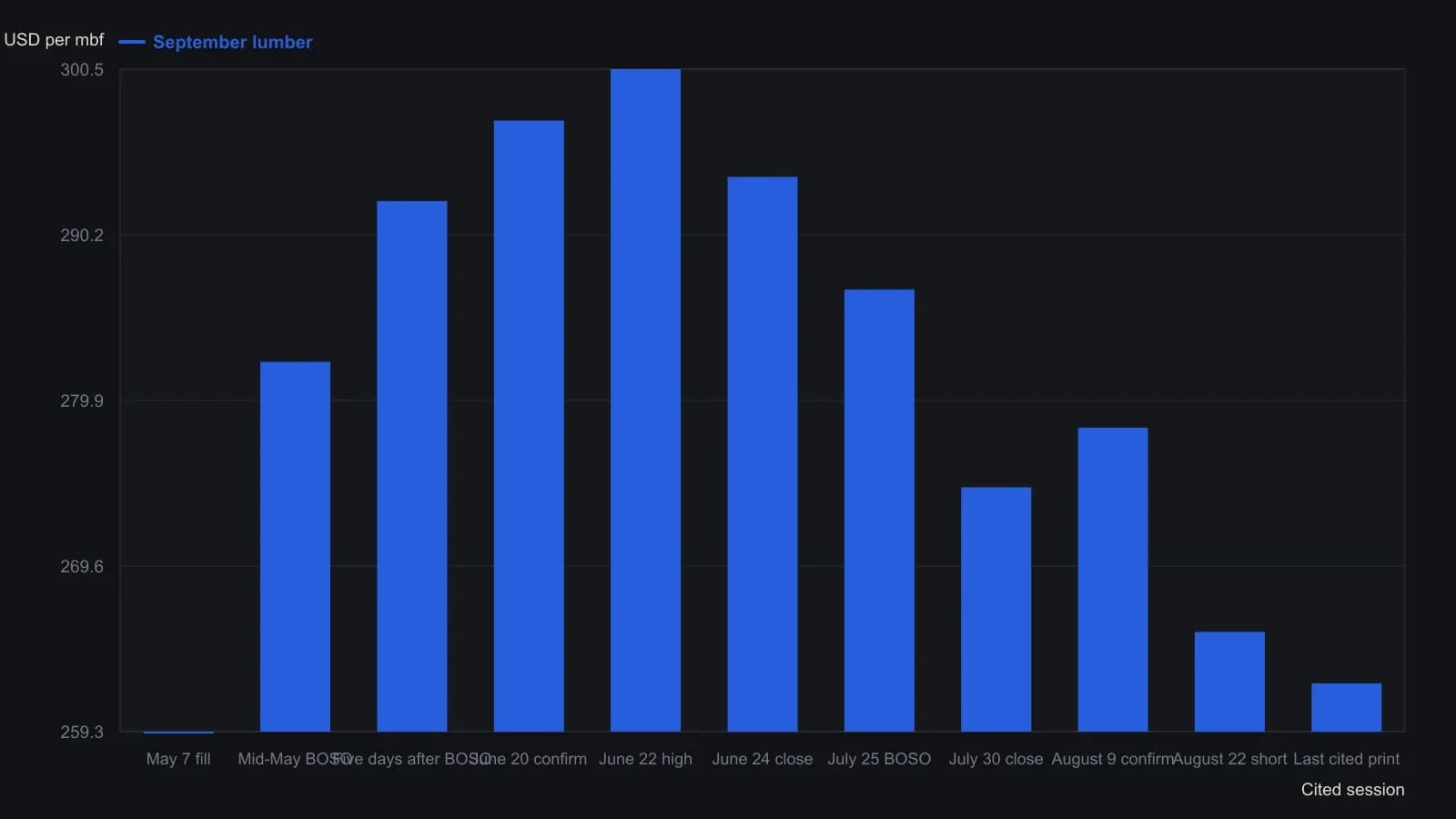
Mid-May is the author’s wording for the BOSO long, not a calendar date. The next point is the stated 10 points above the 282.30 entry. Several July engulfing prints were left out because the article does not date them tightly enough to order against the July 25 BOSO without guessing.
All readings on this track · 80 readings
- 1988Rebuild MACD-Mo and MACD-H before treating them as signals
- 1989Four-span MACD lookbacks as perishable parameters
- 1989Weekly then daily MACD confirmation on individual stocks
- 1991Regime-gated MACD and stochastic rules inside a checklist
- 1991Constructing MACD signal lines and divergence tests
- 1991MACD parameter order and cycle phase lag
- 1992Lengthened bond MACD as an equity regime filter
- 1992Long-horizon MACD construction from paired exponential averages
- 1993Constructing a signed ten-point trend filter
- 1994Constructing lag-reduced double exponential averages for MACD
- 1994Seeding DEMA2 filters to build a MACD signal
- 1994Constructing MACD from lag-reduced exponential averages
- 1994TEMA1 from nested exponential averages, then a two-horizon MACD
- 1994Constructing entry and exit on a relative-strength MACD
- 1994Constructing a relative-strength MACD crossover spreadsheet
- 1995Consensus presignal filters for Relative Strength Index, MACD and the Stochastic oscillator
- 1997Confirm the MACD turn with price, then exit on the histogram
- 1997Reconstructing a stochastic oscillator, MACD, and a triple-smoothed oscillator
- 1997Moving-average windows before crossovers and MACD
- 1999Second-stage MACD on relative-strength inputs
- 1999Constructing MACD from exponential-average spreads for crossover and divergence
- 1999Coding candlesticks into numeric indicators
- 2001Second-low confirmation with a percentage oscillator and money-flow filter
- 2001Constructing MACD from exponential average spreads and a signal line
- 2002Separate bounded and trend-following oscillator rules
- 2002Sort the regime before assigning MACD and stochastic jobs
- 2002Building classic divergence filters from RSI and MACD
- 2002Weekly highs and lows as trend gates
- 2002Constructing channel-normalized Fisher reversal signals
- 2002Affine-price and the Fisher transform as a constructed companion to MACD
- 2003Regularized EMA construction with a MACD line and a thrust oscillator
- 2003Curvature-penalized exponential averages versus MACD
- 2003MACD, moving averages, and a trend filter as one timing system
- 2003Fractional MACD and linear-regression reversal construction
- 2004Weekly MACD-histogram timing of bear-market rallies
- 2004Candlestick triggers filtered by MACD divergence
- 2004Staging energy-complex tops with trendline, breakout, and MACD
- 2005Selling climax holds versus fails
- 2006Treat a sideways Wave as permission before a breakout
- 2007MACD with a Stochastic oscillator for spotting trend reversals
- 2007Rebuilding an S&P 500 fifth-wave count after a broken target
- 2007Constructing MACD, RSI, and stochastic confirmation for futures
- 2007MACD histogram divergence needs a confirming close
- 2007Write the plan as a stack: ratio, boundary, then oscillators
- 2008MACD divergence and Stochastic oscillator confirmation on lumber futures
- 2008Assign confirmation, timing, and a stop before a currency pair is tested
- 2008Confirm the ten-bagger launch path before the MACD exit
- 2008Reading the offloaded evidence file
- 2008A Leader companion for MACD direction warnings
- 2008Relative strength exits with MACD averages and RSI
- 2008Assign one job per indicator in a three-screens rule set
- 2008Sequencing RSI, MACD, and average crossovers
- 2010Constructing the Schaff Trend Cycle from MACD and a dominant-cycle window
- 2010Schaff Trend Cycle as a MACD and Stochastic oscillator combination
- 2010Combining Relative Strength Index, the stochastic oscillator, and MACD as slope filters
- 2010Short-term wave and ratio clues without direction calls
- 2010A precise pullback entry and an unplanned profit-protection exit
- 2010Filtering MACD false signals with trendline breaks
- 2011Vendor feeds as an input variable in a MACD evaluation
- 2012Out-of-the-money versus in-the-money option sensitivity to implied volatility
- 2012MACD window tuning as hold-time control
- 2012Combining a moving-average crossover with MACD and support-resistance
- 2012Testing a published MACD entry with a histogram and signal-line agreement filter
- 2012Treat sample systems as a lab before live rules
- 2013Constructing moving averages and MACD from one price series
- 2013The next-bar price that forces a MACD signal-line cross
- 2013Constructing next-bar MACD reversal prices
- 2013Constructing inverted MACD reversal prices
- 2014Shared-filter combinations of the stochastic oscillator, MACD, and RSI
- 2014Square-root lookbacks for combined MACD and RSI
- 2015Audit open interest and trend before trusting oscillator crossovers
- 2016MACD without a signal line, confirmed by moving-average trend filters
- 2016Use RSI, MACD, and a moving average as a market-health consensus
- 2016MACD line versus histogram is a display problem first
- 2017Weekly and daily MACD on a single daily chart
- 2017Weekly and daily MACD as a stacked momentum filter
- 2017Nested weekly and daily MACD from paired EMA spreads
- 2018Weekly and daily PPO scale versus MACD, with bounded RSI and stochastic readings
- 2018Constructing a weekly and daily percentage price oscillator
- 2020Constructing Wyckoff tape reading with MACD, moving-average, and RSI filters