1997issue C121-6
Dow high-yield rank rotation as a testable portfolio procedure
A long-horizon Dow case study compares two annual high-yield constructions and writes Rank rotation, a price-among-yields filter, and Seasonal trading as one portfolio procedure.
- The case study compares two annual Dow constructions: the ten highest-yielding members and the five lowest-priced names among those ten, each held in equal dollar amounts for one year and then re-sorted.
- The review extends the lookback of those high-yield constructions to 1957 and frames them as out-of-favor blue-chip selections that collect an above-average dividend while waiting for mean reversion.
- A year-end crowding effect around the popular screens is presented as a Seasonal trading overlay, with mid-December entries compared with the last session and an exit on the first session of the new year.
- The high-yield rotations are treated as low-maintenance cornerstone sleeves and as a risk-adjusted benchmark against which more active systems can be judged.
Two annual Dow constructions
The case study compares two annual Dow constructions: the ten highest-yielding members and the five lowest-priced names among those ten. Each list is held in equal dollar amounts for one year and then re-sorted.
Rank rotation is the shared rule. The sleeve is rebuilt from the new ranks at the annual reset.
Out-of-favor blue chips
The review extends the lookback of those high-yield constructions to 1957. It frames the names as out-of-favor blue-chip selections that collect an above-average dividend while waiting for mean reversion.
Editorial reading: this is Value investing stated as a screen. The yield sort and the price-among-yields cut define the sleeve before any later comparison is made.
The 1957 to 1996 comparison
Over the 1957-1996 window, a year-end 1956 stake of $10,000 grew to $3,687,220 in the five-stock version, $2,408,320 in the ten-stock version, and $550,141 in the Dow industrials. The comparison excludes commissions and intra-year dividend interest.
Why the sample window matters
The author argues that shorter backtests concentrated in the post-1982 bull market overstate what later users should expect, even though the longer sample still looks favorable versus the index.
Year-end crowding as Seasonal trading
A year-end crowding effect around the popular screens is presented as a Seasonal trading overlay. The overlay compares options or stock entries in mid-December with the last session and exits on the first session of the new year.
Cornerstone sleeves and a working benchmark
The article treats the high-yield rotations as low-maintenance cornerstone sleeves and as a risk-adjusted benchmark against which more active systems can be judged.
How $10,000 grew in two Dow high-yield sleeves versus the DJIA
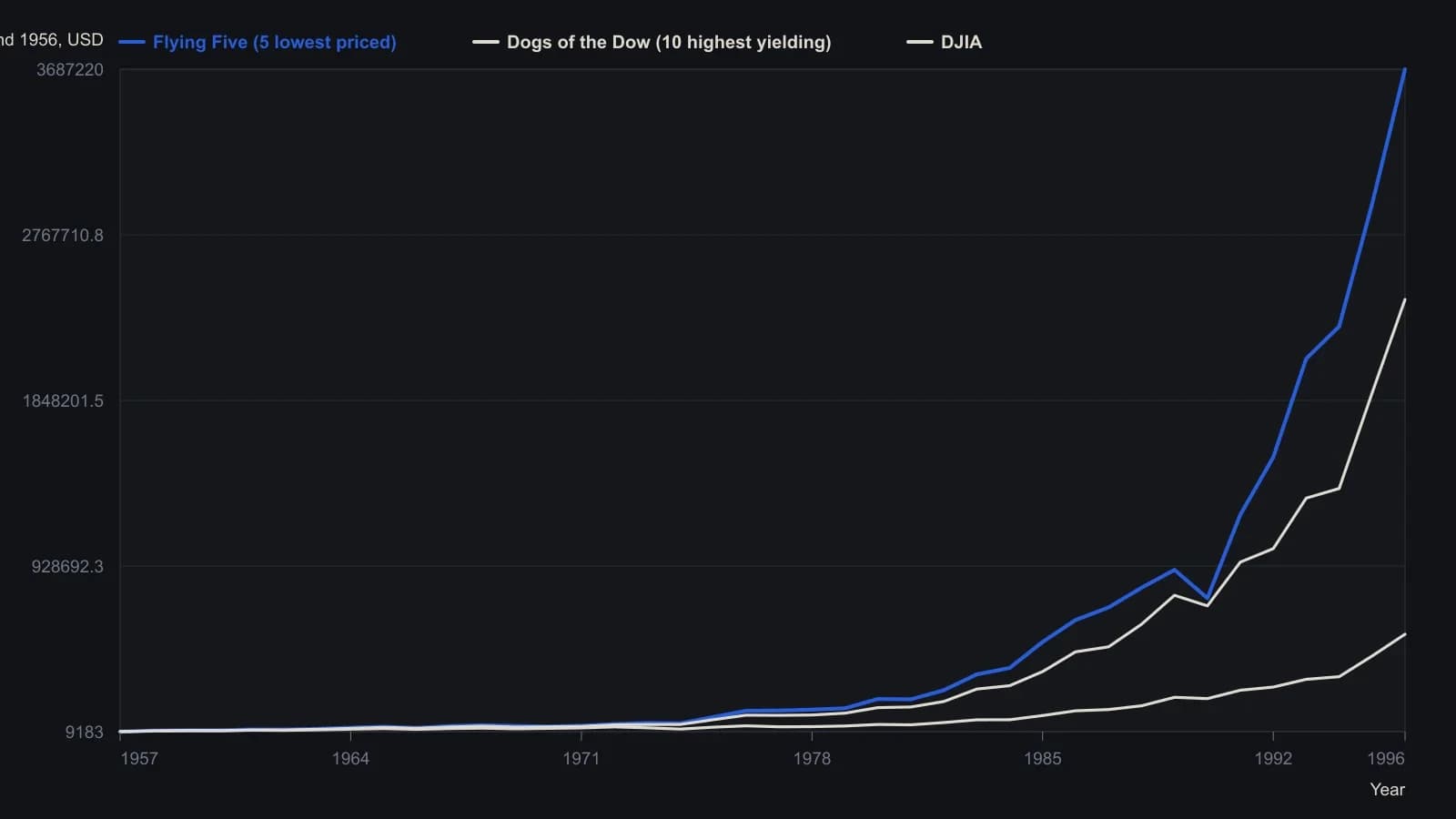
Commissions are omitted, as is interest earned on dividends during each holding year. Sleeves are equal-weighted and rebalanced annually.
All readings on this track · 16 readings
- 1988A two-rule classroom book of cheapness and new highs
- 1995A supermarket-chain case for yield, trendline, and a written checklist
- 1996Annual normalized-yield rank rotation for cyclical sleeves
- 1996Value filter then rank-rotate as one procedure
- 1997Dow high-yield rank rotation as a testable portfolio procedure
- 1998Low relative P/E plus a trendline reversal for regime-aware stock selection
- 1998Rank rotation, value screens, and ten-stock diversification
- 2001Earnback period ranking for growth-adjusted screens
- 2003Stress-testing calendar yield rotation in a declining tape
- 2003A value overlay and strangle hedge during a growth-led regime
- 2005Unfashionable value versus momentum in the book
- 2007Why premove fundamentals rarely flag tenfold-price moves
- 2012Year-end yield rank rotation with a collapse veto
- 2015A five-name January book from yield and price ranks
- 2017Screening value traps with regime-aware overlays
- 2017A pre-trade fail test for the cheap-looking name