2005issue C071-4
Overnight and regular session execution in Nasdaq 100 names
The archive workflow split fourteen Nasdaq 100 names into an overnight-trading-session and a regular-trading-session. Session-analysis, seasonal-trading, and rank-rotation then ranked which names to execute or skip after the open.
- Fourteen highest-capitalization Nasdaq 100 names over 770 sessions from 2 January 2002 to 21 January 2005 summed to a 47.44 percent index weight.
- Overnight-trading-session and regular-trading-session dollar results showed a strong inverse correlation of r equals -0.785.
- Eleven of the fourteen names plus the index-tracking-stock failed to post same-sign profitability in both sessions. The three highest-returning names were the exceptions that gained in both.
- Regular-trading-session results differed after a rising overnight-trading-session versus a falling one, so the procedure qualifies names by the session-pattern test and uses rank-rotation as ranking and index weight change.
Two auctions instead of one close
The archive workflow treated each name as two prints rather than one close-to-close path. Session-analysis separates the overnight-trading-session from the regular-trading-session so each auction can be judged on its own volume, spread, and implementation cost.
The overnight-trading-session is the gap return measured from the prior close to the next regular-session open. The regular-trading-session is the regular-hours return measured from the opening print to the same-day close. An extreme-overnight-gain is an overnight rise larger than plus one percent. An extreme-overnight-loss is an overnight decline larger than minus one percent.
The studied set was the fourteen highest-capitalization Nasdaq 100 names over 770 sessions from 2 January 2002 to 21 January 2005. Those names summed to a 47.44 percent index weight.
What flipped between sessions
Across the 770-day sample, overnight and regular-session dollar results for the studied names showed a strong inverse correlation of r equals -0.785. Eleven of the fourteen names plus the index-tracking-stock failed to post same-sign profitability in both the overnight-trading-session and the regular-trading-session.
The three highest-returning names in the set were the exceptions that produced gains in both sessions and therefore did not follow the overnight-versus-regular flip.
A $10,000 starting stake in each of the fourteen names on 1 January 2002 averaged $17,196 after 770 trading days, while the index-tracking-stock finished at $9,329.
Regular-trading-session results differed materially after a rising overnight-trading-session versus a falling overnight-trading-session, so a close-to-close total conceals which auction produced the move.
Overnight versus regular-session dollar P&L in the 14 largest Nasdaq 100 names
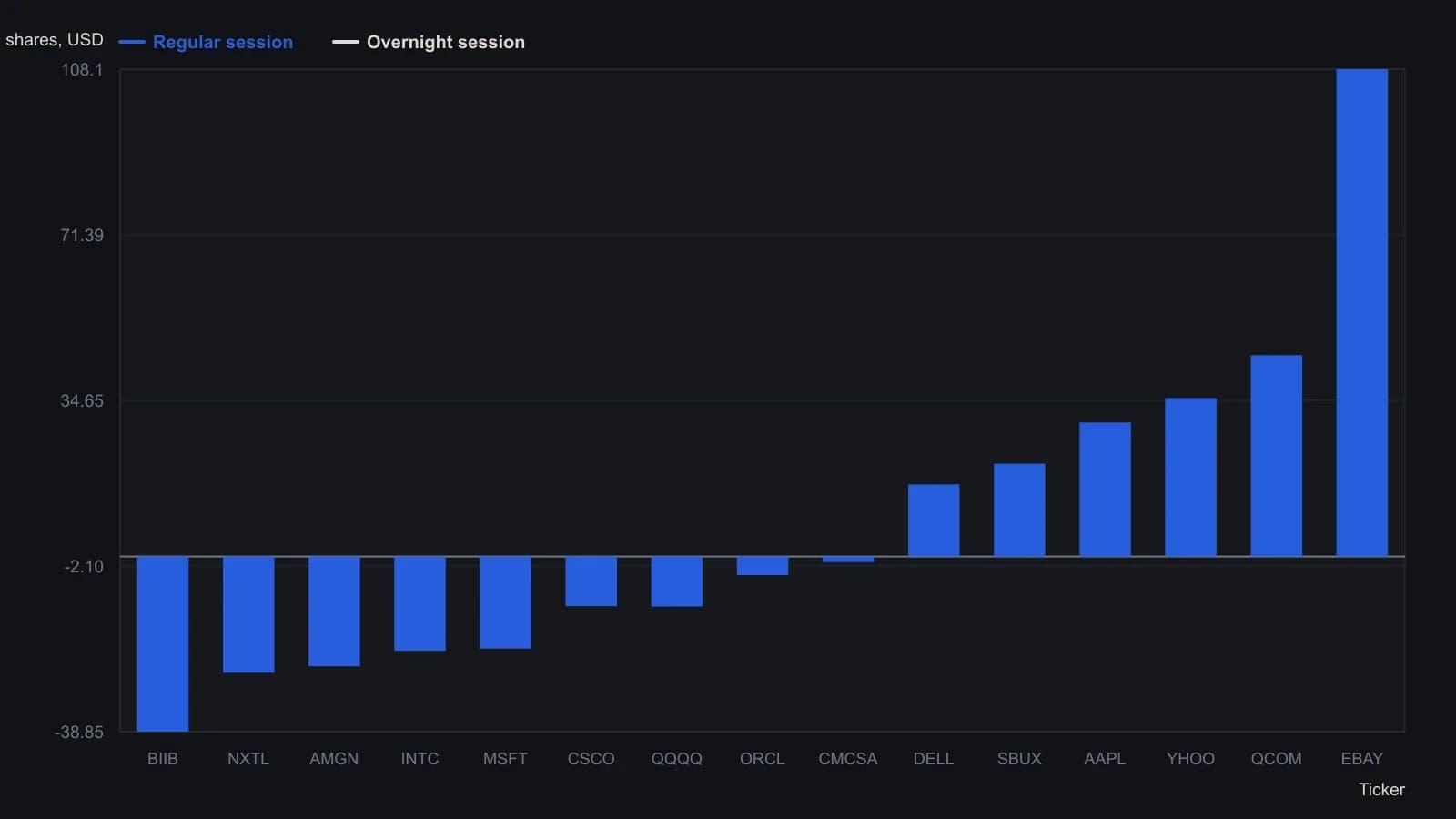
Results are stated for a 100-share long. Several zero overnight prints mean the two session columns need not sum to the buy-and-hold path. QQQQ is the index tracker, not one of the 14 names.
Qualifying names and rotating the set
Seasonal-trading makes a rising or falling overnight book a testable condition for entry, exit, or abstention. Rank-rotation then replaces names in the tradeable set as their session-qualification ranking changes, rather than locking the procedure to a fixed ticker list.
The procedure is specified as qualifying whatever names currently meet the session-pattern test, then rotating newer names in as ranking and index weight change.
All readings on this track · 18 readings
- 1990Constructing a second-hour session residual exponential index
- 2000Treat an open limit book as an execution filter
- 2002Constructing a long, short, or flat pre-trade checklist
- 2003Session-window trims for mechanical day-system evaluation
- 2004Overnight session entry rules after regular hours
- 2005Overnight and regular session execution in Nasdaq 100 names
- 2006The intraday workspace as a combined decision procedure
- 2006Same-session trading needs presence and next-signal rules
- 2007Session filters for moving-average entry rules
- 2008Related-market checklist, session filter, and ATR-scaled stop
- 2008After-hours session regimes and the next-day close
- 2008Evaluating a next-open entry after one-day corrections
- 2010Session range share: currency futures versus the mini index
- 2011Dollar travel, afternoon sessions, and a 1:2 first-loss bound in equity-index futures
- 2012Last-hour volume breaks with a first-hour exit
- 2013Same-session and multi-session trades as one rule-based procedure
- 2015Session clock bars from public quote feeds
- 2016Session-gated moving-average entry construction